
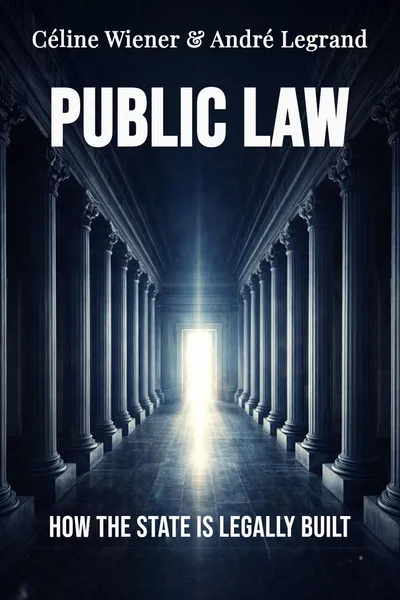
Public Law
How the state is legally built
Description
When we sign a lease, buy a secondhand car, or lend a friend money, we rarely stop to think that the rules governing all of it belong to one branch of law and not another. A contract between two people sits in private law — the law of equals, where neither party can force the other to do anything the other hasn't agreed to. But the moment the tax office sends a demand, a mayor refuses a building permit, or a hospital turns someone away, we've crossed into a different country with different rules. That country is public law, and Céline Wiener and André Legrand set out, in their book of the same name, to map it.
Their starting point is deceptively simple: public law is the law that governs the state and its relationship to everyone else. It decides how power is created, how it's divided, how it's exercised, and — crucially — how it can be stopped. It's the law behind the constitution, behind the ministries, behind the prefect and the town hall and the administrative tribunal. We live inside it every day, mostly without noticing, the way we live inside a building without studying its load-bearing walls.
What Wiener and Legrand do is take those walls apart and show what holds them up. The state, in their telling, isn't a natural object. It's a legal construction, assembled from rules that themselves have to be ranked, obeyed, and enforced. And the whole thing only works if there's some way to make power answer for itself.
The question we’re asking : If public law is what builds and binds the state, what actually holds the structure together — and what stops it from collapsing into pure command?What we’ll see : How Wiener and Legrand assemble the state piece by piece, from the dividing line at its foundation up to the moment a judge can refuse it.
Table of contents
01 Chapter 1 — The line that splits the law in two
The first move Wiener and Legrand make is to draw a border. On one side sits private law, which governs relationships between people who stand on equal footing — buyers and sellers, landlords and tenants, spouses, business partners. Nobody in that world holds power over anyone else by right. Agreement is everything; a contract binds because both sides said yes. On the other side sits public law, where one of the parties is the state, and the state is emphatically not our equal. It can tax, requisition, expropriate, regulate, and sanction, and it can do much of this without asking.
This inequality is the whole point, and the authors are careful not to treat it as a scandal. The state wields powers no private person could, because it's charged with something no private person carries: the general interest. A town can force a landowner to sell so a road can be built, not because the town is greedy but because the road serves everyone. The authors call these the prerogatives of public power — exceptional tools justified by an exceptional mission. The trade-off is that these same tools, left unchecked, are exactly what we should fear.

02 Chapter 2 — The pyramid everyone obeys
Having drawn the border, Wiener and Legrand turn to how the rules inside public law are arranged. Their answer is a hierarchy — a pyramid of norms in which every rule draws its validity from the one above it. At the summit sits the constitution. Below it, international treaties and, in a European setting, the law flowing from the European Union. Below those, the statutes voted by parliament. Below statutes, the decrees and regulations issued by the government, and below those again, the orders of ministers, prefects, and mayors. Each level must respect the one above; a decree that contradicts a statute is defective, and a statute that violates the constitution is on shaky ground.
The idea has a lineage, and the authors trace it to the Austrian jurist Hans Kelsen, who in the early twentieth century described law as a stepped structure where norms produce other norms. It's an elegant image because it solves a basic puzzle: why should anyone obey a parking order from a mayor? Because the mayor is empowered by a statute, which is authorized by the constitution, which rests on the sovereignty of the people. Authority cascades downward, and legitimacy climbs back up. The humblest administrative order is, in principle, connected by an unbroken chain to the founding act of the political community.
03 Chapter 3 — The machinery of the state
With the border drawn and the norms ranked, Wiener and Legrand describe the apparatus that public law actually governs: the state as a working machine. They begin with the separation of powers, the old principle, sharpened by Montesquieu, that the functions of making law, applying it, and judging disputes should sit in different hands. The point was never tidiness. It was fear — the recognition that power concentrated in one place turns tyrannical, and that the surest check on power is other power. The legislature writes, the executive acts, the judiciary decides, and each is meant to restrain the others.
But the state the authors describe is far larger than those three branches. Beneath the political summit stretches the administration — the ministries, agencies, prefectures, town halls, and public establishments that actually deliver the general interest in practice. This is where public law does most of its daily work, in the permits granted and refused, the public services organized, the contracts signed to build a school or run a water network. The authors present the administration not as a neutral tool but as a legal creature in its own right, with powers defined by law and bounded by it.
04 Chapter 4 — The judge who can tell the state no
Everything in the preceding chapters — the border, the pyramid, the machinery — shares a weakness Wiener and Legrand never let out of sight. A rule that binds the state in theory binds it only when someone can force the state to obey. The authors return, again and again, to the same hinge: public law becomes real at the moment a judge can look at an official act and declare it unlawful. Without that, the whole edifice is architecture without foundations, a promise the powerful make to themselves.
This is why administrative justice occupies such a central place in their account. In the French tradition the ordinary courts were long forbidden to judge the administration, on the theory that judging power is itself an act of governing. The solution was a separate branch of courts — crowned by the Conseil d'État — created to judge the administration from within the state yet independently of it. Over the nineteenth and twentieth centuries these courts built, case by case, a body of principles the administration must respect even where no statute spells them out: proportionality, due process, equality, the duty to give reasons.
05 Conclusion
We started with a lease and a secondhand car, in the private world where agreement is everything and nobody commands anyone. Public law is the other world, the one we enter the moment the state appears as a party — and Wiener and Legrand have shown it to be a deliberate construction rather than a natural fact. A dividing line gives it its logic, a hierarchy of norms gives it its order, an administration gives it its reach, and a judge gives it its teeth. Pull out any one piece and the state stops being a state under law.
Related books