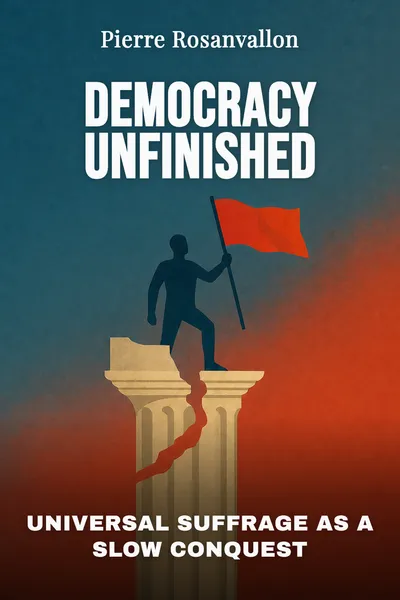
Democracy Unfinished
Universal suffrage as a slow conquest
Description
For most of us, the vote feels like the bottom layer of democracy — the thing that was there first, the floor everything else was built on. One person, one voice; you turn eighteen, you get a ballot, end of story. It reads like a fact of nature, or at least like a settled achievement, something the modern world simply decided to do. Pierre Rosanvallon, the French historian who has spent decades taking democracy's furniture apart to see how it was made, tells a very different story. Universal suffrage, in his account, was not the starting point. It was a conquest, and a slow one — fought over for more than a century, granted grudgingly, hedged with conditions, and reversed more than once before it stuck.
His book Democracy Unfinished follows that struggle through the French experience, from the Revolution that first dared to imagine the citizen-voter to the long nineteenth century that kept qualifying, restricting, and redefining who counted. The surprise is how contested every step was — not just who could vote, but what a vote even was, whether it belonged to a person or to a stake in society, whether the point was to express a will or to certify a competence. These were not technicalities. They were fights over the meaning of political equality itself.
And Rosanvallon's title carries a claim in its adjective. The word he keeps returning to is inachevée — unfinished. Not broken, not betrayed, but incomplete in a way that never quite resolves, because each victory opened a new gap between the promise of equal citizenship and the reality of how societies actually distribute voice.
The question we’re asking : How did the vote, which we treat as democracy's foundation, become universal — and why does Rosanvallon insist the conquest is still not complete?What we’ll see : How the modern idea of the citizen-voter was invented, resisted, narrowed, and gradually forced open — and what the achievement still leaves undone.
Table of contents
01 Chapter 1 — The word came before the thing
Rosanvallon begins with a paradox that runs through the whole book: the language of universal suffrage arrived long before the practice. The French Revolution proclaimed the sovereignty of the nation and the equality of citizens, and in those words was the seed of everyone voting. But the men who wrote the declarations did not, in fact, mean everyone. They meant a nation understood as an abstraction — a single collective body whose will had to be represented, not the sum of every living adult reaching into a ballot box. The gap between the principle announced and the practice organized was there from the first day.
The Constitution of 1791 made the split explicit by dividing the French into active and passive citizens. Passive citizens held civil rights — they were protected by the law, they belonged to the nation — but they did not vote. Active citizens, defined by a tax threshold, chose the electors who chose the deputies. Rosanvallon's point is that this was not hypocrisy so much as a genuine theory: the vote was understood as a public function, a job entrusted to those judged capable of exercising it, rather than a right that flowed automatically from being a person.

02 Chapter 2 — The property qualification that would not die
After the Revolution came the retreat, and Rosanvallon spends a good deal of the book on how the vote was narrowed back down. Under the Restoration and the July Monarchy, France ran on a system of census suffrage — the right to vote tied to how much tax one paid. Under Louis-Philippe, the electorate was a tiny sliver of the adult male population, a few hundred thousand men in a country of tens of millions. The governing idea was that only property gave a man the independence to vote freely; the poor man, dependent on his employer or his landlord, would simply vote as he was told.
This was not presented as a defense of privilege but as a defense of political reason. The propertied citizen had a stake in stability, an interest in the country's prosperity, and the leisure to inform himself. The wageworker, it was argued, had none of these, and enfranchising him would hand the state to numbers unmoored from judgment. Rosanvallon insists that we take this argument seriously, because it was sincerely held and because its ghost never entirely disappears — the suspicion that some voters are too dependent, too ignorant, or too poor to be trusted with a real choice.
03 Chapter 3 — Counting heads, and what heads meant
Once the vote became universal, at least for men, a subtler problem surfaced — the one Rosanvallon may find most interesting. Universal suffrage rests on a strange act of abstraction: it treats every voter as identical, one head equal to every other head, stripped of wealth, education, family, and role. The ballot counts individuals as interchangeable units. But nineteenth-century society did not experience itself that way at all. It experienced itself as a web of ranks, trades, regions, and dependencies. Making the vote universal meant asserting an equality that daily life flatly contradicted.
This is why, in Rosanvallon's account, the arrival of the number changes the meaning of politics. Before universal suffrage, a nation's political weight was a matter of interpretation — who spoke for the country, whose interests mattered, was argued and asserted. Afterward, legitimacy could be counted. The majority became a fact you could add up, and that arithmetic carried an authority nothing else could match. The vote turned the messy question of the popular will into a countable quantity, and the count became sacred precisely because it seemed to remove human judgment from the verdict.
04 Chapter 4 — A machine still missing its parts
Here Rosanvallon steps back to say what the long conquest actually accomplished — and what it did not. Universal suffrage solved the problem of political equality in one precise sense: it made every citizen formally equal at the moment of the vote. This was an enormous achievement, and nothing in the book diminishes it. But formal equality at the ballot box, Rosanvallon argues, is only the first and thinnest layer of what democracy was supposed to deliver. The harder task was always to turn the counted individual into a genuine political subject — someone whose voice registers not only once every few years but in the continuous life of a society. That task the vote alone cannot perform, and this is where his word unfinished bites.
The gap he identifies is the one between the sovereign of election day and the citizen of ordinary time. We consecrate the individual as an equal for the length of a ballot and then return them to a world where economic power, information, and organization are distributed as unequally as ever. Universal suffrage universalized the ritual of equality without universalizing its substance. The machine of representation was built, its right to vote finally extended to all, and yet it still lacked the parts that would make the represented feel actually represented between elections.
05 Conclusion
The vote we treat as democracy's floor turns out, in Rosanvallon's telling, to be its long-contested summit — reached by a road that doubled back on itself again and again. The word universal appeared in 1789, the thing was proclaimed and suspended in 1793, won and clawed back between 1848 and 1850, extended to men and withheld from women until the middle of the twentieth century. What looks from here like a natural birthright was a century and a half of argument over whether a vote belonged to a function or a person, to property or to a head.
Related books