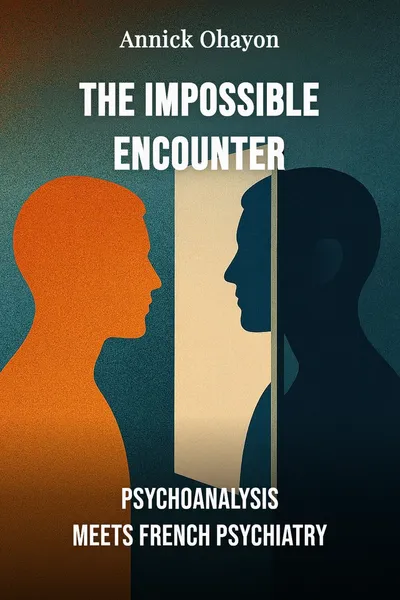
The Impossible Encounter
Psychoanalysis meets French psychiatry
Description
In the early 1920s, a handful of French doctors started reading Freud in translation and arguing about what to do with him. France was not an easy place for psychoanalysis to land. The country had its own proud tradition of psychiatry, running back through Jean-Martin Charcot and Pierre Janet, and it regarded the Viennese newcomer with a mix of curiosity and suspicion. Freud himself had studied with Charcot in Paris in the 1880s, which only made the later coolness sharper. The idea arrived, in other words, already half-familiar and already contested.
That tension is the subject of Annick Ohayon's book The Impossible Encounter. Her argument is that psychoanalysis and French psychiatry spent most of the twentieth century circling each other — sometimes allied, often rivals, never fully merged and never fully separated. One was a theory of the unconscious that happened inside private consulting rooms; the other was a medical institution with hospitals, patients, and the authority of the state. They needed each other and resented each other in roughly equal measure.
Ohayon tells this as an institutional story rather than a story of ideas in the abstract. She follows the societies that split and reformed, the hospitals that took analysts in, the moment Jacques Lacan turned the whole thing into a national event, and the quieter rupture of recent decades. The couch and the clinic, it turns out, were never going to settle into one household.
The question we’re asking : How did a Viennese theory of the unconscious work its way into a French medical institution that neither wanted it gone nor could make it fit?What we’ll see : A century of alliances, splits, and a shared bed that never became a marriage, told through the institutions that lived it.
Table of contents
01 Chapter 1 — Two disciplines, one couch
To see why the encounter was so fraught, it helps to see what each side actually was. French psychiatry, by the time Freud's work crossed the border, was a confident discipline with a long lineage. It had Philippe Pinel freeing the mad from their chains in the Paris asylums around 1800 as a founding myth, and it had a nineteenth-century golden age built on careful clinical observation of symptoms. Charcot's demonstrations at the Salpêtrière, where he staged the symptoms of hysteria before audiences, had made Paris a world capital of nervous disease. This was a tradition that described, classified, and watched.
Psychoanalysis offered something almost opposite. Where psychiatry observed the symptom from the outside, Freud proposed to listen — to follow the patient's associations, slips, and dreams toward a hidden meaning. It was not a hospital practice; it happened one patient at a time, behind a closed door, over months and years. It did not classify so much as interpret. And it rested on claims about infantile sexuality and the unconscious that many French doctors found either scandalous or simply unserious.

02 Chapter 2 — The years the resistance held
The institutional history begins in earnest in 1926, with the founding of the Société psychanalytique de Paris, the first French psychoanalytic society. It was a small, mixed group — a few doctors, a princess, some literary sympathizers. Marie Bonaparte, great-grandniece of Napoleon and a devoted follower who would later help Freud flee Vienna, gave the movement money, social standing, and a certain glamour. Ohayon notes how much the early French reception owed to this blend of medicine and high society rather than to the universities or the hospitals, which largely kept their distance.
Through the 1930s the movement grew slowly and remained marginal to official psychiatry. The medical faculties did not teach it; the asylums did not practice it. Analysis stayed a private affair, conducted in apartments, discussed in a small journal, carried on by a few hundred people at most. The surrealists embraced Freud with far more enthusiasm than the doctors did, which did the cause no favors inside the profession — association with poets and painters confirmed the suspicion that this was not real medicine.
03 Chapter 3 — Lacan, the hospital, and the long entanglement
Jacques Lacan changed the scale of everything. Trained as a psychiatrist, he had written a thesis on paranoia in 1932 that impressed even those outside the field, and from the 1950s his famous seminar turned psychoanalysis into a Parisian intellectual event. His call for a "return to Freud," read through linguistics and philosophy, pulled in students, writers, and thinkers far beyond the clinic. Psychoanalysis in France stopped being a quiet medical specialty and became a cultural force.
It also became a theater of splits. The question of training — how long a session should last, who could certify an analyst, whether the international movement could dictate French practice — tore the societies apart repeatedly. Lacan's unorthodox short sessions were a central scandal. The result was a series of ruptures, including the break that produced his own school in the 1960s, each one spawning new institutions. Ohayon's account makes the pattern clear: French psychoanalysis reproduced itself by schism, and the schisms were about authority as much as about theory.
04 Chapter 4 — A marriage that never quite settled
Step back and the French case looks like a particular answer to a general question: what happens when a foreign idea enters a national institution? It can be rejected, or absorbed and tamed. France did neither cleanly. Psychoanalysis was neither expelled nor digested; it moved in, took over the conversation, and stayed a guest who never became family. Ohayon's "impossible encounter" names exactly this — a cohabitation that works for decades without ever resolving into a single discipline.
What made it impossible, in her telling, was not a clash of personalities but a difference in the kind of thing each side was. Psychiatry is a medical specialty, answerable to the state, to statistics, to the demand that treatments be shown to work. Psychoanalysis is a practice of listening and interpretation, suspicious of measurement, organized around the singular case rather than the population. You can house them under one roof, but you cannot make them speak the same language about what counts as evidence or cure. For a long while the French institution simply chose not to ask the question too loudly.
05 Conclusion
The story Ohayon tells runs from a few doctors arguing over translated Freud in the 1920s to a discipline that, within two generations, spoke for much of French psychiatry — and then found that authority quietly draining away. The couch and the clinic shared a bed for the length of the twentieth century without ever becoming one household. They needed each other: psychiatry for a language of meaning, psychoanalysis for patients, legitimacy, and walls. But the needs never produced a true merger, only a long, productive, and unstable cohabitation.
Related books