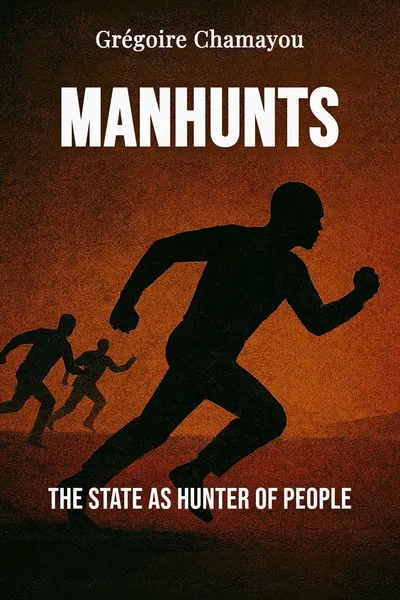
Manhunts
The state as hunter of people
Description
In the fourth century BC, Aristotle wrote a sentence that sounds, to modern ears, almost casual in its brutality. The art of war, he said in the Politics, is in a sense a natural art of acquisition — a kind of hunting that should be practiced against wild animals and against those men who, though born to be ruled, refuse it. Hunting men, in other words, was not a crime or an aberration for the philosopher. It was a legitimate branch of the same skill that pursued deer and boar. The prey was simply a certain sort of human being, and the pursuit was, in his word, just.
Grégoire Chamayou, a French philosopher, takes that sentence and follows it down through twenty-three centuries. His book Manhunts, published in French in 2010, is not a catalogue of massacres. It is something stranger and more unsettling: a philosophical history of a specific power relation, the one in which a human being becomes something to be tracked, cornered, and captured by other human beings acting in the name of order. Slave-hunters, conquistadors chasing Indigenous people through the forests of the Americas, patrols pursuing runaways, police rounding up the undocumented — Chamayou reads them as chapters of one long technology.
What holds the chapters together is not cruelty but structure. Before anyone can be hunted, someone has to decide that this person belongs to the class of the huntable — and that decision, Chamayou argues, is where power does its quietest and most consequential work. The hunt is always preceded by a definition.
The question we’re asking : How did the pursuit of human beings become a recognized, even respectable, exercise of power — and what does every such hunt require before it can begin?What we’ll see : A philosopher follows the figure of the hunted human from the ancient world to the modern street, and asks who gets marked as game.
Table of contents
01 Chapter 1 — The hunt that takes humans as game
Chamayou begins by insisting that manhunting is a distinct thing, not a metaphor and not merely another word for violence. War, in the classical understanding, was fought between adversaries who recognized each other as combatants, however unequal. The hunt is asymmetrical by design. The hunter and the quarry do not belong to the same order of being. One pursues, the other flees; one is the subject of the action, the other is reduced to an object to be seized. This is the relation Chamayou wants to isolate and examine, because it recurs across societies that otherwise have nothing in common.
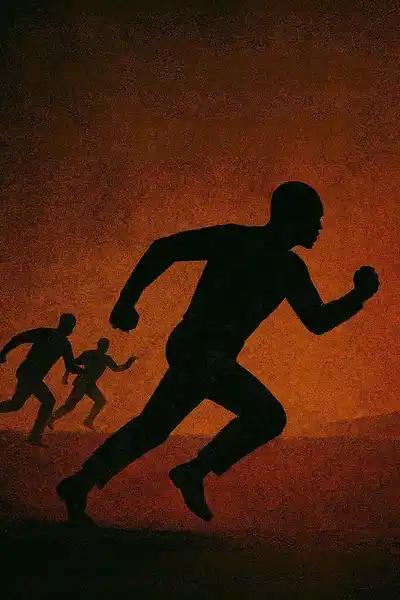
The defining feature of the hunt is that the prey is not fought but tracked. It is pursued across terrain, read through signs and traces, cornered where it cannot run. The verbs are those of venery: to flush out, to run down, to bag. When these verbs are applied to human beings, something has already happened at the level of thought. The person on the receiving end has been withdrawn from the category of persons who can negotiate, surrender, or claim protection. They have been placed, instead, among the things one captures.

02 Chapter 2 — Aristotle, and the philosophy that made prey
The genealogy runs back to Greece, and Chamayou returns repeatedly to Aristotle because the philosopher supplied the theory the practice needed. In the Politics, some human beings are described as natural slaves — people who possess enough reason to follow instructions but not enough to govern themselves, and who are therefore better off, on Aristotle's account, under a master. From this premise the hunting of men follows almost logically. If some people are meant by nature to be ruled and resist that station, then pursuing them is not violence against the natural order but the restoration of it.
What Chamayou draws out is how the argument works. It does not begin with a hunt and look for a justification afterward. It begins with a claim about what certain people are, and the permission to hunt them flows from that claim. The prey is defined into existence before it is ever pursued. This is the crucial inversion: the natural slave is not a person who has been captured, but a category of person who is understood, in advance, to be capturable. The hunt merely realizes a status the theory has already assigned.
03 Chapter 3 — Slaves, natives, and the industrial hunt
The scenes Chamayou assembles from the modern world show the ancient grammar scaling up. In the Spanish conquest of the Americas, Indigenous people who fled forced labor were hunted with dogs bred and trained for the purpose — animals that became instruments of a colonial economy. The pursuit was not incidental to conquest; it was one of its working methods, a way of converting free human beings into a controllable labor supply. The theological debates of the period, over whether the natives had souls, were in part arguments about which side of the huntable line they fell on.
Atlantic slavery industrialized the form. A person held in bondage who escaped did not become, in the eyes of the system, a free person; they became a fugitive, which is to say prey. Chamayou details the machinery this produced: professional slave-catchers, patrols riding the countryside at night, rewards posted for the return of the living body, tracking dogs, and eventually laws that compelled even free territories to assist in the capture. The runaway was hunted not because they had committed a crime in the ordinary sense but because their flight was itself treated as an offense against the order of property.
04 Chapter 4 — When the hunted become a we
Stepping back, Chamayou's argument turns on a single hinge that runs beneath every scene: the hunt cannot begin until a category has been drawn. This is why his book is a work of philosophy and not only of history. The decisive act is not the chase but the classification that precedes it — the moment a group is defined as the sort of thing that may be pursued. Change the definition and the hunt loses its footing. This is why struggles against manhunting have so often been struggles over words, over who counts as a person rather than a quarry.
The category is never neutral, and it is never quite stable. Chamayou notes that those marked as prey have always found ways to contest the mark, and that the most powerful contestation is collective. A single fugitive can be run down. A group that recognizes itself as a group — that turns the imposed category back into a shared identity and a common defense — changes the arithmetic of the hunt. The maroon communities of escaped slaves, the networks that hid and moved the pursued, the solidarities that formed around the undocumented: these are the moments when the object of the hunt refuses to remain an object.
05 Conclusion
Chamayou began with a line from Aristotle and ends far from the ancient world, but the shape of the thing has not changed. Across every scene — the conquered forest, the plantation road at night, the modern checkpoint — the same operation repeats. A group is named as lower, the naming is presented as truth, and the pursuit of its members is folded into the ordinary maintenance of order. The dogs and the bounties are the visible part. The category that authorizes them is the part that does the real work.
Related books