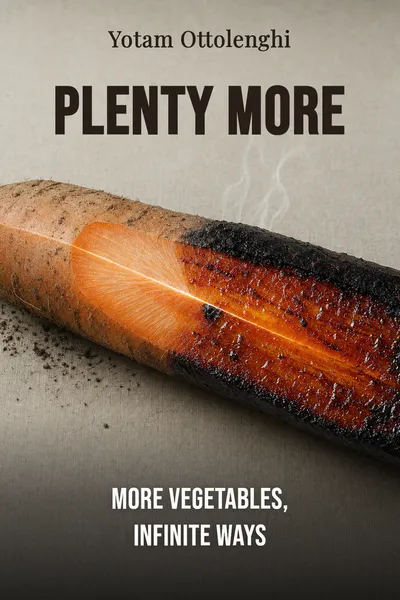
Plenty More
More vegetables, infinite ways
Description
In 2010, a Jerusalem-born chef running a small group of delis in London published a cookbook called Plenty. Yotam Ottolenghi had spent years writing a vegetarian column for the Guardian while being, by his own admission, a committed omnivore, and the book collected the best of it. It became a phenomenon. It sold well over a million copies, sat on kitchen counters far beyond the vegetarian world, and quietly changed how a generation of home cooks thought about a plate of vegetables. So when the follow-up arrived four years later, the expectation was heavy. A sequel to a book that beloved could easily have been a scrape of leftovers.
Plenty More, published in 2014, was not that. It gathered more than 150 new vegetable-forward recipes, and instead of sorting them the usual way — by ingredient, by season, by course — Ottolenghi did something stranger. He arranged the whole book by how you cook. Tossed, steamed, blanched, simmered, braised, grilled, roasted, fried, mashed, cracked, baked, sweetened. Each chapter is a verb, not a shopping list. It is a small structural decision that turns out to say a great deal about how he thinks food actually works.
The move sounds academic. In practice it is the opposite: it is how someone who lives in a kitchen organizes their instincts. Heat and technique change a carrot far more than the carrot itself ever varies. A book built on that idea is making a quiet argument about where flavor comes from — and, underneath, about what a vegetable is even for.
The question we’re asking : What does it mean to build a cookbook around cooking methods rather than ingredients, and what does that choice reveal about how Ottolenghi thinks about vegetables?What we’ll see : We follow the logic of a book that treats fire and water as the main characters, and vegetables as ingredients finally allowed to lead.
Table of contents
01 Chapter 1 — The book organized by fire and water
Open Plenty More and the table of contents reads like a set of instructions rather than a menu. The chapters are named for actions: Tossed, Steamed, Blanched, Simmered, Braised, Grilled, Roasted, Fried, Mashed, Cracked, Baked, Sweetened. A raw shaved-fennel salad and a slow-braised chickpea stew live in different worlds not because one is a starter and the other a main, but because one meets almost no heat and the other spends an afternoon in a low oven. The vegetable is secondary. What happens to it is the organizing fact.
This is unusual even among ambitious cookbooks. Most sort by ingredient (the tomato chapter, the aubergine chapter) or by occasion (weeknight, weekend, feast). Ottolenghi's own first Plenty had been arranged loosely by vegetable type. The sequel breaks that habit deliberately, and the effect on a reader is immediate. We stop asking what do I have in the fridge and start asking what do I feel like doing. Roasting on a cold evening. Charring something over flame in summer. The mood of the cooking, not the contents of the crisper drawer, becomes the entry point.

02 Chapter 2 — Why the method comes before the vegetable
The claim underneath the structure is that technique does more to a vegetable than the vegetable does on its own. A cauliflower simmered soft and dressed cold is a mild, almost creamy thing. The same cauliflower roasted at high heat until the edges blacken becomes nutty, sweet, faintly bitter, closer to a roasted nut than to a boiled floret. Nothing about the plant changed. The heat did the work. Ottolenghi keeps returning to this: the raw material is a starting point, and the cooking is where character is decided.
This is why the chapters cluster the way they do. Blanching and steaming preserve freshness and color, keeping a vegetable close to itself. Braising and simmering coax out sweetness and soften structure, trading brightness for depth. Grilling and roasting introduce char and caramelization, the flavors that come only from browning. Frying adds crunch and richness. Each method is a different lever, and once you feel how the levers work you can reach for the right one without a recipe telling you to. The book is teaching a sense of cause and effect.
03 Chapter 3 — A pantry that does the heavy lifting
If method is the skeleton of the book, the pantry is its bloodstream. Ottolenghi's cooking is famous for a particular set of ingredients that recur constantly: tahini, sumac, za'atar, preserved lemon, pomegranate molasses, rose water, Aleppo chile, black garlic, generous handfuls of soft herbs. These are the flavors of the eastern Mediterranean and the Levant, the tastes he grew up with in Jerusalem, and they run through Plenty More the way a signature runs through a painting. A plain roasted vegetable becomes his the moment one of them arrives.
The strategy is straightforward once you see it. Vegetables, on their own, are often quiet. What Ottolenghi does is surround them with layers of acid, salt, sweetness, and aromatic intensity so that the finished plate never reads as bland or ascetic. A squash gets pomegranate seeds for tart pop and tahini for richness. A salad gets sumac for sourness and toasted nuts for crunch. The vegetable stays at the center, but it is dressed and accessorized until it carries the whole dish without help from meat.
04 Chapter 4 — Vegetables at the center, not the side
Step back from the recipes and the real proposition of Plenty More comes into focus. For most of Western culinary history, a meal was organized around a piece of meat, and vegetables were what surrounded it — the supporting cast, the thing you added for color or fiber or duty. A vegetarian meal, under that logic, was defined by subtraction: the same plate with the center cut out. Ottolenghi's whole project is to refuse that framing. In his books, vegetables are not what is left when the meat is gone. They are the reason to cook.
The method-first structure serves this argument directly. By treating braising or grilling as the star and letting any vegetable step into the technique, the book puts vegetables where the protein normally sits — at the heart of the plate, taking the elaborate treatment usually reserved for a roast or a steak. A whole roasted celeriac or a charred head of cabbage gets the attention and the technique of a main event, because in this kitchen it is one. That is a shift in status, not just in menu.
05 Conclusion
So the peculiar table of contents turns out to be the argument in miniature. A book sorted by tossing, steaming, roasting and frying is telling us, before we cook a single thing, that the drama of a vegetable happens in the pan, not at the market. Ottolenghi built Plenty More around that conviction, layered it with the sour-sweet-smoky pantry of the eastern Mediterranean, and let more than 150 dishes demonstrate it one method at a time.
Related books