
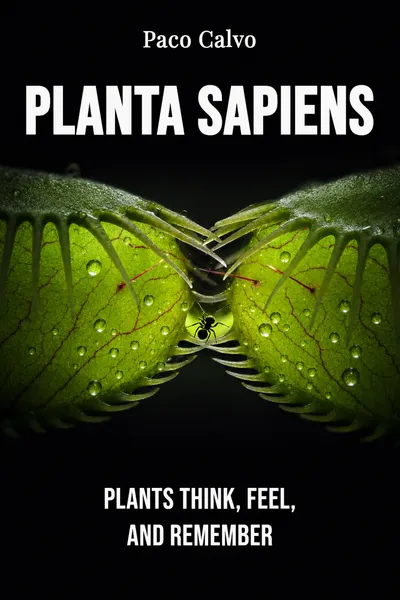
Planta Sapiens
Plants think, feel, and remember
Description
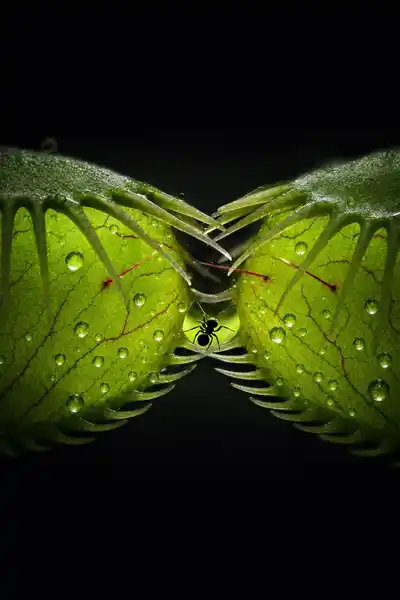
A Venus flytrap counts. Touch one of the tiny trigger hairs inside its trap and nothing happens. Touch a second hair within roughly twenty seconds, and the trap snaps shut. The plant has, in effect, kept a tally — one touch could be a raindrop, two within a short window is likely an insect worth the energy of closing. Paco Calvo, a philosopher of cognition who runs a plant-behavior lab at the University of Murcia in Spain, opens Planta Sapiens with facts like this one because they sit uncomfortably against everything we assume about what a plant is: a passive green thing, closer to a rock than to an animal, living but not really doing.
Calvo's book, published in 2022, gathers a decade of research — his own and others' — that keeps producing results we struggle to file. Plants that learn to ignore a harmless stimulus. Plants that seem to anticipate a coming event. Plants that appear to be sedated by the same anaesthetic that puts a human under. None of this requires a brain, and that is precisely the point Calvo keeps returning to. The trouble may not be that plants are dumber than we thought. The trouble may be the yardstick.
He is careful, and the book is at its best when it resists the temptation to make plants into people. Calvo is not claiming a fern feels sadness. He is asking a harder question: if intelligence means responding to the world in flexible, information-driven, goal-directed ways, then why have we drawn the circle to include only creatures that look and move like us? Planta Sapiens is a patient case for widening it — and for what that widening costs us in comfortable certainty.
The question we’re asking : When a plant senses, learns and decides without a brain, what is our word intelligence actually measuring?What we’ll see : How a cognition researcher reads the hidden behavior of plants, and why it unsettles the boundary we drew around minds.
Table of contents
01Chapter 1 — The problem is the ruler, not the plant
Calvo starts by putting the mirror back on us. For centuries the West sorted the living world into a ladder — minerals at the bottom, plants above them, animals higher, humans on top — and plants earned their low rung for a simple reason: they don't move, at least not at a speed we notice. Aristotle granted them a "vegetative soul" capable of nutrition and growth but not sensation. That intuition never really left. We call a comatose patient in a "vegetative state," and the metaphor does its quiet work: to be plant-like is to be barely alive.
The catch, Calvo argues, is that our whole vocabulary of intelligence was built by animals, for animals. We recognize a mind by watching a body dart, flee, hunt, learn a maze. Plants operate on a different timescale entirely — a tendril hunting for a support, a root steering around a rock, a stem tracking the sun across a day. Speed up a time-lapse and the passive green thing suddenly looks like it is groping, choosing, straining toward things. The behavior was always there. We just move too fast to see it.

02Chapter 2 — What a plant does when it senses the world
The sensory range Calvo describes is what first breaks the spell. A plant has no eyes, yet it detects light with real precision — not just its presence, but its direction, intensity, duration and colour, through pigments called photoreceptors distributed across its tissues. It registers the ratio of red to far-red light, which tells it whether a neighbour is shading it and crowding it out. It responds to gravity, to touch, to humidity, to the chemistry of the soil around its roots. Some plants even react to sound: research Calvo cites suggests the beach evening primrose sweetens its nectar within minutes of sensing the wingbeat frequency of a pollinator.
None of these senses is housed in an organ we would recognize. Perception is spread across the entire body, which means a plant is, in a sense, sensing with all of itself at once. Calvo leans on the idea that the growing root tip behaves almost like a mobile sensory antenna, probing ahead, testing the ground, and redirecting growth when it meets an obstacle or a patch of nutrients. Charles Darwin, writing with his son Francis in 1880, had already floated something similar — that the tip of the root acts like the brain of a simple animal, directing movement. The claim was mostly ignored for a century. Calvo treats it as unfinished business.
03Chapter 3 — The chemistry of memory and decision
If a plant can sense, can it remember? Calvo turns to the work of Monica Gagliano, whose experiments with the sensitive plant Mimosa pudica became a flashpoint in the field. Mimosa folds its leaves when disturbed. Gagliano dropped potted plants a short distance, repeatedly, onto a soft surface — enough to trigger the defensive folding but not to harm them. After a number of drops, the plants stopped folding. They appeared to have learned the drop was harmless and stopped wasting energy on a pointless response. Startle them a different way and they folded again, ruling out mere exhaustion. Most striking, Calvo reports, some plants seemed to retain this learned indifference for weeks.
This is habituation — one of the simplest forms of learning, studied for decades in animals. To find it in an organism with no neurons at all is either an error or a genuine puzzle, and Calvo is honest that the results have been contested and hard to replicate. He presents them not as settled fact but as the kind of finding that ought to make us cautious about where we draw lines. Alongside habituation he discusses evidence of associative learning, plants linking a neutral cue to a resource the way Pavlov's dogs linked a bell to food.
04Chapter 4 — Where the line between us and them was drawn
Step back from the flytraps and the Mimosa, and Calvo's larger argument comes into focus: the concept of intelligence we inherited is not a neutral description of the world but a self-portrait. We defined mind around the things we happen to have — a centralized brain, quick movement, a nervous system — and then went looking for those features elsewhere. Where we didn't find them, we recorded an absence. Plants are the extreme test case because they meet the functional demands of cognition, sensing and integrating and responding, using none of the hardware we assumed was mandatory.
This is why Calvo, trained as a philosopher, keeps circling back to the definition rather than piling up more experiments. His field, sometimes called plant neurobiology, provokes fierce resistance precisely because of its vocabulary — critics object that words like "learning," "memory" and "decision" smuggle in animal assumptions. Calvo's response is that we have no better words, and that refusing to use them is its own kind of prejudice, ruling out the possibility before the evidence is heard. The honest move is to keep the terms, define them functionally, and let the data push on them.
05Conclusion
Return to the flytrap counting to two. What looked at first like a mechanical reflex turns out to be a plant gathering information, weighing it against the cost of acting, and committing — the same functional loop that, in an animal, we would not hesitate to call behavior. Calvo doesn't ask us to believe the plant feels its decision. He asks why we were so quick to assume it makes none. Across the book, that shift keeps repeating: the strangeness we sense is less about the plants than about the narrowness of what we were prepared to see.