Packers
Glory in green and gold
Description
Green Bay, Wisconsin, is a city of roughly 105,000 people, tucked at the mouth of the Fox River where it empties into the bay of the same name. By every logic of modern professional sports, it should not have a team. The National Football League is a league of Los Angeles, New York, Dallas — markets measured in millions, stadiums financed by billionaires, franchises that pack up and move when the money points somewhere warmer. And yet the smallest city in American major-league sports has, since 1919, held onto one of its most decorated teams. The Green Bay Packers have won thirteen league championships, more than any other franchise in the sport.
The volume assembled by the editors of Sports Illustrated is a tribute to that improbability — a book built from photographs, reporting, and the accumulated memory of more than a century. It moves through the frozen-field folklore, the names that turned into street signs and trophies, the seasons that ended in confetti. It lingers on the images: breath hanging in December air, mud-caked jerseys, a coach carried off on shoulders. This is a franchise whose history reads less like a corporate timeline and more like the story a town tells about itself.
What the collection keeps circling back to is not just the winning, though there is plenty of it. It is the strange, durable bond between a team and the place that refuses to let it go — a bond written into the ownership papers themselves, and worn on the backs of fans who show up in subzero cold as if attendance were a civic duty. The green and gold is not a brand here. It is closer to an inheritance.
The question we’re asking : How did a team from the smallest city in major American sports become one of its most storied — and what holds that bond together?What we’ll see : A century of championships, the men who built the legend, and the peculiar arrangement that keeps a small town at the center of a billion-dollar league.
Table of contents
01 Chapter 1 — A town that owns its team
The Packers were founded in 1919 by Earl "Curly" Lambeau, a former Notre Dame player, and George Whitney Calhoun, a local sportswriter. The name came from the Indian Packing Company, which put up money for jerseys and equipment in exchange for the team carrying its name. It was a scrappy beginning — passing the hat at games, playing on rough ground, folding once into near-bankruptcy in the early years. What emerged from that instability, though, became the franchise's defining feature and the thread the book returns to again and again.
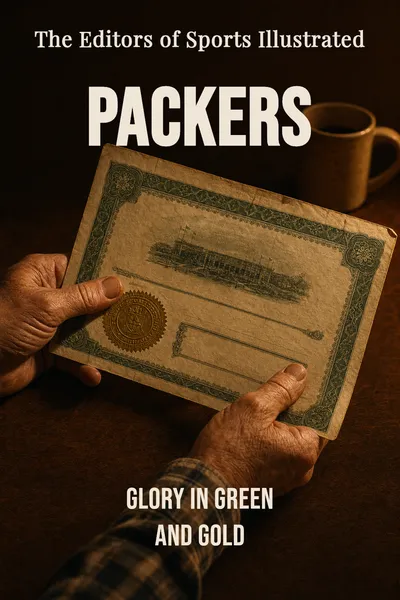
In 1923, to save the team from collapse, Green Bay reorganized the Packers as a publicly owned, nonprofit corporation. Shares were sold to residents. There is no single wealthy owner, no man in a luxury box who can threaten to relocate the club to a bigger market. Instead there are hundreds of thousands of shareholders, most holding stock that pays no dividend, grants no perks, and can never really be sold at a profit. People buy it anyway. They frame the certificates. The Packers remain the only community-owned team in the major American leagues, and that fact has kept them anchored to a place that would otherwise have lost them decades ago.

02 Chapter 2 — The dynasties that made the myth
A franchise earns its legend on the field, and the Packers have done so across distinct eras that the book lays out in sequence. The first belonged to Curly Lambeau himself, whose teams won six championships between 1929 and 1944, built around innovative use of the forward pass at a time when most clubs still trusted the ground game. Lambeau's Packers made the small city a national name well before television, when the league was still assembling itself out of industrial towns and semipro squads.
The era that fixed the Packers in the American imagination came under Vince Lombardi, hired as head coach in 1959. In nine seasons he transformed a losing team into a dynasty, winning five league titles in seven years, including the first two Super Bowls, in January 1967 and January 1968. Lombardi's name now sits on the trophy every NFL team plays to win. The book gives real space to the imagery of those years — the Ice Bowl of December 1967, played against Dallas in temperatures near thirty below, decided by a quarterback sneak in the final seconds. It is the kind of moment that becomes shorthand for a whole franchise.
03 Chapter 3 — Faces in the green and gold
A team's history lives in its people, and the collection is generous with portraits. It returns often to Lombardi, less as a strategist than as a presence — the gap-toothed grin, the camel coat on the sideline, the demand for a perfection he seemed to believe was actually attainable. His players spoke of him for the rest of their lives, and the photographs catch the mix of fear and devotion he inspired.
Around him stand the men of that dynasty, several of whom became fixtures of the sport's memory. Bart Starr, the quarterback who scored the winning touchdown in the Ice Bowl, was the calm center of those championship teams. Paul Hornung and Jim Taylor carried the running game; Ray Nitschke anchored a punishing defense; Forrest Gregg held the line. The book presents them not as statistics but as characters, each one a piece of the mythology that a town assembled and then handed down.
04 Chapter 4 — Why one small city still matters
Step back from the trophies and the frozen-field folklore, and the Packers become an argument about what a sports franchise can be. The modern NFL is among the most valuable and centralized entertainment operations on earth, its teams owned by billionaires, its stadiums bankrolled by public money and named for whichever corporation bids highest. Franchises relocate. Loyalties are treated as revenue streams. Against all of that stands a nonprofit corporation in a city of a hundred thousand people, owned by its fans, unable to leave.
The book's deeper subject, threaded through every photograph, is this contrast. Green Bay is the league's living reminder of where the sport came from — the industrial towns, the community squads, the era before the game became a product. The Packers cannot be moved to a larger market because no single person has the authority to move them. That structural quirk, born of a desperate rescue in 1923, has become the franchise's identity and its moral. It is why the green and gold feels less like a logo than a birthright.
05 Conclusion
The Sports Illustrated collection closes where it begins — with the improbability of it all. A team founded on meatpacking money in 1919, rescued by its own townspeople in 1923, carried to thirteen championships by coaches and players whose names became the sport's furniture. The photographs do the closing argument: breath in the cold, mud on the jerseys, a city that never stopped showing up. The glory in green and gold, the book insists, was never only about winning. It was about who the winning belonged to.
Related books