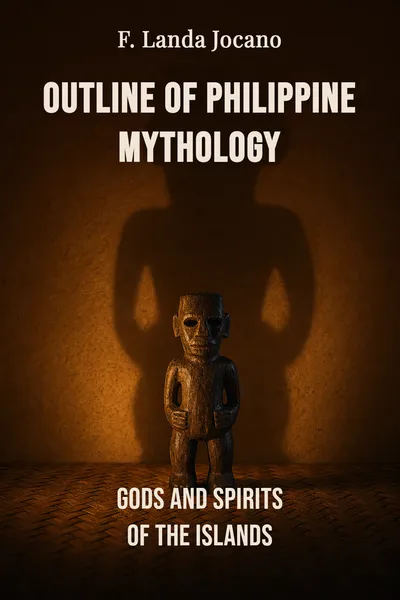
Outline of Philippine Mythology
Gods and spirits of the islands
Description
When Spanish ships reached the archipelago in the sixteenth century, they found no single religion to convert, but hundreds of local pantheons — deities of the rice fields, spirits of the rivers and the dead, creator figures whose names shifted from one island to the next. The friars wrote much of it down, mostly to know what they were trying to erase. For centuries after, the old gods survived in scraps: a chant a grandmother remembered, a ritual folded into a Catholic feast, a story told to children that no one thought to call mythology. The systematic account came late.
F. Landa Jocano, a Filipino anthropologist, set out to gather those scraps into something that could be read whole. His Outline of Philippine Mythology, published in 1969, is not a retelling of a few dramatic legends but a survey — an attempt to map the deities, the spirits, the creation stories and the cosmologies that ordered indigenous life before the Church redrew the map. He worked from colonial chronicles, from the fieldwork of earlier ethnographers, and from oral lore still alive among peoples the missionaries never fully reached.
The book's ambition is quiet but large. It refuses to treat the beliefs of the Tagalog, the Bisaya, the Bagobo, the Ifugao and dozens of others as a collection of curiosities. It treats them as a body of thought — a way a people explained where the world came from, who governed it, and what happened after death. What emerges is less a gallery of monsters than the outline of a lost intellectual system, one that Jocano insists deserves to be recovered rather than smiled at.
The question we’re asking : What did Filipinos believe about their gods and their world before the friars arrived, and how do we recover it now?What we’ll see : How Jocano assembled a scattered inheritance into the outline of a native cosmology, and why the assembling itself is the achievement.
Table of contents
01Chapter 1 — The gods before the friars came
The first thing Jocano's survey makes clear is that there was never one Philippine mythology. The archipelago holds thousands of islands and dozens of distinct peoples, and each carried its own pantheon, its own creator, its own hierarchy of lesser powers. What the book offers is not a unified religion but a family resemblance across many — recurring roles filled by different names, similar cosmic architecture built with local materials. The survey's job is to hold these side by side without flattening them into one.
At the top of many of these systems sits a supreme deity, often a distant creator who set things in motion and then withdrew. The Tagalog knew Bathala, the maker who ruled over the sky and the affairs of humankind. The Bisaya spoke of Kaptan and, in some accounts, of Maguayen, powers of sky and sea whose quarrel or cooperation began the world. Among the Ifugao of the northern highlands, the divine order was crowded and specific, with gods assigned to harvests, to war, to the reaping of individual crops. The supreme being is rarely the god one prays to daily. That role falls lower down.

02Chapter 2 — A cosmos with three floors and a low sky
If the pantheons varied, the shape of the universe they inhabited was strikingly consistent. Across many groups Jocano surveys, the cosmos comes in layers — a sky world above, the earth of the living in the middle, and an underworld below. This vertical arrangement is not decorative. It maps where the powers live, where the dead go, and how the ordinary world sits wedged between forces larger than itself. To know the layers was to know one's own place among them.
The sky in these accounts is close, not the infinite void of later astronomy. Several creation tales describe a heaven so low that a person pounding rice would strike it with the pestle, until some act — irritation, a curse, a blow — pushed it up to where it hangs now. The detail is worth noticing: the separation of sky and earth is often the first event, the primal act that makes room for the world to happen at all. The cosmos begins by pulling apart, and the sky's distance is itself the trace of an original quarrel.
03Chapter 3 — How the world and the first people were made
The creation stories are where Jocano's survey is richest, because nearly every people had one and no two match. Yet common motifs surface again and again, as if variations on a shared grammar. The world is often born from a struggle or an accident among primal powers rather than designed in calm. In one widely recorded Bisayan account, the sky and the sea are at odds, and a great bird, finding nowhere to land, stirs them against each other until the islands are flung up as the result of their conflict — the archipelago itself the debris of a fight.
The origin of the first humans carries its own recurring image: people emerge from bamboo. In the well-known version, a bird pecks at a floating length of bamboo, it splits, and out step the first man and the first woman, Malakas and Maganda — the strong one and the beautiful one. The story is simple, but Jocano notes how it distributes the sacred through ordinary material. Humanity does not descend from the heavens; it comes out of a plant that grows in every yard. The origin of people is placed, quite literally, within arm's reach.
04Chapter 4 — Reading a people back into itself
Step back from the individual gods and stories, and the deeper subject of Jocano's book comes into view: the recovery of a worldview that colonial history had scattered. His work is not just a catalogue of deities. It is an argument that indigenous Filipinos possessed a coherent system for explaining the cosmos — and that this system was worth reconstructing with the same seriousness a scholar would bring to Greek or Norse myth. The framing itself is the intervention.
That argument had to be made because the sources were compromised. Much of what survives was written by the very missionaries who set out to abolish it, filtered through Spanish categories and the assumption that these were the errors of heathens. Later fieldwork caught fragments before they faded. Jocano's method is to work across all of it — chronicle, ethnography, living oral lore — precisely because no single source is trustworthy alone. The mythology has to be triangulated rather than simply read off a page, and every reconstruction carries the seam where the sources were joined.
05Conclusion
The gods Jocano gathered had spent four centuries in the margins — surviving as folk belief, as ritual smuggled into Christian feasts, as stories no one had thought to write down as a whole. His Outline pulled them into a single frame: the remote creators, the crowded middle world of anito and diwata, the layered cosmos with its low sky, the bamboo that split to release the first man and woman. Read together, the scattered pieces stop looking like superstition and start looking like a system of thought.
Related books