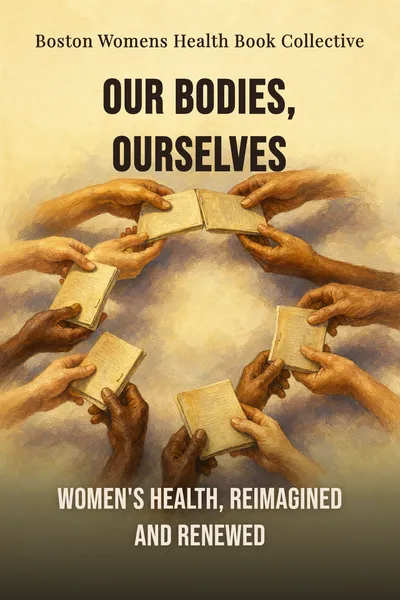
Our Bodies, Ourselves
Women's health, reimagined and renewed
Description
In 1969, a group of women at a workshop in Boston sat down to compare notes on something nobody had put in a book for them: their own bodies. They had questions about menstruation, pregnancy, contraception, sex, and the medical system that treated them, and when they went looking for straight answers, they mostly found doctors who wouldn't explain and textbooks written in a language that wasn't meant for patients. So they did the research themselves. They read, they interviewed, they pooled what they knew, and the following year they printed the result on newsprint. It cost seventy-five cents. It was called Women and Their Bodies, and it sold hand to hand.
Two years later, that stapled course packet had a commercial publisher, a new title, and a name that would outlast almost everything else on the shelf: Our Bodies, Ourselves. It went on to sell millions of copies, get translated and adapted around the world, and be revised again and again across five decades. What started as a workaround for women who couldn't get their doctors to talk to them became the reference work an entire generation reached for first.
The book keeps coming back in updated editions because the terrain under it keeps shifting: new science, new drugs, new debates about who controls reproduction, new understandings of gender and sexuality. Each revision is less a polish than a fresh reckoning with what women actually need to know now. That habit of renewal is the thread worth pulling.
The question we’re asking : How did a homemade booklet by non-experts become the lasting authority on women's health, and why does it keep being rewritten rather than simply reprinted?What we’ll see : The making of the book, the idea of knowledge it put in ordinary hands, what it actually says, and why staying current is built into its DNA.
Table of contents
01Chapter 1 — A pamphlet stapled together in Boston
The origin is almost defiantly unglamorous. In May 1969, at a women's liberation conference in Boston, a session on "women and their bodies" drew a crowd who discovered they shared the same frustration: they knew remarkably little about how their own bodies worked, and the people who did know weren't inclined to explain. A dozen or so of them kept meeting afterward. They gave themselves assignments, spread across topics like anatomy, sexuality, pregnancy, childbirth, and abortion, and each brought back what she had found. There was no single author. The text was assembled the way the group learned, in pieces, out loud, checked against each other.
What they were reacting to was a specific experience of medicine at the time. A woman walked into a doctor's office and was expected to be a good, quiet patient. She was rarely told what a procedure involved, what a drug did, or what her options were. Information flowed one direction, from a mostly male profession down to a mostly female clientele, and asking too many questions was treated as a nuisance. The group's insight was that this silence wasn't neutral. Not knowing how your own body worked left you dependent, and dependency was the whole problem.

02Chapter 2 — Knowledge taken back from the experts
The book's deeper argument isn't any single medical fact. It's about who gets to hold health knowledge in the first place. For most of modern medicine, expertise had been something professionals kept and dispensed, and the patient's job was to comply. Our Bodies, Ourselves proposed something closer to the opposite: that a woman is entitled to understand her own body well enough to make her own decisions, and that this understanding is not a favor granted by a doctor but a right she can claim.
The method matched the claim. Instead of speaking from an authority's chair, the book gathers women's accounts of what things actually felt like, then sets those experiences beside the medical facts. A section on childbirth doesn't just describe the physiology; it tells you what different choices are like from the inside, what the routines of a hospital can feel like, where women found themselves overruled. The effect is that the reader is treated as a competent adult capable of weighing information, not as someone to be managed.
03Chapter 3 — What the book actually says about a body
Strip away the history and Our Bodies, Ourselves is, at bottom, a comprehensive guide, and its coverage is the reason it stuck. It moves through anatomy and physiology, sexual health and pleasure, relationships, birth control, pregnancy, childbirth, and the postpartum period, then into the long arc of a life: fertility and infertility, menopause, aging. Later editions widen further, into mental health, nutrition, environmental exposures, and navigating a health system that can be as confusing as any diagnosis. The ambition is to hand a reader enough to find her bearings on almost any question about her body.
The register is what makes it usable. It doesn't flinch, and it doesn't lecture. Subjects that other books skirted, sexuality in frank detail, abortion, sexual assault, the realities of living with a chronic condition, are treated directly and without shame, on the premise that you can't make good decisions about something you're too embarrassed to name. At the same time it resists false certainty. Where the evidence is contested or a choice comes down to values, the book says so, and lays out the considerations rather than issuing a verdict.
04Chapter 4 — A book that keeps being rewritten
The most telling thing about Our Bodies, Ourselves is that it was never finished. From the 1970 newsprint edition onward, the collective revised it repeatedly across the decades, and the revisions weren't cosmetic. Whole chapters were rebuilt as the science moved, as drugs came and went, as the legal ground under reproductive rights shifted, and as the culture's understanding of sex, gender, and identity changed. A book about the body had to keep pace with what was actually known and lived, or it would quietly become misinformation.
That habit of renewal turns out to be the real argument the book makes about health knowledge. It treats expertise not as a fixed monument to be preserved, but as something provisional, always subject to correction as evidence accumulates and as the people it describes speak up about what it missed. The newly revised editions aren't apologies for earlier errors so much as an admission built into the project from the start: what we know about the body is a moving target, and honesty requires updating.
05Conclusion
The seventy-five-cent booklet that a dozen women stapled together in Boston became one of the most durable health references in publishing, and it got there by trusting that ordinary readers could handle real information about their own bodies. What began as a workaround for women who couldn't get their doctors to explain grew into millions of copies, translations and adaptations around the world, and a run of updated editions that has now stretched across more than fifty years. The voice stayed the same even as the pages were rebuilt: frank, unashamed, and firmly on the reader's side.
Related books