Orthodoxy
The rediscovery of Christianity
Description
In 1905, G. K. Chesterton published Heretics, a collection of essays that took apart the fashionable philosophies of his contemporaries one by one — the pessimists, the progressives, the aesthetes, the imperialists. It was sharp, funny, and merciless. And it landed him with a reproach he apparently couldn't shake. A critic, G. S. Street, complained that he wasn't obliged to take his own views seriously until Chesterton had produced some of his own. Chesterton, thirty-one at the time and already one of the most quoted journalists in London, decided to take the dare literally. Three years later, in 1908, he answered with Orthodoxy.
The book is not an argument from authority. It is something stranger and more personal: the story of a man trying to build his own philosophy from scratch, working, as he put it, some ten minutes ahead of the truth. He wanted to found a heresy of his own. He wanted to be the first to see the things he was seeing. And when he had finally assembled his private creed — his sense that the world was both a wonder and a battlefield, that life needed loyalty and criticism at once — he made an awkward discovery. It already had a name. Somebody had thought of it two thousand years earlier. He was, in his own phrase, the man who with the utmost daring discovered what had been discovered before.
Orthodoxy is often filed under Christian apologetics, and it is that. But it reads less like a defence of a fortress than the diary of an explorer who set sail to find a new island and ran aground on his own country, mistaking it for the New World. What makes the book worth returning to is the route Chesterton takes to get there — and what he thinks he found waiting on the shore.
The question we’re asking : How does a man setting out to invent his own philosophy end up defending the oldest one in the room?What we’ll see : A journey that starts in the mind's own strange logic and ends in a defence of the very thing it set out to replace.
Table of contents
01Chapter 1 — The man who discovered England
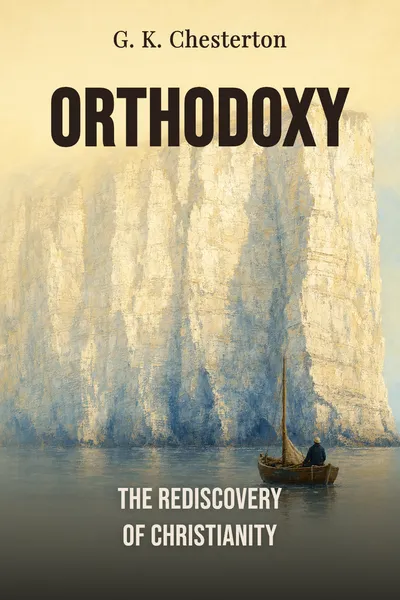
Chesterton opens with a fable about himself. Imagine, he says, an English yachtsman who miscalculates his course and lands, with great excitement, on what he takes to be an undiscovered South Sea island — only to find it is Brighton. He plants his flag on the pavilion and asks a policeman the name of this savage tribe. The joke is aimed squarely at Chesterton's own predicament. He had spent his youth as a proud, adventurous free-thinker, drifting from paganism through agnosticism, determined to construct a fresh outlook that owed nothing to anyone. The whole romance of his intellectual life, he admits, was the romance of arriving somewhere new.
The trouble was that everything he arrived at turned out to be occupied already. He worked out, on his own, that life was worth living and yet somehow tragic, that the world was to be loved fiercely and still improved. He assembled these instincts like a man building a boat from driftwood. Then he opened a book of Christian theology and found the boat had a name and a captain and a two-thousand-year logbook. The philosophy he had daringly pioneered was the one his grandmother had recited to him without his listening.

02Chapter 2 — The maniac and the small circle of reason
Before Chesterton will praise anything, he wants to diagnose the modern confidence in pure reason, and he does it with an image that has outlived the book's arguments: the madman. We assume, he says, that the insane are those who have lost their reason. In fact the madman is very often the one who has lost everything except his reason. The man in the asylum with a complete theory that the whole world is conspiring against him is perfectly logical. Every fact fits. Point out that people ignore him and it proves the conspiracy is subtle; point out that they attack him and it proves the conspiracy is desperate. His logic is airtight. What he has lost is not reason but proportion — the health that comes from the wide, careless things reason cannot supply.
03Chapter 3 — The suicide of thought
Having set the trap, Chesterton springs it on the progressive thinkers he most admired. Modern thought, he argues, has developed a talent for cutting off the branch it sits on. He calls it the suicide of thought. Take the skeptic who doubts everything: eventually his doubt turns on his own power to think, and reason attacks reason until nothing can be affirmed at all. Take the man who worships evolution or flux so completely that he can no longer call anything good, because to call a thing good is to fix it, and he has forbidden all fixed things. Each fashionable idea, followed to its end, quietly destroys the ground it needs to stand on.
His favourite example is humility. The old humility, he says, made a man doubtful about his efforts, which spurred him to try harder. The new humility makes a man doubtful about his aims, which stops him working at all. We have, he writes, a modesty that has settled in the wrong place — men are unsure of the very truths they ought to hold with conviction, and dogmatically certain of the things they ought to question. The result is a paralysis dressed up as open-mindedness. An open mind, he remarks, is like an open mouth: it is meant to close on something solid.
04Chapter 4 — The romance of orthodoxy
The word orthodoxy sounds, to most ears, like a cage — a set of rules imposed to keep people small. Chesterton's whole book is aimed at reversing that instinct. A fixed doctrine, he argues, is not the wall of a prison but the wall of a playground. Children play most freely on a high mountain meadow when there is a fence at the edge of the cliff; remove the fence and they huddle terrified in the centre. The dogma, far from cramping life, is what lets life be adventurous. Boundaries make the game possible.
This is why he keeps calling Christianity a romance rather than a theory. A romance combines the two things he had been hunting from the first page: the strange and the secure, the sense that the world is an astonishing place and the sense that it is our home. He argues that the creed answers the double need exactly — it lets us be at war with the world and in love with it at once, to hate a thing enough to change it and love it enough to keep it. The balance is not a compromise between two moods but a fierce holding of both, the way a person can be furious with a friend and loyal to them in the same breath.
05Conclusion
The yachtsman who set out to find a new island and landed on his own shore is Chesterton's portrait of himself, and by the last page the joke has curdled into something closer to gratitude. He had tried to be a heretic, to build a philosophy ten minutes ahead of the truth, and found that the truth had been waiting patiently for two thousand years, holding the seat he thought he was inventing. The rediscovery, not the discovery, is the whole point of the book — and it is why he offers his own confused route rather than a set of proofs.
Related books