
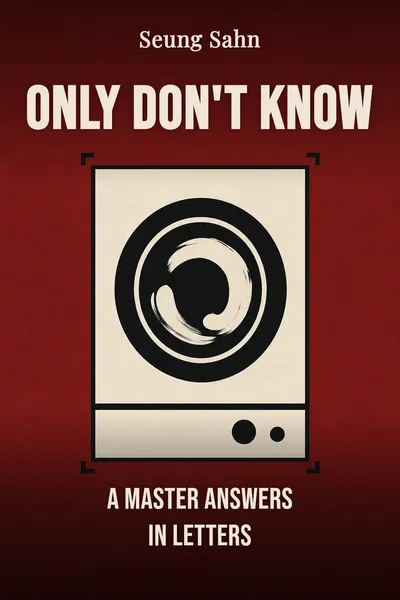
Only Don't Know
A master answers in letters
Description
Sometime in the 1970s, a Korean Zen master who barely spoke English arrived in Providence, Rhode Island, and started a school by fixing washing machines and talking to anyone who wandered in. His name was Seung Sahn, and within a few years he was running centers across the United States, Europe, and beyond. He kept an unlikely habit for a man that busy: he answered his mail. Not the way a public figure answers mail, through an assistant and a form letter, but personally, by hand, sometimes hundreds of pieces a month. Students, strangers, people in the middle of a divorce or a crisis of faith wrote to him, and he wrote back.
Those letters became one of his real classrooms. A selection of them was gathered into a book, Only Don't Know, and reading it feels less like studying a doctrine than like being handed someone else's private correspondence and told, go ahead, this is for you too. The questions are ordinary in the way anyone's questions are ordinary — what do I do about my anger, my job, my dying parent, my doubt. The answers are short, direct, occasionally funny, and almost never what the writer expected. He rarely explains. He turns the question around and hands it back.
There is something strange about learning the most interior of disciplines through the most mundane of formats. A stamp, an envelope, a delay of weeks. And yet the format is not incidental to what he was teaching — it may be the clearest expression of it. A letter forces a person to sit with a question long enough to write it down, and then to sit again, waiting, before the reply arrives.
The question we’re asking : How does a Zen master teach the most personal thing there is — through something as slow and impersonal as the post?What we’ll see : A correspondence that turns kitchen-table trouble into practice, and a teacher who spends every reply refusing to be the answer.
Table of contents
01Chapter 1 — Hundreds of letters a month
Seung Sahn came to America in 1972 with almost no English and a conviction that Zen could travel. He founded what became the Kwan Um School of Zen, and as it grew, so did his mail. People wrote from retreat centers he had visited once, from cities he would never see, from inside marriages and hospitals and jobs they hated. He answered them. This was not a sideline to his teaching; alongside the formal interviews and the retreats, the letters were where a great deal of the actual work happened, one correspondent at a time.
What strikes a reader first is how unguarded the exchanges are. A student confesses that she cannot stop crying. Another admits he thinks his practice is going nowhere. Someone writes, with real embarrassment, that he wants to quit. Seung Sahn does not soften these arrivals with sympathy in the usual sense. He receives the trouble plainly and answers plainly, which turns out to be its own form of respect. He treats the writer as capable of hearing something true, rather than as a patient to be managed.

02Chapter 2 — The koan hidden in the question
The move Seung Sahn makes again and again is to refuse the question as posed. Someone asks how to stop being angry, and instead of a technique he answers with a question of his own: who is angry? What is anger, right now, before you name it? He is doing on paper what a teacher does in a face-to-face interview — taking the neat little problem the student has packaged and cracking it open so the student has to look inside rather than reach for a fix.
This is the koan method carried into ordinary life. A koan is not a riddle with a clever solution; it is a question designed to exhaust the thinking mind until something more immediate steps forward. When a correspondent asks about the meaning of life or the nature of enlightenment, Seung Sahn will not supply a meaning. He will ask what color the sky is, or tell the person to go drink their tea. The point is not evasion. The point is that the answer being requested lives in the wrong place — in concepts, in the future, in the head — and the teacher keeps pointing back to the present moment where nothing is missing.
03Chapter 3 — Work, love, and the tired mind
Not every letter is about Zen in any formal sense. People write about the things people always write about — a job that grinds them down, a relationship falling apart, a parent dying, a mind that will not stop churning at three in the morning. Seung Sahn does not treat these as lesser questions to be handled before the real spiritual matters. For him they are the real spiritual matters. There is no separate holy life waiting somewhere past the laundry and the resentment.
On work, he tends to collapse the gap between the sacred and the tedious. A student frustrated that daily labor pulls them away from practice is told, more or less, that the labor is the practice — that washing the dishes with a clear mind is not a distraction from Zen but exactly where it lives. He himself had swept floors and repaired machines. He was not romanticizing menial work; he was refusing the idea that enlightenment happens somewhere cleaner than a person's actual day.
04Chapter 4 — The teacher who kept pointing away from himself
Step back from any single letter and a pattern emerges about how Seung Sahn understood his own role. A charismatic teacher receiving devoted mail from around the world could easily have become the center of it all — the sage whose approval students craved, the personality the practice orbited. He worked, letter after letter, to prevent exactly that. He kept turning attention away from himself and back toward the writer's own experience, their own don't-know mind, the moment in front of their own eyes.
The correspondence format made this possible in a way the physical presence of a famous master might not have. A letter cannot be swooned over in real time. By the time the reply arrives, weeks may have passed; the emotional charge of writing it has cooled; the student is alone again with the words on the page. The delay does part of the teaching. It puts distance between the seeker and the source, so that whatever insight lands has to be metabolized in solitude rather than absorbed as the glow of being near the teacher.
05Conclusion
The washing machines got fixed, the school kept growing, and the letters kept coming until Seung Sahn's death in 2004. What he left in Only Don't Know is not a system or a set of doctrines to memorize. It is a record of one man meeting hundreds of ordinary human questions with the same steady, unhurried attention — never the same words twice, always the same movement, turning the question back to the one who asked it.