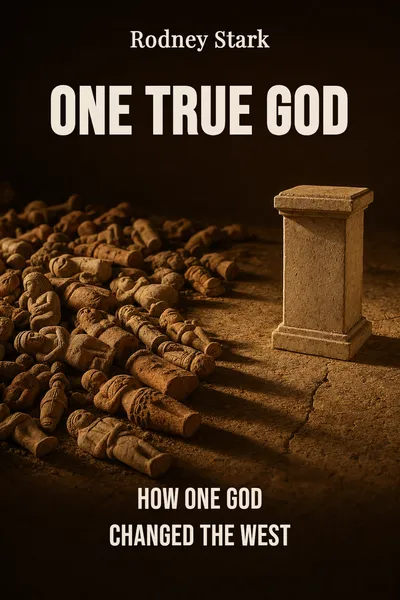
One True God
How one god changed the West
Description
Somewhere in the second millennium before our era, in the world that produced Babylon and Egypt and the crowded pantheons of the Near East, a small and unremarkable people began insisting on something that would have struck their neighbors as either mad or rude. There was, they said, only one God. Not a chief god, not the strongest god in a divine committee, not the local deity of a particular tribe. One. The others were not weaker rivals; they simply did not exist. It was an odd position to hold in a religious marketplace where gods were as plural as cities, and it should, by every reasonable expectation, have gone nowhere.
It went, instead, almost everywhere. The sociologist Rodney Stark, in his book One True God, takes this improbable insistence and asks what it actually did — not to theology, but to history. His argument is that monotheism is not simply one religious idea among many but a different kind of idea altogether, one that behaves differently, spreads differently, and demands differently. A God who is the only God can ask things of people that a god sharing the sky with a dozen others never could. And because He can ask more, He gets more: more loyalty, more organization, more staying power.
The counterfactual is where the stakes become clear. Strip the single God out of the story and the West we know does not appear. The Jews, had they stayed polytheist, would be a footnote beside the Babylonians — remembered faintly, extinct entirely. Christianity offered as merely one more savior among the mystery cults would have faded like Mithraism. Islam without Muhammad's radical pruning of Arab paganism would never have left the desert. Stark's book is an attempt to explain why the arithmetic of the divine mattered so much.
The question we’re asking : What does believing in a single God actually change — not in heaven, but in the course of human events?What we’ll see : How the arithmetic of monotheism reshaped loyalty, morality, and the very map of Western history.
Table of contents
01Chapter 1 — The claim of a single God
Stark begins by refusing a comfortable assumption — that all religions are, at bottom, the same thing in different costumes. They are not. A polytheist and a monotheist do not merely worship different gods; they hold fundamentally different theories about what a god is and what one owes it. The polytheist deals with many divine beings, each with a portfolio, each requiring the right offering at the right moment. The relationship is transactional and, crucially, non-exclusive. You can serve the god of the harvest on Tuesday and the god of war on Friday, and no one is offended, because gods are understood as specialists, not sovereigns.
Monotheism breaks this arrangement completely. If there is only one God, then that God is not a specialist to be consulted but a totality to be obeyed. There is nowhere else to take your business. This is the pivot on which Stark's whole argument turns: exclusivity. A jealous God — and the God of Israel is explicitly, famously jealous — forbids the hedged bets that polytheism runs on. He wants everything, and He offers, in return, something the crowded pantheons could not: a coherent, single relationship with the divine, and a moral order that flows from a single will rather than from a squabbling committee.

02Chapter 2 — The advantages of a demanding faith
The puzzle sharpens once you notice that monotheism is harder. It asks more, forgives less, and rules out the convenient hedging that made polytheism so livable. Common sense suggests a demanding faith should lose to an easy one. Stark argues the opposite, and here he leans on the economics of religion he had developed over decades: high-cost religions are often stronger religions, precisely because the cost screens out the half-committed and binds the rest more tightly.
A god who demands little inspires little. If serving a deity requires nothing more than an occasional offering, the relationship stays shallow and the community stays loose. But a God who demands exclusive loyalty, moral conduct, and real sacrifice generates something a casual cult cannot — intense commitment, dense social bonds, and a willingness to endure. The early Christians did not spread despite persecution; the persecution, and their refusal to buckle under it, was itself a demonstration of the faith's seriousness that drew others in.
03Chapter 3 — The market of the sacred
To explain how these advantages played out, Stark treats religion the way an economist treats an industry — as a market of competing firms offering competing products to a public that shops among them. It is a deliberately unsentimental lens, and it does real work. In a genuinely open religious market, where many faiths compete for adherents, the vigorous ones thrive and the complacent ones wither. Monotheism, with its distinctive product, enters this market with a peculiar and powerful sales proposition.
The proposition is exclusivity as a feature, not a bug. A polytheistic religion competing for converts is, in a sense, always undercutting itself — it invites you to add its god to your collection, which means it never wins your whole allegiance and never fully mobilizes you. Monotheism offers a total package: the one true God, a complete moral order, a defined community, and salvation available to anyone willing to pay the price of belief. It does not ask to be added; it asks to replace everything else. That is a far more powerful thing to sell.
04Chapter 4 — What the West inherited from monotheism
Step back from the mechanics and the shape of Western history itself comes into focus differently. Stark's larger claim is that monotheism did not merely add a religion to the West; it reset the terms on which the West would fight, believe, and belong. Consider conflict. Polytheistic peoples had wars in abundance, but they did not have religious wars in the strict sense, because there was nothing exclusive to fight over — one could always accommodate another people's gods alongside one's own. Only when a faith insists that its God is the only God does the category of the holy war become possible. The West's long, bitter history of religious violence is, uncomfortably, one of monotheism's direct bequests.
But the same exclusivity that made those wars conceivable also produced the moral architecture the West still stands on. A society with gods has customs; a society with one God has Commandments — a moral law understood as universal, binding, and non-negotiable because it issues from the single source of everything. The idea that there are things no ruler and no majority may rightfully do, that human obligations are anchored in something above human convenience, grows out of this soil. Strip out the one God and you do not merely lose the churches; you lose the particular seriousness with which the West came to treat right and wrong.
05Conclusion
Return to that small people insisting, against every neighbor and every convention, that there was only one God. The insistence looked hopeless — a minority position in a world built for many gods, forever tempted back toward the easier plural faiths next door. It should have vanished. Instead it proved to be the most consequential religious idea the West would ever hold, because a God who is the only God asks more, binds tighter, and travels farther than any specialist deity of the old pantheons ever could.
Related books