
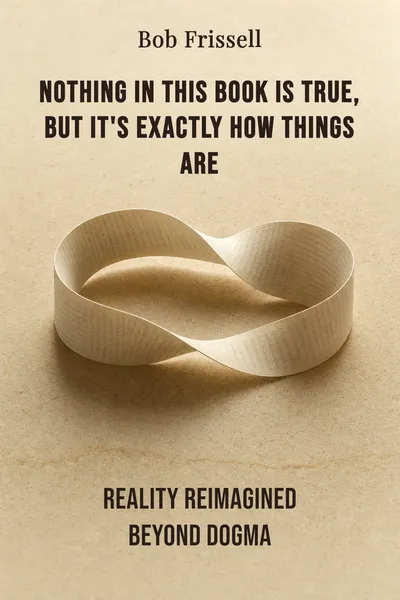
Nothing in This Book Is True, but It's Exactly How Things Are
Reality reimagined beyond dogma
Description
In 1994, a Rebirther and workshop teacher named Bob Frissell published a slim, strange book with a title that does half the arguing for it: Nothing in This Book Is True, but It's Exactly How Things Are. The line lands like a shrug and a dare at once. Before we've read a word of the argument, we've been told the argument can't be checked, and that this is somehow the point. Frissell had spent years around the breathwork and consciousness-expansion scene, and he arrived not as a scholar but as a devoted relay — a man passing along what he'd learned from teachers he trusted, chief among them the figure who called himself Drunvalo Melchizedek.
What follows inside is a sprint through a lot of territory that most bookshops file far apart. The lost civilization of Atlantis. Sacred geometry and the golden ratio. A breathing practice tied to a geometric field around the body. Speculative claims about human origins, extraterrestrials, secret governments, and a coming shift in consciousness. Frissell braids these threads into a single tapestry and refuses, cheerfully, to defend any single one of them on the terms a skeptic would demand. The book was a cult success, sold steadily for years, and became a fixture on the shelves of readers drawn to alternative spirituality.
That combination — total conviction, zero verifiability, and a title that admits it — is the thing worth sitting with. A book that says it isn't true, then spends two hundred pages telling us how things really are, is doing something more deliberate than it first looks. It's setting terms for how it wants to be read, and it's making a bet about what its readers are actually after.
The question we’re asking : What is a book doing when it tells us, on the cover, that none of it is true?What we’ll see : How Frissell assembles his worldview, where its ideas come from, and what kind of reading it quietly asks for in return.
Table of contents
01Chapter 1 — The title is a warning label
Start with the sentence itself, because Frissell means us to. Nothing in this book is true, but it's exactly how things are. It's not modesty and it's not a disclaimer bolted on by a nervous publisher. It's a frame. Frissell is telling us in advance that he will not be playing the game of evidence, footnotes and falsifiable claims — and that he considers that game beside the point for the material he's handling. What he offers instead is a description meant to be felt as accurate rather than proven as correct.
The move has a long lineage in mystical writing, where the deepest claims are held to be the ones language can only gesture at. A teacher says a thing is both true and not true, and the contradiction is supposed to knock the rational mind slightly off balance so something else can get through. Frissell borrows that posture and applies it to a wildly eclectic body of content. The title, read this way, is less a joke than a set of instructions: don't grade this the way we'd grade a textbook.

02Chapter 2 — Sacred geometry and the shape of everything
The intellectual spine of the book, to the extent it has one, is sacred geometry — the old idea that certain shapes and proportions are woven into the structure of reality itself, and that understanding them is a way of reading the mind of creation. Frissell walks through the familiar cast: the circle, the square, the golden ratio, the sequence of nested forms that mystics and some artists have treated as more than mathematical curiosities. The claim is that these patterns recur from the atom to the galaxy, and that this recurrence is not coincidence but design.
Central to his account is a form he calls, following his teacher, the Flower of Life — an arrangement of overlapping circles from which, the book argues, all the fundamental shapes of geometry can be derived. Frissell presents it as a kind of master template, a diagram that quietly encodes the blueprint of physical existence. Around it he arranges Platonic solids, the proportions of the human body, and the spiral growth patterns found in shells and plants. The through-line is seductive: if the same ratios keep showing up everywhere, maybe they're pointing at a single underlying order.
03Chapter 3 — Breath, Atlantis, and the physics of consciousness
From geometry the book moves to practice, and here Frissell is on his home ground. He came out of the Rebirthing tradition founded by Leonard Orr, a method built around conscious connected breathing that practitioners say can surface and release buried emotional material. Frissell treats breath as more than physiology. In his telling it's the hinge between the body and the larger energetic field, the practical technique through which the grand cosmology becomes something a person can actually do on a Tuesday morning.
That field has a name in the book: the Merkaba, described as a geometric structure of counter-rotating energy surrounding the body, which a specific breathing meditation is meant to activate. This is the point where the sacred geometry of the middle chapters and the breathwork of Frissell's own background snap together. The shapes aren't just out there in the galaxies; one of them, the argument goes, is right here around each of us, and the breath is how we switch it on. Cosmology and self-help become the same gesture.
04Chapter 4 — Reading a book that dares us not to believe it
Step back from the specific claims and a different question comes into focus: what is this kind of book for? Frissell's title tells us it isn't true, which means its value can't lie in its accuracy. It has to lie somewhere else — in the experience of entertaining a totally re-enchanted picture of reality for a couple hundred pages, and noticing what that does to us. The book is less a set of propositions than an invitation to loosen the grip of the ordinary story we carry about matter, history and the self.
There's a real appetite behind that. Frissell's readers, on the whole, aren't looking for peer review; they're looking for a world with more mystery in it than the disenchanted, thoroughly explained one they're handed daily. A worldview that connects the golden ratio to the human body to the fate of the planet offers something the standard picture withholds: the sense that everything is secretly linked, that you personally sit inside a meaningful pattern, and that a breathing practice might plug you into it. Whether it's true almost misses the point of why someone reaches for it.
05Conclusion
Nothing in This Book Is True, but It's Exactly How Things Are earned its cult following precisely because it refused the terms most books accept. Frissell strings together sacred geometry, conscious breathing, the Merkaba, lost Atlantis and a coming shift in consciousness into one continuous story, and hands it over without asking us to prove any of it — because he told us on the cover that we couldn't. The friend who took the workshop came back lit up, and this is him telling us everything at once.