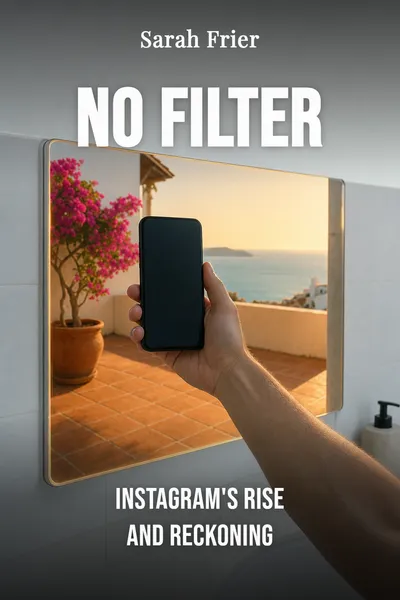
No Filter
Instagram's rise and reckoning
Description
In October 2010, a small photo app called Instagram appeared in Apple's App Store. Two co-founders, Kevin Systrom and Mike Krieger, had built it in a few weeks by stripping down a clunkier check-in app until only one thing remained: you took a picture, ran it through a filter, and shared it. Within twenty-four hours, twenty-five thousand people had signed up. Within two months, a million. Neither founder had planned for that. They spent the early days just trying to keep the servers from falling over.
Sarah Frier, a Bloomberg reporter who covered the company for years, tells that story in No Filter — but she's after something bigger than a startup fairy tale. Her book traces how a twelve-employee company sold to Facebook for around a billion dollars in 2012, then kept growing until it reshaped what a photograph is for. Along the way, the thing Systrom built to be tasteful and calm became the engine of the influencer economy, the reference point for a generation's sense of beauty, and, eventually, a subject of congressional concern about teenage mental health.
Frier had unusual access — the founders, early employees, executives, the influencers who got rich, and the ones Instagram quietly left behind. What she assembles isn't a takedown and isn't a valentine. It's the account of how good intentions, a great product, and an owner with different priorities collided, and who paid for the collision. The app that promised no filter turned out to filter almost everything.
The question we’re asking : How did a small app built for beautiful photos end up remaking self-expression, wealth, and the way we compare ourselves to strangers?What we’ll see : Frier's reporting on the people who made Instagram, the deal that swallowed it, and the culture it left in its wake.
Table of contents
01Chapter 1 — Two founders and a filter
Kevin Systrom didn't come from the usual coder mold. Frier draws him as a Stanford graduate with a taste for design, whiskey, and good coffee — someone who cared how things looked and felt more than how clever the engineering was underneath. He'd bounced through Google and a startup, learned to code at night, and built a location app called Burbn that did too many things at once. When he and Mike Krieger, a soft-spoken Brazilian engineer, sat down to figure out what people actually used, the answer was narrow: they posted photos. So the two of them cut everything else away.
The filters were the trick, and Frier is good on why. Phone cameras in 2010 were mediocre, and the pictures they produced were flat and gray. A filter didn't just add a mood — it hid the flaws, made an ordinary lunch look like something worth sharing. Systrom built the first one, X-Pro II, himself. The app made anyone feel like they had an eye. That flattery, more than any feature, is what Frier identifies as the seed of everything that followed.

02Chapter 2 — The Facebook deal that changed everything
In April 2012, when Instagram had thirteen employees and no revenue, Mark Zuckerberg bought it for roughly a billion dollars. Frier reconstructs the negotiation as a mix of flattery and threat: Zuckerberg admired the app, and he feared it. Facebook had been slow on mobile and slow on photos, the two things Instagram did best. Buying the company was cheaper than being beaten by it. Systrom, worried about competing against a giant, took the deal — with a promise that Instagram would keep running independently.
For a few years, that promise mostly held, and Frier shows Instagram thriving inside Facebook while retaining its own culture. The team stayed small, protective of the product's simplicity, resistant to cramming it with features. Systrom kept his hand on the aesthetic. Under Facebook's resources the user base exploded, passing a billion accounts. From the outside it looked like the rare acquisition that didn't ruin the thing it bought.
03Chapter 3 — The influencer economy Instagram built
Frier devotes some of her sharpest chapters to a business Instagram never set out to create. The founders had imagined a home for artful photography. What emerged instead was a marketplace, where a well-composed feed and a big following could be converted directly into money. She traces the rise of the influencer as an economic category — ordinary people who built audiences around travel, fitness, beauty, or parenting, and then sold access to those audiences to brands.
The mechanics are unglamorous once she lays them bare. A photo of a smoothie or a hotel room is really an ad, and the whole apparatus of sponsored posts, affiliate links, and undisclosed partnerships grew up faster than any rules could catch it. Frier follows individual creators through the grind: the pressure to post constantly, the anxiety of a flat week, the way a shift in the algorithm could erase a livelihood overnight. The freedom of being your own media company came bundled with a boss who never explained the rules.
04Chapter 4 — What a photo app did to the self
Step back from the deal and the influencers, and Frier's real subject comes into focus: what Instagram did to the people using it. A product designed to make ordinary moments look beautiful also taught a generation to measure their own lives against an endless stream of edited ones. The comparison is constant and largely invisible — you don't feel a study being run on you, you just feel a little worse after scrolling, without quite knowing why.
Frier reports on the internal reckoning too. She recounts research, including work later surfaced by whistleblower disclosures, suggesting that Instagram made body-image issues worse for a meaningful share of teenage girls, and that the company understood this from its own studies. The cruelty of the platform's design, she argues, isn't that it's ugly — it's that it's beautiful. The polish is the problem. A feed of flawless faces and enviable trips is a machine for producing quiet inadequacy, and it works precisely because nothing about it looks like a machine.
05Conclusion
Systrom and Krieger walked out of the company in 2018, and Frier ends close to where the reckoning began: two founders who built something they were proud of, watched it grow beyond their control, and left when they could no longer shape it. The app outlived their departure and kept expanding, still the reference point for how billions of people show their lives to one another. The filters they invented to flatter a bad phone camera long ago stopped being the point. The editing had moved inward.
Related books