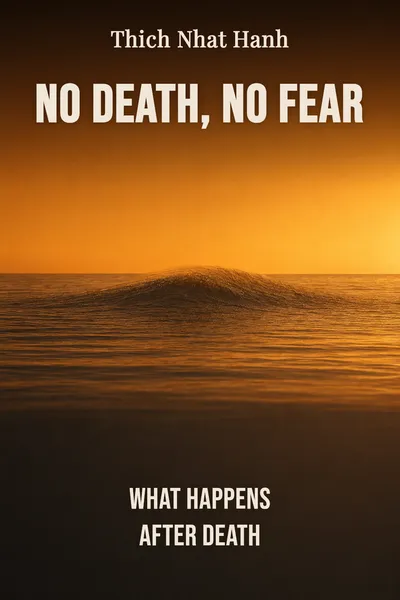
No Death, No Fear
What happens after death
Description
The Zen teacher Thich Nhat Hanh spent much of his long life sitting with people who were dying, and with people who had just lost someone. He was born in central Vietnam in 1926, ordained as a monk at sixteen, and lived through a war that killed many of his students and friends. Exile followed. He would not be allowed to return home for nearly four decades. A man who has watched that much death, we might expect, would have something bracing to say about it. What he wrote instead, in a slim book called No Death, No Fear, is almost tender.
His claim is startling in its plainness. Our fear of death, he argues, is built on a misunderstanding — the belief that we came from nothing at birth and will become nothing when we die. Between those two nothings, we imagine, sits a separate self that can be lost. Take that picture apart carefully, he says, and the fear it generates loses its grip. Not through willpower, and not through faith in an afterlife, but through looking closely at what is actually in front of us: a cloud, a wave, a sheet of paper, the face of someone we have loved and think we can no longer find.
The book belongs to a tradition twenty-five centuries old, but Thich Nhat Hanh refuses the tone of the sage on the mountain. He writes the way he taught — slowly, with concrete images, circling back. Death here is not a problem to be solved with an argument. It is a habit of perception to be gently undone.
The question we’re asking : If our terror of dying rests on how we picture ourselves, what would it take to see clearly enough to stop being afraid?What we’ll see : How a Zen teacher takes apart the fear of death, image by patient image, and offers something other than consolation.
Table of contents
01 Chapter 1 — The fear underneath every other fear
Thich Nhat Hanh starts where most of us actually live, not with metaphysics but with dread. Somewhere beneath the ordinary anxieties — money, health, whether we are loved — sits a deeper one, the fear that one day we will simply stop existing. He calls it the fear of nothingness, of annihilation, and he thinks it quietly organizes a great deal of how we behave. We accumulate, we cling, we try to leave a mark, all of it a way of arguing against the void we imagine is coming.
The trouble, he says, is the picture we hold of ourselves. We believe there was a moment, at birth, when we passed from non-being into being. And we believe there will be a symmetrical moment, at death, when we pass back from being into non-being. On one side, nothing; on the other, nothing; in between, a little island of self, precarious and alone. It is this island that fears the water on both sides.

02 Chapter 2 — A cloud never dies
The image he returns to most often is a cloud. A cloud floats across the sky and then, one afternoon, it is gone. We might say the cloud has died. But nothing has been lost. The cloud has become rain, and the rain has become a river, and the river has become the tea in the cup we are drinking. Look into the tea, Thich Nhat Hanh says, and we can see the cloud. It did not pass into nothingness. It changed form. There was never a moment when the cloud was nothing at all.
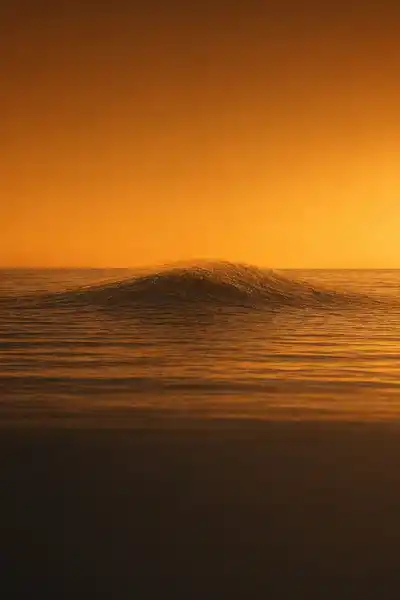
From the cloud he moves to the wave. A wave rises, crests, and falls back into the sea, and we might mourn its ending. But the wave was never separate from the water. It was always water taking a particular shape for a while. When the shape dissolves, the water is not diminished by a drop. If the wave could understand that it is water, he writes, it would lose its fear of no longer being a wave. The rising and the falling would still happen, but they would no longer feel like birth and death.
03 Chapter 3 — Signlessness, or how to look for a loved one
The hardest case is not our own death but someone else's. Here the images could feel cold, and Thich Nhat Hanh knows it. He tells of a woman grieving her mother, unable to bear that she is gone. His counsel is strange and gentle at once: her mother has not gone anywhere. She has only changed the form in which she is present. The daughter carries her mother in every cell, in the way she walks, in the shape of her hands. To look for the mother in the old form is to miss her in all the new ones.
He gives this a name — signlessness. A sign is the particular form by which we recognize something: a face, a voice, a body of a certain age. When that sign disappears, we conclude the thing itself has disappeared. But the sign was only ever one manifestation. He tells of burning incense and watching the smoke: when the visible smoke fades, the incense has not vanished into nothing, it has dispersed into the air we breathe. Our loved ones are like that, diffused rather than deleted, present in forms we have not yet learned to recognize.
04 Chapter 4 — When there is no going and no coming
Step back from the individual images and a single quiet claim holds the whole book together. Our fear of death, Thich Nhat Hanh argues, is really a fear generated by a wrong idea of the self — the idea that we are a separate, bounded thing that appeared once and will one day be erased. Nearly everything he offers is an attempt to loosen that idea, not by denying that we exist, but by showing that we exist far more widely and continuously than we assumed. What we call a self is a river, not a stone.
This is why he insists the book is not offering consolation in the usual sense. Consolation soothes a fear while leaving its cause intact. He wants to remove the cause. If there is no separate self that came from nothing, then there is nothing to be annihilated, and the terror has no object. The freedom he describes is not the comfort of believing we will survive. It is the stranger relief of noticing that the question of surviving was framed wrongly from the start — that there is, as he puts it, no going and no coming, only continuation.
05 Conclusion
Thich Nhat Hanh died in 2022 — a report he would have corrected. He would have said he had not gone anywhere, that he was continuing in his students, his books, the trees at the monastery he founded, the breath of anyone practicing what he taught. It is easy to read that as a comforting turn of phrase. The book's whole labor is to make us take it literally: to look at the cloud in the tea, the smoke in the air, the mother in the daughter's hands, until continuation stops being a metaphor and becomes what we actually see.
Related books