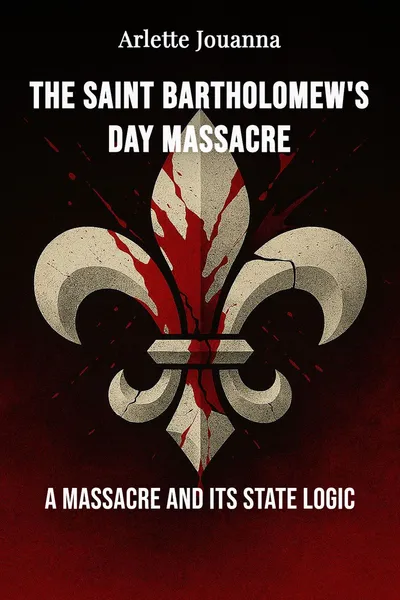
The Saint Bartholomew's Day Massacre
A massacre and its state logic
Description
On the morning of August 24, 1572, Paris woke to the sound of bells and the sight of bodies in the Seine. Six days earlier the city had been celebrating: Marguerite de Valois, sister of the young King Charles IX, had married Henri de Navarre, a Protestant prince, in front of Notre-Dame. The match was supposed to seal a fragile peace between Catholics and Huguenots after a decade of civil war. The most prominent Protestant nobles of the kingdom had come to the capital for the wedding. Within a week, most of them were dead.
The killing spread outward from a handful of aristocratic targets into a citywide slaughter, then rippled across France to Rouen, Lyon, Bordeaux, Toulouse. The death toll has never been fixed with certainty — estimates range from a few thousand to more than ten thousand across the kingdom. For centuries the event was read through the lens of legend: a cold-blooded plot hatched years in advance, an Italian queen mother pulling the strings, a Church blessing the blood. The historian Arlette Jouanna spent her career taking that story apart.
Her reconstruction refuses the tidy plot. It follows instead a chain of hurried, frightened decisions taken over a few days by a court that felt itself cornered — and it asks a harder question than 'who is guilty.' It asks what kind of power allows a king to order the deaths of his own subjects, outside any court, and still call itself legitimate. The answer sits at the awkward birth of the modern state.
The question we’re asking : How did a royal wedding meant to end a civil war become the order to kill, and what did that order reveal about the power giving it?What we’ll see : We follow the days that turned a peace celebration into a slaughter, and end on the quarrel historians still have over what it means.
Table of contents
01Chapter 1 — A wedding, and then a shot in the street
France in 1572 had already lived through three religious wars. The Peace of Saint-Germain, signed in 1570, had granted the Huguenots limited worship and a few fortified towns, and it had brought their leader, Admiral Gaspard de Coligny, back into the royal council. Coligny had the ear of the twenty-two-year-old Charles IX, and he was pushing the crown toward war with Catholic Spain in the Netherlands — a project the king's mother, Catherine de' Medici, and much of the council regarded as reckless. The wedding of Marguerite and Henri de Navarre was the peace made flesh: a Catholic princess and a Protestant prince, joined to knit the two Frances together.
But the celebration gathered enemies in one place. The Guise family, the great Catholic clan, blamed Coligny for the assassination of their patriarch years earlier and had never forgiven him. Paris itself was fiercely Catholic, sullen at the sight of heretic lords parading through its streets, its preachers denouncing the marriage as an offense to God. The city was armed, tense, and easily inflamed.

02Chapter 2 — The night the council decided
What happened in the Louvre on the night of August 23 to 24 is the hinge of the whole affair, and it is precisely where the sources thin out. There was no minute-taker in the room. What survives are later accounts, memoirs written by people with reasons to shift the blame. Jouanna reads them against each other rather than trusting any one, and the picture that emerges is not a plan unfolding but a panic resolving.
The council — Catherine de' Medici, the king, a handful of the most trusted advisers — seems to have concluded that the failed shot had made things catastrophically worse. The Huguenot leaders were now dangerous, mobilized, and unappeasable; an inquiry that pointed at the Guises risked civil war, and one that exonerated them would satisfy no one. Out of that dead end came a brutal calculation: a limited, surgical strike. Kill Coligny and a defined circle of Protestant captains before they could act, decapitate the party, and present the kingdom with a fait accompli.
03Chapter 3 — From a targeted strike to a general killing
The distance between what the council ordered and what Paris did is the second great point of Jouanna's account. A decision to kill perhaps a few dozen named noblemen turned, within hours, into the slaughter of thousands of ordinary Protestants. Understanding how requires looking away from the palace and toward the street.
Paris in 1572 was a city primed for religious violence. Its people had been told for years that heresy was a pollution, a sickness in the body of Christendom that God would punish the whole city for tolerating. When the militia was mobilized and the killing of the Protestant lords began, the signal was read by many Parisians not as a limited royal operation but as a license — the long-awaited permission to cleanse the city. Neighbors turned on neighbors. Houses were marked, doors broken, families dragged out and butchered. The Seine filled with corpses.
04Chapter 4 — Reason of state before the state existed
Strip away the legend and what remains, in Jouanna's reading, is a government that claimed the right to kill its own subjects without trial, in the name of the kingdom's survival. That claim is the massacre's deepest meaning. The council had reasoned that certain men were so dangerous to the state that ordinary law — arrest, charge, judgment — could not contain them, and that the crown could dispose of them by extraordinary act. This is the logic later thinkers would name reason of state: the principle that the preservation of the polity can override the rules that normally bind it.
The trouble is that in 1572 this logic had no accepted place in French political thought. The king was supposed to be the fountain of justice, bound by it, not above it. By ordering deaths outside the law and then owning them publicly, the monarchy exposed a raw and frightening power at the heart of sovereignty — the power to make exceptions to its own legitimacy. The massacre horrified contemporaries not only for its blood but because it showed the crown acting as judge, jury and executioner in one nocturnal decision.
05Conclusion
The bells that woke Paris on August 24 had been rung to launch a killing the council imagined it could keep small and clean. Within hours the order meant for a few dozen men had become a slaughter of thousands, and the wedding staged to end a civil war had reopened one that would drag on for another quarter-century. Charles IX, who claimed the massacre as royal policy to hide that it had escaped him, died less than two years later, reportedly haunted by it. The peace of Saint-Germain was ash.
Related books