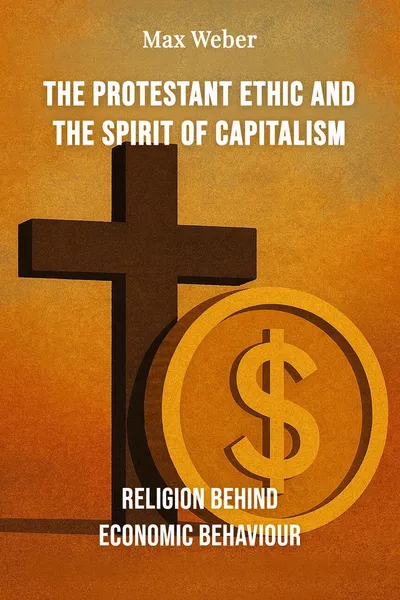
The Protestant Ethic and the Spirit of Capitalism
Religion behind economic behaviour
Description
In the early 1900s, a German sociologist named Max Weber went looking at an odd pattern in the economic records of his region. In the mixed Catholic-and-Protestant areas of Baden, the people who owned the factories, ran the banks, and filled the technical schools were disproportionately Protestant. Catholics, on the whole, stayed in the crafts and the smaller trades. It was the kind of fact that gets noticed and then explained away — richer minorities behave one way, poorer ones another, and religion is just along for the ride. Weber refused the easy version. He suspected the causation ran the other direction: that something inside a particular strand of Protestant belief had shaped how people worked, saved, and thought about money in the first place.
Out of that suspicion came a long essay, published in two parts across 1904 and 1905, with a title that reads like a thesis all by itself: The Protestant Ethic and the Spirit of Capitalism. Weber was not arguing that Protestants invented business, or that religion alone built the modern economy. His claim was stranger and more precise. He wanted to show that the mental habits capitalism runs on — treating work as a duty, reinvesting profit rather than enjoying it, submitting the whole of life to method and discipline — did not arise from greed. They came, at least in part, from people trying to save their souls.
It is a genuinely counterintuitive move. We tend to assume that wanting to get rich is the most natural motive in the world, and that capitalism simply gave it room to run. Weber turns that around. Pure acquisitiveness, he points out, has existed everywhere, in every age, and it never produced anything like the rational, restless, self-denying economic order of the modern West. Something else had to make people work like that.
The question we’re asking : Where did the strange discipline at the heart of modern capitalism actually come from, if not from simple greed?What we’ll see : How a religious idea about work and salvation quietly became the reflex of an entire economic world.
Table of contents
01Chapter 1 — A puzzle in a statistical table
Weber begins not with theology but with numbers, and with a distinction he thinks everyone gets wrong. There is nothing modern, he insists, about the desire for money. Greedy merchants, ruthless moneylenders, and adventurers chasing fortune have existed in ancient Rome, in medieval trade routes, in every society that ever minted a coin. If capitalism were just greed unleashed, it would be as old as human history. What was new in the modern West was something almost opposite in spirit: a disciplined, methodical, almost joyless pursuit of profit as an end in itself, pursued by people who denied themselves the pleasures the money could have bought.
To make the strangeness concrete, Weber reaches for Benjamin Franklin. In Franklin's advice — time is money, credit is money, a penny saved is a penny earned — Weber hears not a con man's cynicism but a genuine moral code. Franklin does not say get rich to enjoy life. He says the honest, industrious accumulation of wealth is a kind of virtue, almost a duty. Idleness is a fault; wasting time is close to sin. This, for Weber, is the "spirit of capitalism" in its purest form: making money treated as an ethical obligation, stripped of any promise of enjoyment at the end.

02Chapter 2 — Calling, work, and the dignity of the everyday
The word is Beruf — vocation, or calling. In older Christian thought, the truly holy life meant withdrawing from the world: the monk, the nun, the priest set apart from ordinary labour. Everyday work — farming, trading, keeping a shop — was at best a spiritual second-best, tolerated but not exalted. Luther, translating the Bible into German, gave the term for one's worldly occupation a new religious weight. Your job, whatever it was, became the place God had set you, the very field in which you were meant to serve. Fulfilling your worldly duties was not a distraction from holiness. It was holiness.
This was already a quiet revolution. It abolished the wall between sacred and profane labour and planted the idea that the tradesman at his counter and the farmer in his field were doing God's work as surely as any monk at prayer. Weber is careful here: Luther himself was traditional in economic matters, suspicious of profit-seeking, no friend of the businessman. On its own, the Lutheran calling did not produce the restless capitalist. But it laid the essential groundwork — the conviction that ordinary work, done diligently, mattered to God.
03Chapter 3 — Calvin, anxiety, and proof by success
That branch is Calvinism, and its engine is the doctrine of predestination. In Calvin's teaching, God has already decided, from before creation, who is saved and who is damned. Nothing you do can change it — no good works, no sacraments, no priestly absolution. And crucially, you cannot know which group you belong to. Weber describes the psychological effect as an "unprecedented inner loneliness." The believer faces eternity utterly alone, cut off from every reassuring ritual the older church had offered, unable to buy comfort with confession or charity.
Such a doctrine is almost unbearable to live under, and human beings, Weber observes, did not leave it alone. Pastors and congregations gradually developed a way to ease the anxiety. If salvation could not be earned, perhaps it could at least be recognised — and the sign of being among the chosen was a life of disciplined, methodical, successful activity in one's calling. Prosperity, achieved through sober hard work, came to be read not as a cause of salvation but as evidence of it. Doubt was itself a temptation to be conquered by ceaseless labour.
04Chapter 4 — The cage that outlived its builders
Here Weber makes his most famous and most bleak turn. The religious impulse that lit the fire did not last. Once ascetic discipline had built its factories, its markets, and its habits of relentless work, the economic order it created no longer needed the faith that produced it. The spirit could evaporate; the structure remained. Baxter had thought the concern for material goods should lie on the shoulders of the saint "like a light cloak, which can be thrown aside at any moment." Fate, Weber writes, decreed instead that the cloak should become a stahlhartes Gehäuse — a shell as hard as steel, rendered in English as the iron cage.
The image is the argument's destination. Modern people are born into an economy that demands the old Protestant virtues — punctuality, industry, thrift, submission to the discipline of work — but demands them without offering any of the meaning that once made them bearable. We work methodically not because we are trying to reassure ourselves about eternity, but because the system simply requires it of anyone who wants to participate. The calling has become a job. The ascetic's self-denial has become the ordinary pressure of earning a living. The theology has drained out; only the compulsion is left.
05Conclusion
Weber had started with a dry statistical fact — Protestants clustered at the top of the economic ladder — and followed it back through Luther's idea of the calling, through Calvin's terrifying God, to the moment when saving one's soul and building one's fortune became, in practice, the same discipline. The connection he drew was never a simple one of cause and effect. He was careful to say religion was one thread among many, and he never claimed Puritans set out to invent capitalism. What he showed was subtler: that the peculiar inner drive modern economic life depends on had a religious birthplace, and that it long outlived its parents.
Related books