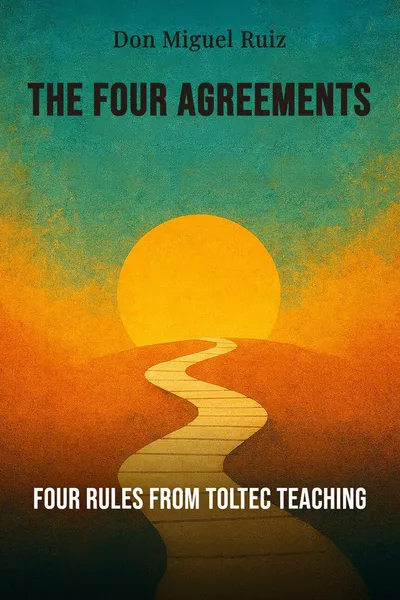
The Four Agreements
Four rules from Toltec teaching
Description
In 1997, a Mexican author named Don Miguel Ruiz published a slim book that almost no publisher expected much from. It ran under 140 pages, cost a few dollars, and drew on what Ruiz called the wisdom of the Toltecs — the people who built Teotihuacan, the vast pyramid city outside what is now Mexico City. Ruiz had trained as a surgeon before a near-fatal car accident in his late twenties turned him back toward the healing tradition his grandmother and mother practiced. The book he wrote out of that turn was called The Four Agreements, and it went on to sell more than ten million copies and sit on the New York Times bestseller list for close to a decade.
The premise is disarmingly simple. Ruiz argues that from the moment we are born, we are handed a set of rules we never chose — by parents, teachers, religion, the whole surrounding culture. We absorb them, agree to them without noticing we are agreeing, and then spend our lives living inside that agreement as if it were reality itself. He calls this the domestication of the human being. Most of our suffering, in his telling, is self-inflicted: we punish ourselves with beliefs we didn't write and judgments we keep repeating.
Against that whole inherited contract, Ruiz proposes four new agreements — four rules a person could choose to live by instead. They sound almost too plain written out. That plainness is the point, and also the trap: the agreements are easy to nod at and genuinely hard to keep. The book is less a philosophy to admire than a daily practice to attempt and fail at and attempt again.
The question we’re asking : What are the four agreements Ruiz proposes, and why does a book this short ask so much of the reader?What we’ll see : How four plainly stated rules work against a lifetime of inherited belief — and what it actually takes to live by them.
Table of contents
01Chapter 1 — The idea that we agreed to all of it
Before the four agreements, Ruiz sets up the problem they are meant to solve, and it's the part of the book people tend to skip toward the practical list. The claim is that everything we believe about ourselves and the world arrived through agreement. As children we had no vocabulary to argue back, so we accepted what we were told — what is good, what is ugly, what we are worth, what is possible. Ruiz borrows a word from animal training and calls it domestication: a system of reward and punishment that teaches us to police ourselves long after the adults have left the room.
The engine that keeps this running, in his account, is the inner Judge and the Victim. The Judge measures every action against the rules we absorbed and finds it wanting. The Victim carries the blame, the shame, the sense of never being enough. Ruiz points out that a human court tries you once for a crime, but the inner Judge retries the same offense thousands of times, year after year. We pay for one mistake endlessly. That repetition, he argues, is where most of our misery actually lives — not in events, but in the stories we rehearse about them.

02Chapter 2 — Impeccable with the word
The first agreement is the one Ruiz calls the most important and the hardest: be impeccable with your word. Impeccable comes from the Latin for without sin, and Ruiz defines sin here as anything we do against ourselves. So the word, for him, is not just speech. It's the force we use to create — to build a relationship or to poison one, to lift a child up or to mark them for life with a single careless sentence. He tells the story of a mother who, exhausted and irritated, tells her small daughter to shut up because her voice is ugly. The girl believes it, stops singing, and carries the verdict into adulthood. One sentence, decades of silence.
03Chapter 3 — Nothing anyone does is about us
The second agreement is the one readers quote most: don't take anything personally. Ruiz's reasoning is blunt. Whatever anyone says or does to you is a projection of their own reality, their own dream, their own wounds. When someone insults you, they are telling you about the state they're in, not delivering a verified fact about your worth. Even when they praise you, the same holds — they are speaking from their needs and their world. To take it personally, Ruiz says, is to agree to whatever poison they're offering, and then to swallow it as if it were ours.
This sounds like permission to stop caring, but that isn't quite his point. The freedom he's describing is the freedom to stop making other people's opinions the measure of your own stability. If you don't take things personally, an insult can't hook you, and flattery can't inflate you, because neither one changed anything true about you. He connects it back to the inner Judge: much of what we take personally from others simply confirms the verdict we were already carrying. Break that link, and a surprising amount of daily suffering loses its grip.
04Chapter 4 — The gap between assuming and asking, the gap between some and all
The fourth agreement is the one that holds the other three together, and it's the reason the book is a practice rather than a pledge: always do your best. On its own it sounds like a motivational poster. Ruiz means something more specific. Your best is not a fixed level — it changes from moment to moment. Your best when you're healthy and rested is not your best when you're sick, grieving, or exhausted. So the agreement is not do your best always in the sense of maintain peak performance; it's do your best given this moment, whatever this moment holds.
This reframing does two things. It defends against perfectionism, because it rules out the demand that you perform at some imagined maximum regardless of circumstance. And it defends against giving up, because even a low day still has a best available in it. Ruiz ties this directly to the inner Judge from the opening chapters: if you genuinely did your best, the Judge has nothing to retry. You remove the fuel of self-recrimination not by succeeding more but by honestly meeting each day where it is.
05Conclusion
The four agreements are easy to state and that has always been part of their appeal and part of the suspicion around them. Be impeccable with your word. Don't take anything personally. Don't make assumptions. Always do your best. Written in a row they look like something you could absorb in a lunch break and move on. What Ruiz builds around them — the domestication, the inner Judge, the dream of the planet we never agreed to on purpose — is the case for why four simple rules might be worth a lifetime of attention rather than an afternoon's.
Related books