

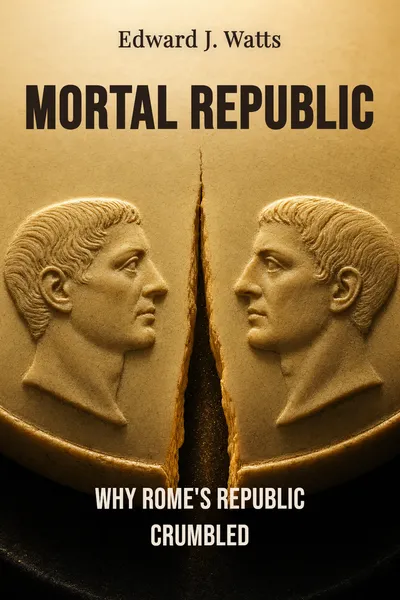
Mortal Republic
Why Rome's Republic crumbled
Description
For roughly four centuries, the Roman Republic worked. Not perfectly, not fairly by any modern measure, but it worked in the way its designers wanted it to: no single man could seize permanent power. Two consuls shared the top office and each could veto the other. Terms lasted a year. A dense web of assemblies, magistrates and unwritten customs made ambition expensive and cooperation cheap. The system had beaten Carthage, absorbed Greece, and outlasted kings across the Mediterranean. Romans of the second century BC could reasonably assume their republic was, if not eternal, at least sturdy.
And then, over roughly a hundred years, it came apart. Not in a single coup, not through invasion, but through a long series of decisions made by Romans themselves — senators who bent a rule to win an argument, tribunes who broke a custom to pass a law, generals who discovered that soldiers loyal to a paymaster were worth more than soldiers loyal to the state. By 27 BC the machinery still existed on paper, but Augustus held the real power, and the republic was a memory dressed up as a constitution. The historian Edward J. Watts, in Mortal Republic, tracks how a system engineered to prevent tyranny ended up producing one.
Watts's interest is not in the villains we already know. It's in the ordinary erosion that made the villains possible — the moment-by-moment choices that, taken one at a time, looked survivable, and taken together, were fatal. Rome did not fall because it was attacked. It fell because Romans stopped protecting the norms that held their politics together, and each transgression made the next one easier.
The question we’re asking : How does a political system built specifically to stop any one man from taking over end up handing itself to a single ruler?What we’ll see : A century of Roman decisions, from a broken land reform to civil wars fought by private armies, and the slow logic by which a republic talks itself into its own ending.
Table of contents
01Chapter 1 — A republic built to distrust one man
The Roman Republic was, above almost everything else, a machine for preventing kingship. The Romans had expelled their last king in the late sixth century BC, and the trauma of that experience shaped the entire design that followed. Power at the top was split between two consuls who governed jointly and could cancel each other out. Every office had a fixed term, usually a single year, so that authority was always temporary and always about to change hands. Ambition existed, but it was channelled into a race for offices held briefly and then surrendered.
What held the system together, though, was not really the written rules. It was a thick layer of custom — the mos maiorum, the way of the ancestors — that told Romans how a senator should behave, when to defer, which lines you simply did not cross even when the law technically let you. Watts is insistent on this point. The republic ran on norms more than on statutes. A consul could theoretically do many aggressive things; what stopped him was the shared understanding that a man who did them would be disgraced, isolated, and finished politically.

02Chapter 2 — The wealth that broke the rules
The first cracks were economic, and they came from success. Rome's conquests poured wealth, land and slaves into Italy on a scale the old order had never anticipated. The rich grew spectacularly richer, buying up land and working it with enslaved captives. Meanwhile the ordinary citizen-farmers who had filled the legions found themselves squeezed off their plots, drifting toward a city that could not absorb them. The republic's prosperity was hollowing out the class of people it depended on.
In 133 BC a tribune named Tiberius Gracchus tried to fix this with a land reform that would redistribute public land to poorer citizens. The proposal was popular and, Watts argues, not especially radical in its content. What made it explosive was how Gracchus pushed it through. When a fellow tribune vetoed the bill, Gracchus had him removed from office — a move the letter of the law arguably permitted but the customs of the republic did not. He had broken a norm to get his way.
03Chapter 3 — When violence became a political tool
Once political killing was on the table, it did not stay contained. Over the following decades, what had been shocking became routine, then structural. Watts charts how Roman politics acquired a grim new grammar in which force was simply another instrument, deployed by ambitious men who found the courts and assemblies too slow. The murder of the Gracchi had opened a door, and a series of larger figures walked through it with progressively larger armies.
The decisive change was in the army itself. The general Gaius Marius, confronting a shortage of eligible recruits, opened the legions to the landless poor. It solved an immediate problem and created a permanent one. These soldiers had no farms to return to; their futures depended entirely on their commander delivering land and plunder. For the first time, legions were loyal to a man rather than to the republic. A general who could promise his veterans a reward now commanded a private force that happened to wear Roman uniforms.
04Chapter 4 — What a self-inflicted death looks like
The deeper claim in Mortal Republic is about how political systems actually die, and it cuts against the way we usually tell these stories. Rome was not overwhelmed from outside. No superior enemy toppled it; at the moment its republic collapsed, it was the dominant power in the known world. The threat was entirely internal. The republic was dismantled, piece by piece, by the very people who benefited from it and claimed to be defending it. Watts's word — mortal — is the point. The republic could die, and it died by its own hand.
What makes the story unsettling is that almost no individual step required a monster. Each transgression was committed by someone who believed their cause justified the exception, who could point to an opponent's earlier breach as license for their own. A norm ignored to win one fight became a precedent available in the next. The cumulative effect was a slow redefinition of what counted as acceptable, until behaviour that would have ended a career in 150 BC was ordinary politics by 50 BC. No single choice looked like the death of the republic. Together they were exactly that.
05Conclusion
By 27 BC the offices of the republic were all still there. Consuls were elected, the Senate convened, the assemblies passed their motions. But Augustus held the armies and the money, and the forms had become a costume over a monarchy. The system that four centuries of Romans had guarded against the return of a king had produced, through its own decisions, something a king would have envied. Watts closes the arc where it began: a republic engineered to distrust any one man, undone not by conquest but by the accumulated consent of its own citizens.