
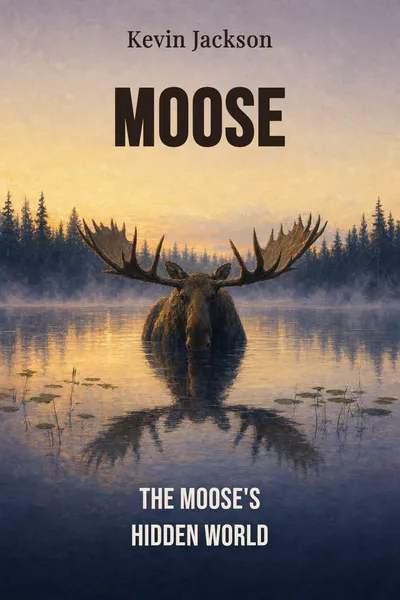
Moose
The moose's hidden world
Description
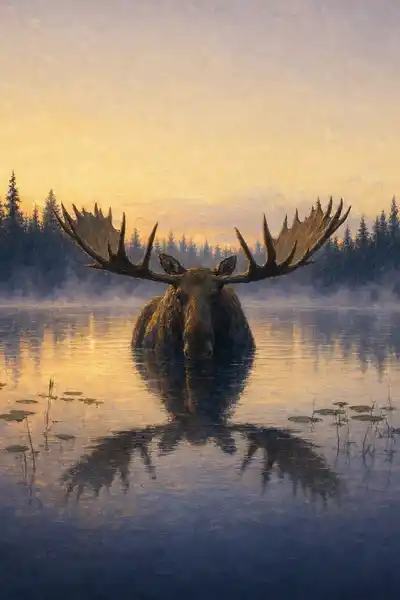
Somewhere in the boreal forest right now, an animal the size of a small horse is standing in a pond up to its shoulders, chewing water plants, and almost nobody is watching. The moose is the largest member of the deer family, a bull can top seven feet at the shoulder and carry antlers spreading nearly six feet across, and yet for an animal that big it is astonishingly good at not being seen. It lives at the edges of where we live — northern Canada, New England, Alaska, Scandinavia, Siberia — in the cold, damp, half-drowned country most people drive past on the way to somewhere else.
The British writer Kevin Jackson spent a book chasing this creature, and what he found is that the moose leads a double life. There is the biological animal, a marvel of adaptation to snow and freezing water. And there is the moose we have built in our heads over thousands of years: the beast whose hooves were once sold as a cure for epilepsy, the meat prized as a delicacy, the silhouette stamped on baseball caps and clothing labels, the cartoon sidekick, the national animal of two countries. The same animal that Julius Caesar wrote about is now the mascot of a Seattle ball club.
Jackson's Moose is a small book about a large subject, and it keeps circling one strange fact: this is a creature almost none of us have met, and almost all of us think we know. It hangs at the intersection of natural history and folklore, science and story, and it turns out the confusion starts with something as basic as its name.
The question we’re asking : How did an animal most people will never see up close become one we feel we recognize on sight?What we’ll see : A wide-ranging natural history that follows the moose out of the northern forests and into human language, empire, politics and cartoon television.
Table of contents
01Chapter 1 — The animal nobody can name
Start with the word, because the word is a mess. In North America the animal is a moose, a name borrowed from the Algonquian languages, roughly meaning something like the one that strips bark. In Europe the very same species, Alces alces, is called an elk. So a European elk and an American moose are the same creature. That would be tidy enough, except that North Americans already gave the word elk to a completely different deer — the one Europeans would call a red deer, and which the Shawnee called wapiti. Two continents, one animal, and the names crossed in the mail.
Jackson unpicks this with obvious relish, because the tangle is genuinely old and genuinely confusing. English-speaking settlers arriving in America met a huge antlered deer and reached for the familiar European word elk, then met an even bigger one and needed a new word entirely, and took moose from the people already living there. The result is that if a Swede tells you they saw an elk and an American tells you they saw an elk, they are describing two different animals — and neither is wrong.

02Chapter 2 — A body built for the cold north
Strip away the folklore and the moose is, above all, a machine for surviving cold, wet, northern country. Its range circles the top of the globe — the forests of Canada and Alaska, New England, Sweden, Norway, Finland, Russia — wherever there is snow, willow, and standing water. Everything about the animal reads as an answer to that environment. The long legs let it wade through deep snow and into ponds. The strange, drooping muzzle is a specialized tool for gripping and stripping vegetation, above the water and below it.
Because a moose is a browser, not a grazer, it does not crop grass like a cow. It eats leaves, twigs, bark and, in summer, huge quantities of aquatic plants, wading and even diving to reach them. An adult can put away tens of kilos of vegetation in a day. The famous dewlap, the flap of skin and hair hanging under the throat — the bell — has no settled explanation, one of those details that keeps naturalists arguing rather than concluding.
03Chapter 3 — From Caesar's forests to the Bull Moose Party
Humans and moose go back a very long way. Stone Age carvings and rock art across the north record the animal as prey, as spirit, as something worth marking on stone. It fed and clothed the peoples of the boreal world for millennia, and its image turns up wherever those people left images. The moose was part of human life long before it was part of human writing.
When it does reach writing, it does so in strange company. Julius Caesar, in his account of the Gallic Wars, describes creatures he calls alces living in the great German forest, and gives them a wonderfully wrong detail: they supposedly had no knee joints and could not lie down, so they slept leaning against trees, and hunters caught them by sawing the trees partway through so the animal would topple and be unable to rise. It is nonsense, but it is old nonsense, and Jackson treats it as a lovely early example of how the moose arrives in our records already wrapped in legend. Later folklore would credit its hooves with curing epilepsy, a belief that kept moose feet in the apothecary trade for centuries.
04Chapter 4 — The creature we keep turning into a symbol
Follow the moose into the present and you find it has become, more than almost any other large animal, a screen for human projection. It fronts the clothing company Abercrombie & Fitch and serves as mascot for the Seattle Mariners baseball team. It gave American children Bullwinkle, the amiable dim-witted moose of The Rocky and Bullwinkle Show, whose gentle stupidity is a cartoon so complete it has almost nothing to do with the real, wary, formidable animal. In Sweden, admirers have set about building a moose statue some 150 feet tall, a giant metal creature you could see from far off — a monument to an animal you almost never see at all.
The gap between those two facts is where Jackson's book quietly lives. The moose is the national animal of Sweden and of Norway, a proud emblem of the northern nations, and it is also a punchline, a logo, a knitted sweater pattern, a highway-sign warning. What holds all these versions together is that almost none of the people who use the symbol have ever stood close to the thing itself. The moose is symbolic precisely because it is remote. We can pour whatever we like into a silhouette we will never have to reconcile with the breathing animal.
05Conclusion
Kevin Jackson set out to write a natural history and ended up writing something closer to a portrait of a misunderstanding — a warm, curious account of an animal we have named wrongly, described fancifully, hunted, eaten, worshipped, cartooned and cast in bronze, all while rarely meeting it face to face. The biological moose, with its wading legs and its annual crop of antlers and its genius for disappearing, turns out to be only half the story. The other half is everything we have hung on it, from Caesar's kneeless beast to the giant Swedish statue rising over the forest.