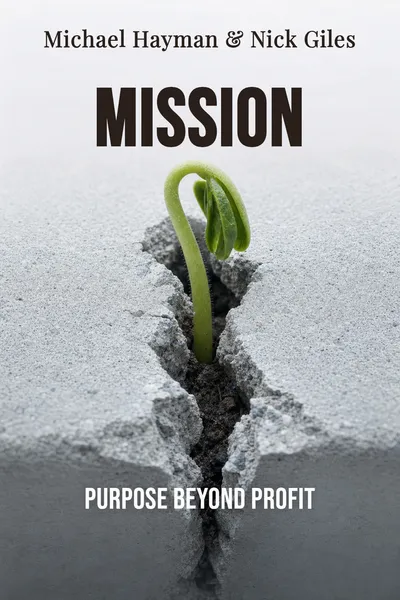
Mission
Purpose beyond profit
Description
There's a specific kind of corporate sentence we've all learned to skip. It hangs in a lobby, etched into glass, promising to "empower" or "transform" or "delight" — and it does nothing, because everyone who walks past it knows it was written by committee to mean as little as possible. Michael Hayman and Nick Giles, two campaigners who spent years building movements and reputations for companies and causes, wrote a book precisely against that sentence. Their argument in Mission is that purpose has quietly stopped being a nice-to-have. It has become the thing that decides which businesses people want to work for, buy from, and believe.
Their case doesn't rest on idealism. It rests on a shift they watched happen: customers who research before they spend, employees who want their week to add up to something, investors who read the culture as closely as the balance sheet. In that world, a company that can only say what it sells is at a disadvantage against one that can say why it bothers. Hayman and Giles interviewed founders, activists and business leaders who had built exactly that — organizations where the mission wasn't decoration but the engine. What emerges is less a theory than a working method.
The temptation, of course, is to treat all this as a branding exercise: find a warm word, put it on the wall, move on. Mission spends most of its pages arguing that this is the fastest way to make purpose worthless. A mission that isn't lived reads as a lie, and a mission that costs nothing convinces no one. So the harder question sits underneath the whole book.
The question we’re asking : Can a company's sense of purpose be something more durable than a slogan — and if so, where does a real one come from?What we’ll see : How Hayman and Giles get from the empty mission statement to a purpose that actually moves people, and what it demands of the people running the show.
Table of contents
01Chapter 1 — The moment purpose stopped being optional
Hayman and Giles open with a change they treat as already settled rather than coming. For most of the twentieth century, the dominant answer to "what is a company for?" was the one Milton Friedman gave in 1970: the business of business is business, and its job is to make money for its owners. It was a clean answer, and for decades it held. The authors don't waste energy attacking it. They simply point out that the ground underneath it has moved.
What moved it, they argue, is transparency and choice. A generation ago, a customer knew a product and a price. Now they can find out where it was made, who made it, how the company treats its people, what it says when nobody polite is listening. That flood of information means a business can no longer control its story by controlling its advertising. The story gets told about it, constantly, by everyone. In that environment, having a genuine reason to exist stops being a marketing luxury and becomes a form of resilience.

02Chapter 2 — Where a real mission actually comes from
Having established that purpose matters, the authors turn to the harder problem, which is that most attempts to manufacture one fail. Their diagnosis is precise. A bad mission statement is written from the outside in — the leadership team asks what sounds impressive, what the market wants to hear, what the competitors are saying. A real mission is dug out from the inside. It already exists, buried in the founding story, the frustration that started the company, the thing the people there actually care about. The job is not invention but excavation.
Hayman and Giles keep returning to authenticity, and they mean something demanding by it. A mission has to be true in the sense that a stranger could watch the company operate for a week and infer it without being told. The examples they gather — from campaigning charities to fast-growing businesses — share this quality: the purpose explains the choices, not the other way around. When a company says it exists to make something accessible and then prices it out of reach, the mission collapses on contact with reality. The test isn't whether the words are inspiring; it's whether they are load-bearing.
03Chapter 3 — The mission has to survive contact with the day job
A mission that lives only in the induction pack is, for Hayman and Giles, worse than none at all, because it teaches everyone that the company's stated values are theatre. So the middle of the book is about the gap between declaring a purpose and running on it — and how the strongest organizations close it. Their recurring point is that purpose has to show up in the unglamorous places: in what gets funded, who gets promoted, which customer gets turned away, what the company refuses to do even when refusing costs money.
They're candid that this is where most purpose initiatives quietly die. It's easy to agree on a mission in a workshop and impossible to feel it in a budget meeting eighteen months later, when a shortcut would boost the numbers and only the mission is standing in the way. The authors argue that these moments — the small, expensive acts of consistency — are where a mission is actually built or lost. A purpose proves itself precisely when honoring it is inconvenient. Every time a company holds the line, the story gets more credible; every time it caves, the erosion is visible to everyone who works there.
04Chapter 4 — Leaders who carry it, and the culture that keeps it
Step back from the mechanics and Mission is finally a book about leadership — because a purpose has no way to enter an organization except through the people who run it. Hayman and Giles are clear that a mission cannot be delegated to a department. The founder or chief executive who won't personally carry it, repeat it, and be seen sacrificing for it, has effectively told the company it doesn't count. The leader's own conviction is the raw material; everything downstream is a transmission of it, and transmission loss is brutal.
What this asks of leaders is more than eloquence. The authors describe qualities that are less about charisma than about consistency: the willingness to say the same thing for years, to make visible decisions that align with the mission even when they hurt, to tell the story so often that it becomes the ambient logic of the place. A mission survives through repetition and example, not through a single memorable launch. The leaders they admire are, in a sense, professional repeaters — patient enough to keep restating the point until the organization internalizes it and starts saying it back.
05Conclusion
Mission returns, in the end, to that empty sentence in the lobby. Hayman and Giles don't want it removed; they want it earned. Their whole method is a way of getting from language that means nothing to a purpose that could be inferred from a company's behavior without anyone reading the wall at all. The mission statement, in their telling, is the visible tip of something that has to run all the way down — into hiring, budgets, the decisions made when no one is watching and the ones made when everyone is.
Related books