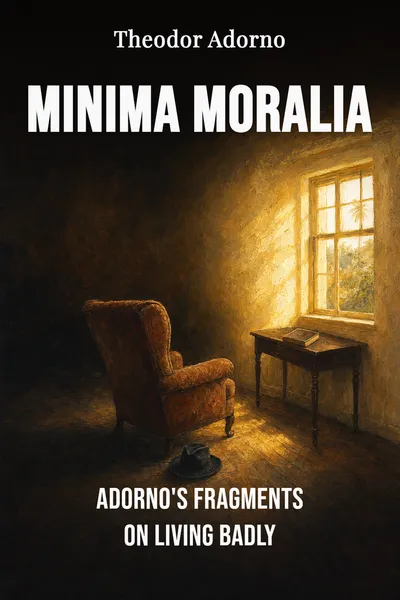
Minima Moralia
Adorno's fragments on living badly
Description
In the early 1940s, a German philosopher named Theodor Adorno was living in exile in Los Angeles, a short drive from the studios of Hollywood, watching a world he understood being remade into a world he barely recognized. He had fled Nazi Germany, lost the language and the streets that had shaped his thinking, and landed in a sunlit America organized around comfort, entertainment and consumption. Between roughly 1944 and 1947 he wrote a strange little book — not a treatise, not a memoir, but a sequence of one hundred and fifty-three numbered fragments, some a paragraph long, some a few pages. He called it Minima Moralia, and gave it a subtitle that told the whole story: Reflections from Damaged Life.
The title is a quiet joke aimed at Aristotle. The Nicomachean Ethics — the great classical account of how to live well, the magna moralia of the good life — assumes there is a good life to be lived. Adorno's counter-proposal is smaller and darker: a minima moralia, the little that can still be said about ethics once the conditions for a decent existence have been pulled out from under it. He dedicated the book to his collaborator Max Horkheimer. It appeared in German in 1951 and slowly became, for many readers, the most personal and the most readable thing he ever wrote.
What makes it unusual is where it looks. Adorno does not start from the state, the market or the factory. He starts from the dinner table, the gift, the way we furnish a room, the tone of a letter, the habit of saying "how are you." He treats the smallest textures of private life as places where a much larger machinery leaves its fingerprints. The book's wager is that if something has gone wrong at the level of the whole, it will show up first, and most honestly, in how we live with each other day to day.
The question we’re asking : How can private life still be lived well when the whole system it sits inside has gone wrong?What we’ll see : How a philosopher in exile turned the smallest habits of everyday life into evidence about the world that shaped them.
Table of contents
01Chapter 1 — A book written from the wreckage
Adorno wrote Minima Moralia in the middle of a catastrophe, and the book never lets us forget it. Europe was at war, the camps were operating, and he was writing in a country that had taken him in but whose culture he found both fascinating and hollow. He had helped found what became known as the Frankfurt School, a circle of thinkers trying to understand why the promise of reason and progress had produced not emancipation but Auschwitz and mass culture. The fragments were his way of thinking about that failure from the inside of his own displaced, comfortable, guilty life.
The form matters as much as the content. Adorno chose the aphorism — short, dense, self-contained — over the systematic argument on purpose. A system, he thought, pretends the world hangs together, that everything can be explained and reconciled. He no longer believed that. A world that had broken so badly could only be described honestly in pieces that refused to add up to a comforting whole. Each fragment circles a small observation and then turns it, often ending on a sentence that reverses what it seemed to be saying.

02Chapter 2 — The house that no longer fits
One of the book's most famous fragments begins with something almost domestic: how are we supposed to live, and where? Adorno looks at the private home, the traditional refuge from the public world, and finds it no longer offers refuge. The old bourgeois interior, with its heavy furniture and its sense of permanence, had become a museum piece, faintly ridiculous. But the new, streamlined living — the functional apartment, the mobile life adapted to work and the market — felt like living in a hotel, a place that belongs to nobody and shapes you to its own convenience.
From this he draws a line that has been quoted ever since: "Wrong life cannot be lived rightly." It is the hinge of the whole book. There is no private corner clean enough to be exempt from a life that is, as a whole, distorted. You cannot furnish your way out of it, cannot retreat into good taste or authentic living, because the taste and the authenticity are themselves products of the same machinery. Even the wish to be at home somewhere becomes suspect, a comfort sold back to you.
03Chapter 3 — Small gestures, large machinery
The engine underneath these observations is a diagnosis Adorno had developed with Horkheimer: that late capitalism does not stop at the workplace. It reaches into leisure, culture, personality, desire — into what they called the culture industry, the mass production of films, songs and entertainment that sell us relaxation while quietly training us to want what we are given. In Minima Moralia this argument comes down from the level of theory and settles onto ordinary life, where it is easier to feel and harder to dismiss.
So he watches how people talk, and hears the machinery in it. Cheerfulness becomes compulsory; the person who is not upbeat is treated as a problem to be fixed. Health itself becomes an ideal so total that it starts to look like a kind of sickness — a body kept fit for a life that offers it nothing worth being fit for. Even psychoanalysis, meant to heal, can become a way of adjusting people to conditions that ought to be resisted. "In psychoanalysis," he writes, "nothing is true except the exaggerations."
04Chapter 4 — Thinking against the current
Step back from the individual fragments and Minima Moralia is asking one hard question: can a person still think and live honestly inside a system that has quietly arranged everything, including the tools they would use to resist it. Adorno's answer is bleak but not hopeless. He does not believe in a pure position outside the wrong life — there is no such place. What he believes in is the effort of thought that keeps naming the wrongness instead of making peace with it.
This is why the broken form is not a stylistic quirk but the argument itself. A finished, systematic book would have implied that the world could be grasped whole and set right, and that was exactly the false promise Adorno distrusted. The fragments stay incomplete on purpose. They model a way of thinking that refuses to round itself off, that keeps the tension open rather than dissolving it into a comfortable conclusion. The reader is left with pieces to hold, not a doctrine to obey.
05Conclusion
Minima Moralia was published in 1951 and made its way slowly into the world, read at first by a small circle and then, decade after decade, by anyone who suspected their own comfort might be hidin
Related books