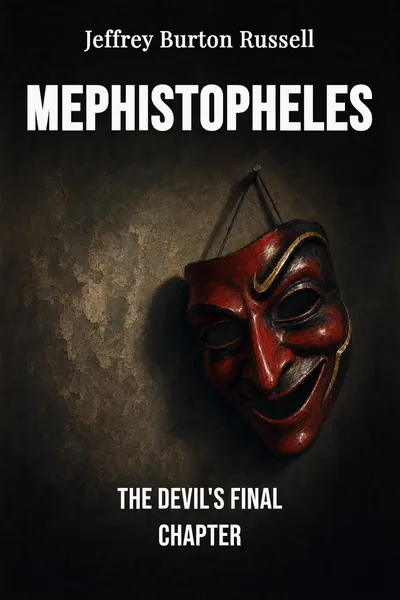
Mephistopheles
The Devil's final chapter
Description
Jeffrey Burton Russell spent the better part of two decades on a single question, and it was not the question most people expect a serious historian to ask. Not whether the Devil exists, but what people have meant, across two thousand years, when they said the word. Between 1977 and 1986 he published four volumes tracking that meaning from its earliest roots through the Middle Ages, and the last of them, Mephistopheles, published in 1986, carries the story into the modern world. The title is borrowed: Mephistopheles is the name the Devil takes in the Faust legend, the tempter who arrives not with horns and fire but with a contract and a conversation.
That choice of name signals what the final volume is really about. Somewhere between the medieval demon and the modern one, the Devil stopped being a beast at the edge of the world and became a figure you could talk to — a personality, an interlocutor, eventually a character in literature. And then, over the eighteenth and nineteenth centuries, educated Europe stopped believing in him at all. Russell's fourth volume is the chapter where the most feared personage in Christian imagination is argued out of existence, or at least out of respectability.
The strange thing is that the disappearance settles nothing. Russell, a medieval historian by training, does not write as a believer trying to win the figure back or a skeptic pleased to be rid of him. He writes as someone convinced that a concept humans held for that long, with that much intensity, was doing real work — and that watching it fade tells us something about ourselves that the belief itself once concealed.
The question we’re asking : What happens to the idea of the Devil when a civilization stops believing in him?What we’ll see : How the most famous villain in Western thought turned into a character, then a joke, then an absence that still has a shape.
Table of contents
01Chapter 1 — The problem a historian set himself
Russell's project rests on a distinction he keeps insisting on. He is not writing the biography of a being. He is writing the history of a concept — what he calls the tradition of the Devil, the accumulated attempt of Western culture to give a face and a name to the experience of evil that seems to exceed any single wrongdoer. His method treats theology, folklore, sermons, paintings and poems as evidence of the same thing: what people at a given moment could imagine when they tried to picture malice itself.
By the time the fourth volume opens, three earlier books have done the heavy lifting. The first traced the roots of the figure in the ancient Near East and early Christianity; the second followed him through the patristic centuries; the third, titled Lucifer, covered the Middle Ages, where the Devil reached his fullest and most coherent form. The medieval Devil was a serious theological problem — a fallen angel whose existence had to be squared with an all-good, all-powerful God, the puzzle philosophers call theodicy.

02Chapter 2 — When the Devil became a character
The hinge of the whole volume is the Faust legend, and Russell spends much of the book tracing how a folk story about a magician who sells his soul became the vehicle through which the modern West did its thinking about evil. The historical Faust was a minor German charlatan of the early sixteenth century. The legend attached to him almost immediately, and by 1587 an anonymous German chapbook had fixed the essential story: a scholar, hungry for knowledge and pleasure, signs a pact with a demon named Mephistopheles.
That demon is a new kind of Devil. He does not roar. He negotiates. Christopher Marlowe, writing his Doctor Faustus around 1592, gave Mephistopheles lines that still unsettle — a fallen spirit who describes hell not as a place but as a condition, the state of being cut off from God, which he carries with him wherever he goes. Russell reads this as a decisive shift. The Devil has become interior. He is less a monster outside the walls than a presence inside the human situation, a mirror for the ambition and despair of the man who summons him.
03Chapter 3 — The Enlightenment tried to laugh him off
Alongside the literary Devil, Russell tracks a second story: the deliberate campaign to be rid of him. The Enlightenment did not argue the Devil out of existence with a single decisive proof. It did something more corrosive — it made him embarrassing. To the philosophers of the eighteenth century, belief in a personal Devil belonged with witch trials and superstition, the residue of a credulous age that reason was meant to leave behind. Voltaire and his contemporaries treated the figure as a joke, and a joke is harder to answer than an argument.
The witch persecutions gave the skeptics their strongest case. For roughly two centuries, from the late fifteenth into the seventeenth, tens of thousands of people, overwhelmingly women, were executed across Europe on charges of consorting with the Devil. Russell, who had studied the subject closely, does not treat this as proof that the concept was harmless. He treats it as the moment the tradition turned lethal — the point where a way of imagining evil became a machine for producing it. The revulsion that followed was, in part, revulsion at what belief in the Devil had licensed.
04Chapter 4 — What a vanished belief still explains
Stepping back, the four volumes together make an argument larger than any of their episodes. Russell's real subject is not a demon but the West's long effort to think about radical evil — the kind that resists being explained away as ignorance, poverty or damaged psychology. The Devil, across two thousand years, was the name that effort wore. To watch the name fade is to watch a civilization decide it no longer needs a vocabulary for a certain kind of horror, and Russell is not convinced the decision was earned.
The test case that shadows the whole book is the twentieth century. Russell wrote in the aftermath of the death camps and the century's industrialized slaughter, and he keeps returning to the question they pose. If evil is only the sum of understandable causes, then Auschwitz is a very complicated accident. The concept of the Devil, whatever its metaphysical status, at least held open the possibility that some acts are evil in a way no explanation dissolves — that malice can be chosen for its own sake. Modern thought, having dropped the figure, has struggled to say this clearly.
05Conclusion
Mephistopheles closes a study that runs from the deserts of the ancient Near East to the concentration camps of the twentieth century, and it closes without tidiness. Russell brings the Devil to the edge of the modern world, watches him become a literary character and then a discarded superstition, and declines to pronounce him either real or safely gone. The figure who began the series as a coherent theological problem ends it as an absence with a distinct outline — the space left where a name used to be.
Related books