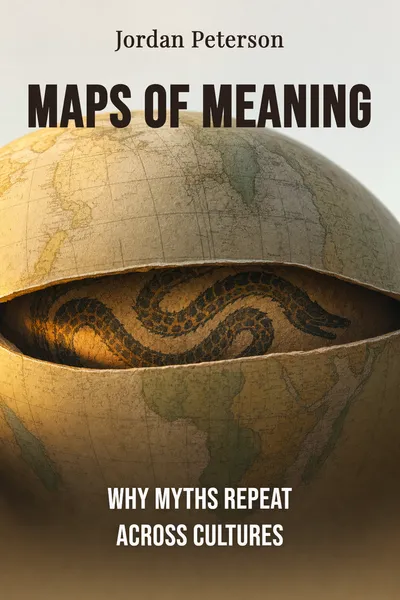
Maps of Meaning
Why myths repeat across cultures
Description
In the early 1990s, a young Canadian psychologist named Jordan Peterson was teaching at Harvard and worrying, more or less full-time, about the Cold War. He wanted to understand how ordinary people had been willing to defend systems capable of ending the world — how a person could become the kind of guard who works a death camp by day and goes home to his family by night. That question sent him somewhere unexpected: not into political science, but into ancient stories. Flood myths, dying gods, hero legends, creation accounts. He noticed they kept telling the same tale.
The book that came out of that decade of reading, Maps of Meaning, appeared in 1999. It is a strange, dense object — part neuropsychology, part comparative mythology, part reading of Jung and Freud and Nietzsche, stitched together with diagrams. The claim underneath all of it is simple to state and hard to swallow: the myths of unrelated cultures resemble each other because the human brain is built the same way everywhere, and those stories are not primitive science that we've outgrown. They are maps of how to act in a world we can never fully understand.
That is a large bet, and it runs against a comfortable modern assumption — that myth is charming, obsolete, the thing rational people replaced with facts. Peterson wants to argue the reverse: that we still navigate by these maps whether we admit it or not, and that pretending otherwise leaves us exposed to something worse. The book is his attempt to make the old stories legible to a mind trained to distrust them.
The question we’re asking : Why have people separated by oceans and centuries told stories with the same shape — and what does that resemblance say about the mind?What we’ll see : How Peterson reads the recurring myth, where he grounds it in the brain, and why he thinks losing these maps is dangerous rather than freeing.
Table of contents
01 Chapter 1 — The flood was always coming
Start with the pattern that unsettled Peterson in the first place. Cultures with no contact — Mesopotamian, biblical, Hindu, Mesoamerican, Greek — tell versions of the same catastrophe. A stable world becomes corrupt. Order dissolves into water, chaos, deluge. Something is lost, and out of the ruin a new order is rebuilt by whoever survived the flood and prepared for it. The Gilgamesh flood, Noah's ark, the Hindu Manu warned by a fish: they are not borrowed from one another. They are, Peterson argues, independent answers to the same problem.
The problem is that reality has a permanent structure, and the story is a compression of it. There is the known — the explored, mapped, familiar territory where things behave as expected. There is the unknown — everything outside that circle, the unexplored, the anomalous, the thing that appears when your plans fail. And there is the process that mediates between them, the part of us that ventures into the unknown and turns it into new known. Peterson calls these the three permanent constituents of experience. Every culture faces them, so every culture ends up narrating them.

02 Chapter 2 — What the brain actually maps
The bolder half of the argument is that this narrative structure is not a cultural invention layered over a neutral brain. It reflects how the nervous system is organized. Peterson leans on the neuropsychology of his era — work on how the brain handles the expected versus the unexpected, and how the two hemispheres divide that labor. One system, he argues, operates within the known: it runs routines, executes plans, treats the world as predictable. The other activates when something violates expectation, when the map fails and the unexpected intrudes.
That second system is the interesting one. When a plan fails — when reality does not deliver what you predicted — the brain does not respond with cool recalculation. It responds first with emotion: anxiety, arousal, a whole-body alarm. The unexpected is not experienced as neutral information. It is experienced as threat and possibility at once, exactly the way myth portrays the unknown: as something monstrous and generative, a dragon that might eat you or might be sitting on the gold. Peterson's claim is that the emotional coloring came first, and the stories are faithful transcriptions of it.
03 Chapter 3 — The dragon and the treasure
If chaos is the flood, the individual response to chaos is the hero. This is where Peterson lets Jung do heavy lifting. Across mythologies the same figure keeps appearing: the one who leaves the safety of the community, goes out to confront the monster in the wilderness, and comes back carrying something valuable — the treasure, the elixir, the rescued maiden, the boon that renews the kingdom. The dragon guards gold. The two go together for a reason.
The reason, in Peterson's reading, is that the unknown is where value comes from. Everything worth having lies outside the current map — new knowledge, new competence, the thing you don't yet possess. But the unknown is also where danger lives, precisely because it is unmapped. So the treasure and the dragon occupy the same territory, and you cannot reach one without facing the other. The hero myth is the culture's way of saying: the thing you need is guarded by the thing you fear, and the only route to it runs through voluntary confrontation.
04 Chapter 4 — Belief as a lived map, not a set of facts
Step back from the machinery and the wager becomes clear. If myths are the brain's maps for acting in an unknowable world, then belief is not fundamentally about propositions — about whether a flood literally happened or a god literally rose. Belief, for Peterson, is a way of inhabiting the world, a stance toward chaos and order that tells you how to move. The modern habit of judging a myth true or false the way we judge a weather report misses what the myth was ever for. It was never a claim about matter. It was a claim about how to live.
This is why he treats the loss of these maps as dangerous rather than as progress. A person still needs to know what to approach and what to avoid, what is worth sacrificing for, what to do when the flood comes. Strip away the inherited stories and that need does not vanish; it goes looking for a replacement. Peterson's Cold War preoccupation surfaces here: the twentieth century's ideologies, he argues, were maps of meaning too — total, rigid, promising to abolish chaos entirely. They filled the space the old myths had held, and they filled it far worse, because a map that admits no unknown becomes a machine for destroying whatever doesn't fit.
05 Conclusion
Peterson began with a guard at a death camp and ended with a theory of why the oldest stories still hold. The route between them was the recurring myth — the flood, the dragon, the hero who goes out and comes back changed — and the claim that these patterns repeat because the brain that produces them is everywhere the same, facing everywhere the same split between the safe-known and the dangerous-unknown. The stories are not outgrown science. They are compressed instructions for living where knowledge runs out.
Related books