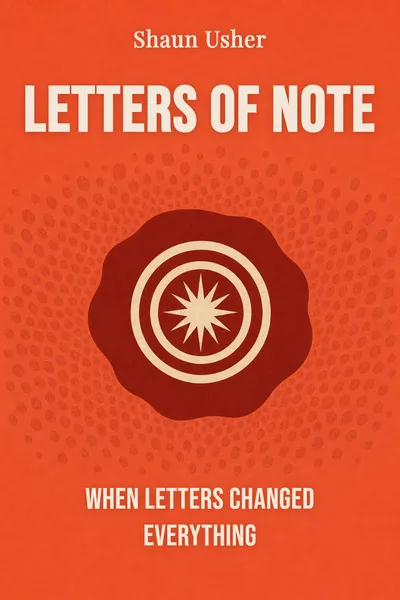
Letters of Note
When letters changed everything
Description
In 2009, a copywriter in Manchester named Shaun Usher started a blog. The idea was almost embarrassingly modest: post interesting old letters, one at a time, with a scan of the original and a clean transcription underneath. He called it Letters of Note. He wasn't a historian or an archivist, just someone who liked correspondence and thought a few other people might too. Within a couple of years the site had drawn tens of millions of visitors — by the time the book arrived, the running tally was somewhere north of seventy million — and Usher had accidentally built one of the most-visited archives of private writing on the internet.
The book that followed in 2013 gathered a hundred and twenty-five of these letters into a single, beautifully produced volume. Some are from famous names — Elizabeth Taylor, Kurt Vonnegut, a nine-year-old who wrote to a president. Many are from people no history book would ever mention. What they share isn't importance in the usual sense. It's that each one, on the day it was written, mattered enormously to at least two people: the person who wrote it and the person who opened it.
That's the quiet argument running under the whole collection. A letter is a private object that occasionally becomes a public one, and the moment it crosses that line, it stops being a transaction and starts being evidence — of a mood, a marriage, a crisis, a joke. Usher's talent was noticing that the most ordinary of these objects could hold more than the grandest official document.
The question we’re asking : Why does a scanned personal letter hold us the way a headline or a history book rarely does?What we’ll see : How one man's blog turned private correspondence into a form of public attention, and what that reveals about the letters we keep.
Table of contents
01Chapter 1 — A blog, then a book, then a stage
Shaun Usher was working in advertising when he set the site up. The format never changed much, and that was the point. Each post presented a single letter — the writer, the recipient, a line or two of context from Usher, then the image of the original page and the full text typed out beneath. No think-pieces, no ranking, no clickbait framing. The letter did the work; Usher mostly got out of its way. It read less like a magazine and more like someone handing you a document across a table and saying, look at this.
The traffic came faster than he expected. Some letters travelled on their own — shared, screenshotted, reposted — and pulled the site into the millions. The appetite was there in a way that surprised even him, because on paper the premise sounds like it belongs to another century. People who spend their days on messaging apps and disappearing photos turned out to be hungry for the slow, deliberate, physical act that all of it had replaced. There was something almost counterintuitive about it: the more instant our own writing became, the more we seemed to crave the evidence of writing that had taken time.

02Chapter 2 — The letters people didn't expect
The range is the first thing that strikes a reader. There's a letter from a Confederate-era ex-slave, Jourdan Anderson, replying with devastating politeness to his former master's request that he return to work. There's Iggy Pop writing a long, generous, genuinely kind reply to a young French fan who had poured out her troubles to him. There's a woman named Emma Hauck, committed to a psychiatric clinic, filling pages with the same phrase to her husband over and over — letters that were never sent, and read now as something close to unbearable.
Some are funny in a way that cuts through the century between us. Robert Pirosh's 1934 letter to Hollywood studios, opening with a giddy list of the words he loves, is essentially a job application that behaves like a poem — and it worked. A child writes to Nikita Khrushchev; another writes to the head of the FBI. The tone swings from grief to farce sometimes within the same page of the book, and Usher trusts the reader to handle the swing. He never sorts them into moods or warns you what's coming — the whiplash is part of the honesty.
03Chapter 3 — What survives when the medium dies
A letter is a strange object. It's usually written to be read once and, in theory, then discarded. Most correspondence in history has vanished — thrown out, burned, lost in moves, left in drawers that got cleared. What survives is a tiny, accidental sample, kept because someone couldn't bear to throw it away. Every letter in Usher's collection is, in that sense, a survivor twice over: it survived the day it was written, and then it survived the decades that quietly erased almost everything around it.
This is where the book's timing matters. Usher was assembling a museum of a dying practice. By 2013 the personal letter was already a rarity — replaced by email, then by texts, then by messages that delete themselves by design. We now produce more written communication than any generation in history and keep almost none of it in a form anyone could open in fifty years. The letter's fragility, it turns out, was also its gift: because it was physical, it could be saved, mislaid, and found again by someone who never expected it.
04Chapter 4 — The archive as a form of attention
Step back from the individual letters and Letters of Note starts to look like a statement about how we pay attention. Usher's real innovation wasn't discovery — it was curation and pacing. On a website built to fragment focus, he did the opposite: one letter, presented whole, given time. The success of that approach, across seventy million visitors and a shelf of books, suggests the appetite for slowness never actually went away. It was just waiting for someone to make space for it, on the very platform that was supposed to have killed it off.
There's also something the collection says about who gets remembered. Official history is built from documents produced by institutions — treaties, laws, minutes, ledgers. Letters are the counter-archive. They record the parts of a life that never make it into the record: the apology, the confession, the joke, the plea. By treating a slave's reply and a rock star's fan mail with the same care as a president's correspondence, the book flattens the hierarchy of whose words are worth keeping. It's a democratic instinct dressed up as a hobby.
05Conclusion
Letters of Note began as a copywriter's side project and became one of the most-visited archives of private writing on the internet — then a run of books, then a stage show, then a fixture. Usher never claimed to be doing anything more than sharing letters he found interesting. But the hundred and twenty-five he chose add up to something larger than any of them: a portrait of what people actually say when they write to each other, unguarded, one reader at a time.
Related books