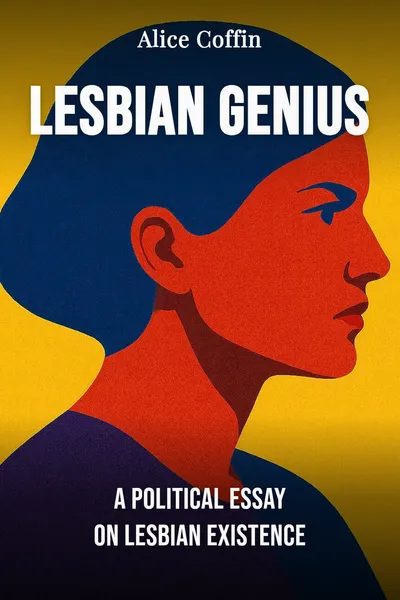
Lesbian Genius
A political essay on lesbian existence
Description
In the autumn of 2020, a French journalist and activist named Alice Coffin published a short, dense book called Le Génie lesbien — rendered in English as Lesbian Genius. Coffin was not a newcomer to public life. She had co-founded a collective pushing for better representation of women in the media, campaigned for LGBT rights across several countries, and worked for years as a reporter before becoming an elected member of the Paris city council. The book gathered two decades of that experience into something that read less like a memoir than a manifesto: a first-person account of a life spent inside newsrooms, activist circles, and institutions, braided with an argument about what it costs to live openly as a lesbian in a culture that would rather she stayed quiet.
The book might have circulated among a committed readership and gone no further. Instead, within days of publication, a single passage was extracted, quoted out of context across television panels and front pages, and turned into a national scandal. Politicians denounced her. Columnists called for her resignation from the council. Coffin received death threats and needed police protection. The woman who had written about being made invisible suddenly could not escape the cameras — though almost no one talking about her seemed to have read past the one sentence everyone was repeating.
That collision, between what the book actually says and what the country decided it said, is the story worth following. Coffin's essay is a deliberate provocation, built to unsettle. But the firestorm around it ended up proving several of her points more vividly than any paragraph she wrote.
The question we’re asking : What does Alice Coffin actually argue in Lesbian Genius, and why did a book about invisibility become impossible to ignore?What we’ll see : A reporter's account of being erased, a weaponized sentence, the politics packed into one word, and the uproar that followed.
Table of contents
01 Chapter 1 — A journalist runs out of patience
Coffin spent much of her career as a reporter, and Lesbian Genius opens from inside that world. She describes newsrooms that treated the lives of women, and lesbians in particular, as a niche beat — covered occasionally, usually by men, almost always framed from the outside. She watched colleagues report on Pride parades and marriage-equality debates with the detached curiosity of anthropologists, and she noticed how rarely anyone like her got to set the terms of the coverage. The book is, in part, a long accounting of that erasure: the stories not told, the voices not sought, the quiet assumption that the default human being is not a woman and certainly not a lesbian.
Her response, over the years, was to organize. She co-founded a group called La Barbe, whose members would show up at male-dominated conferences wearing fake beards to mock the uniformity of the people on stage. She helped launch an association of LGBT journalists to push back on how their communities were depicted. These were not abstract campaigns; Coffin recounts them as a working professional who had grown tired of waiting for institutions to represent her fairly, and had decided to force the issue instead.

02 Chapter 2 — The sentence that set France on fire
The controversy turned on a handful of lines in which Coffin writes that she no longer reads books by men, no longer watches their films, no longer listens to their music — a deliberate act of withdrawal to make room, in her own attention, for the women whose work the culture had crowded out. In the pages around it, she is clear about the register: this is a political gesture, a way of noticing how completely a lifetime of cultural consumption had been organized around men, and of refusing to keep feeding that imbalance automatically. It is provocation as method, the kind of statement meant to make a reader flinch and then think.
The flinch arrived. The thinking mostly did not. Within days the passage was lifted out, flattened into a slogan, and broadcast as proof that Coffin wanted to abolish men, erase them, hate them. Television panels debated her supposed call to eliminate half the population. Commentators who had clearly read only the quote competed to express their outrage. A sentence about where she chose to direct her own attention became, in the retelling, a program for social cleansing.
03 Chapter 3 — What "lesbian" is doing in the title
The word in the title is not decoration. Coffin uses lesbian deliberately, as a political category and not merely a private fact, and the choice carries most of the book's weight. She draws on a tradition of feminist thought — the one associated with writers like Monique Wittig and Adrienne Rich — in which lesbian names less a sexual preference than a position outside a social order built on the assumption that women exist in relation to men. To be a lesbian, in this framing, is to have stepped out of an arrangement the culture treats as natural, and from that vantage point to see its machinery more clearly.
That is where the genius of the title comes from. Coffin is not claiming that lesbians are smarter than everyone else. She is making a claim about standpoint: that people pushed to the margins of a system often understand it better than those comfortably at its center, because they have had to study the rules that others simply inhabit. The outsider notices the water the insider swims in. Lesbian existence, for Coffin, is a form of knowledge as much as a form of love — a way of seeing that the dominant culture would prefer to keep invisible precisely because it sees too much.
04 Chapter 4 — A book, and the reaction it provoked
Step back from the arguments themselves and the more interesting question is not whether Coffin is right, but what the response to her reveals. A short essay by an elected official, drawing on decades of activism and a recognizable line of feminist theory, was met not with argument but with alarm — as though the real transgression were not any specific claim but the tone in which it was made. The country seemed able to tolerate a lesbian who explained herself gently and far less able to tolerate one who did not apologize for taking up space.
That reaction maps onto a broader pattern in how minority voices are received. There is often an unspoken contract on offer: you may speak about your oppression, provided you do so in a way that reassures the majority, that stays measured, that never asks anyone to feel implicated. Break the contract — raise your voice, name names, refuse to flatter — and the conversation stops being about what you said and becomes about how you said it. Coffin broke the contract on purpose, and the ferocity of the backlash suggested she had touched something the contract was designed to protect.
05 Conclusion
Coffin remained on the Paris city council through the storm, kept her police protection for a stretch, and watched her slim book become one of the most talked-about and least-read titles of its season. The sentence about not consuming men's work still trails her, usually without its surrounding paragraphs. The rest of the essay — the newsroom years, the organizing, the argument about standpoint and visibility — mostly stayed behind the noise, which is its own kind of proof of the point.
Related books