Last Rambles Amongst the Indians of the Rocky Mountains and the Andes
A life among indigenous Americas
Description
By the time George Catlin sat down to write Last Rambles, he was an old man who had already given his best years to a single obsession. Decades earlier, in the 1830s, he had traveled up the Missouri River and produced hundreds of portraits of Plains peoples, convinced that he was documenting a world about to disappear. He had toured that gallery through American and European cities, chased by debt and skeptics. Most men would have stopped there. Catlin did not. In his late fifties and sixties, he went back into the field — not to the familiar Upper Missouri this time, but south and west, into the Rocky Mountains and down into South America, to the Andes and the great river basins beyond.
Last Rambles is the record of those later journeys. It is a traveler's book in the oldest sense: canoe trips down enormous rivers, nights in unfamiliar villages, encounters with peoples whose languages he could not speak and whose customs he watched with a painter's attention. He describes landscapes that dwarf a man, hunts and ceremonies, the practical business of moving through country with no roads. Running underneath it all is the same conviction that had driven him north thirty years before — that these peoples and their ways were worth looking at closely, and worth putting on paper before something erased them.
What we get, then, is not a young explorer's adventure but a late reckoning: one man returning to the work of his life, still sketching, still watching, still certain the watching mattered. The Americas he crosses are vast and various, and his enthusiasm rarely flags. But it is a specific pair of eyes doing the looking, at a specific moment in history, and that shapes everything he sees.
The question we’re asking : What did an aging painter go looking for when he crossed the Rockies and the Andes late in life, and what did he actually find?What we’ll see : A last set of expeditions across two continents, and the record one nineteenth-century witness left of the peoples he was determined to see.
Table of contents
01 Chapter 1 — The man who came back for more
To understand Last Rambles, we have to understand the man who wrote it. Catlin was a Pennsylvania lawyer who abandoned the law for painting, then abandoned settled painting for something stranger. Sometime around 1830 he decided that the indigenous peoples of North America were vanishing before an advancing frontier, and that no one was recording them faithfully. So he went. He spent years traveling among the Plains nations, painting portraits, scenes, objects, ceremonies, amassing what he called his Indian Gallery — several hundred paintings and a trove of artifacts.
That gallery became his life and, in a sense, his prison. He exhibited it across the eastern United States, then took it to London and Paris, always short of money, always hoping a government or a patron would buy it and keep it whole. It never quite worked. The debts mounted. And yet the underlying drive never dimmed. He believed he was doing something no one else was doing, and he was, for the most part, right.

02 Chapter 2 — Rivers, mountains, and the long canoe
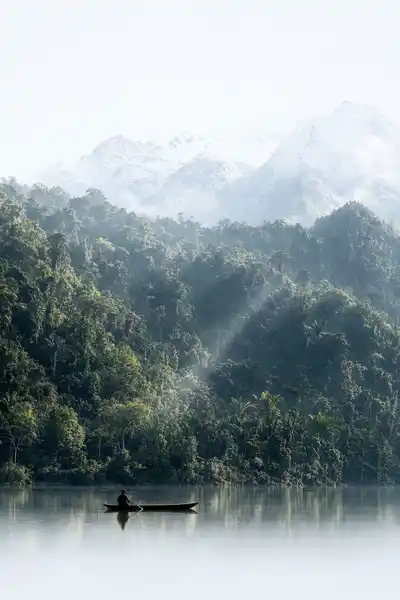
The physical texture of the book is water and rock. Catlin is forever on a river, in a canoe, moving through country that has no other roads. The great South American waterways carry him for days between villages, and he renders them with a painter's sense of scale — the width of the current, the wall of forest, the way weather and light change what the eye takes in. For a reader, the rivers are the spine of the journey; they are how he arrives everywhere, and how he leaves.
The Andes give him the opposite sensation: not the flat immensity of the river basins but altitude, cold, and the strain of moving a body through thin air and steep ground. He describes highland communities living where the land seems to offer little, and he notes, with the practical curiosity that runs through the whole book, how people manage — what they grow, how they travel, what they wear against the cold. The Rocky Mountain passages carry a similar attention to terrain as something you have to negotiate, not merely admire.
03 Chapter 3 — What Catlin thought he was recording
Catlin was explicit about his mission, and it colors every page. He believed he was preserving something on the edge of being lost. The peoples he painted in North America had already, in his lifetime, been pushed from their lands, thinned by disease, and remade by contact. He carried that conviction south with him: that the customs, faces, and ways of life he encountered were precious precisely because they might not survive the century, and that a faithful visual record was the one thing he could contribute against that erasure.
This gives the book its earnestness. He is not collecting curiosities for a drawing-room audience so much as building an archive. He wants the reader to see these communities as coherent worlds with their own order — their own governance, beliefs, crafts, and dignity — rather than as scenery. Compared with much writing of his era, there is a real effort at respect. He admires what he sees, defends the peoples he meets against casual contempt, and insists on their humanity in terms that were not universal among nineteenth-century travelers.
04 Chapter 4 — The eye of a nineteenth-century witness
Step back from the rivers and portraits and a larger question emerges: what does a single traveler's lifelong record actually preserve? Catlin's answer, delivered across a career and closing with these last journeys, is that one determined witness can capture a great deal — faces, customs, the feel of a place — that would otherwise leave no trace. That is not a small thing. Much of what we have of certain communities in his era survives because a stubborn painter decided they were worth the canoe trip.
Yet the same account shows the limits of that kind of witness. Catlin saw as an outsider, briefly, through the frame of his own convictions. He could paint a ceremony without fully understanding it, describe a people without their language, and mistake the moment of contact for the whole of a culture's story. His record is vivid and sincere and also partial — shaped by what he was equipped to notice and blind to what he was not. The document tells us about the watched, but it tells us just as reliably about the watcher.
05 Conclusion
Catlin came back one more time because he did not know how to stop. The Rockies and the Andes were farther than the Missouri, and he was older than he had any business being on a fast river in a canoe, but the impulse was unchanged from the young man who had first gone north thirty years before. Last Rambles closes a life that never really left the field. The paintings, the notes, the endless movement between villages — all of it was one continuous effort to hold on to something he was certain would slip away.
Related books