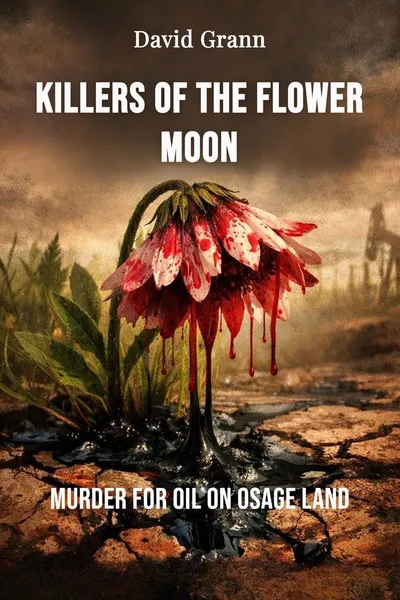
Killers of the Flower Moon
Murder for oil on Osage land
Description
In the early 1920s, the Osage were, per capita, among the wealthiest people in the world. They drove chauffeured cars, sent their children to schools in Europe, built mansions on the Oklahoma prairie, and hired white servants to run their households. The reversal is what David Grann builds his book around: the tribe had been pushed decades earlier onto a stretch of rocky, seemingly worthless ground in Indian Territory, land nobody else wanted. Then oil was found beneath it. Because the Osage had negotiated to keep the mineral rights collectively, every enrolled member held a share — a headright — in the fortune that gushed out of the ground. By 1923 the tribe was taking in millions of dollars a year in royalties.
And then Osage began to die. Not from illness or accident, at least not obviously. They were shot, poisoned, and in one case blown up in their own house in the middle of the night. Mollie Burkhart, an Osage woman married to a white man, watched her family fall one by one: a sister shot, another sister and brother-in-law killed in the explosion, her mother wasting away from what looked like slow poisoning. Local investigations went nowhere. Private detectives were hired and turned up nothing, or turned up dead. The death toll that Grann traces stretches far past the two dozen the era officially recorded.
The case became one of the first major investigations of what would become the FBI, then a young and unproven bureau under a young and ambitious J. Edgar Hoover. Grann tells the story on two levels — the crime and the men who eventually cracked it — but he does not stop there. The deeper subject is how a killing spree of this scale could unfold in plain sight, and why almost everyone with power over Osage lives had a reason to look away.
The question we’re asking : How did the wealthiest people in America become targets of a killing spree that nobody in authority would stop?What we’ll see : How the Osage fortune drew the killers, how a young federal bureau built its first big case, and the quieter system that made the murders possible.
Table of contents
01Chapter 1 — The richest people per capita on earth
The Osage had good reason to distrust generosity when it was offered to them. Driven from their lands in Kansas in the 1870s, they bought a reservation in northeastern Oklahoma with their own money, choosing ground so broken and infertile that white settlers had no use for it. It was a defensive calculation: if the land was worthless, perhaps they would finally be left alone. The calculation failed in the most spectacular way imaginable. Beneath that stony prairie lay one of the largest oil deposits in the United States at the time.
What saved the tribe, at least in principle, was a clause its leaders fought for when the reservation was broken up into individual allotments. The Osage kept the mineral rights in common. No single member could sell the oil under his feet; instead, every person on the tribal roll held an equal headright, an undivided share in the whole. As drilling companies bid fortunes for leases at auctions held under a tree that became known as the Million Dollar Elm, the money flowed back to the tribe and was divided among the headright holders.

02Chapter 2 — A wave of deaths nobody would investigate
The deaths did not announce themselves as a pattern. They came scattered, over years, wearing the disguises of ordinary misfortune. Anna Brown, Mollie Burkhart's sister, was found dead in a ravine in 1921, a bullet in the back of her head that the first examiners somehow failed to notice. Others died of what doctors called wasting sickness or bad liquor. Charles Whitehorn was shot the same week as Anna. The Osage began to speak of a reign of terror, and to count their own dead with a precision the authorities never matched.
Mollie's family was hit again and again. Her mother, Lizzie, declined steadily and died in a way that fit the poisoning others suspected. Then, in March 1923, her sister Rita and Rita's husband were killed when a bomb destroyed their house in the town of Fairfax, an explosion so violent it woke the whole community. Whoever was doing this had grown bold enough to use dynamite in the middle of town. Mollie herself, a diabetic dependent on insulin injections administered by white doctors, was almost certainly being slowly poisoned too.
03Chapter 3 — Hoover's young bureau makes its case
The case reached Washington at a useful moment for J. Edgar Hoover. Newly installed at the head of the Bureau of Investigation, the forerunner of the FBI, Hoover wanted to remake a scandal-tainted agency into a professional, scientific force — and he needed a victory to point to. The Osage killings, sensational and stubbornly unsolved, offered exactly that opportunity, along with the risk that a public failure could sink his ambitions early.
Hoover turned much of the fieldwork over to Tom White, a former Texas Ranger who belonged to an older tradition of frontier lawmen even as he served a modernizing bureau. White assembled a small team, including agents who worked undercover across the Osage country — posing as a cattleman, an insurance salesman, a medicine man — to move through a community where everyone knew everyone and outsiders were watched. Slowly, they mapped the web of relationships around the dead.
04Chapter 4 — The paperwork that made murder legal
The trials answered who killed Mollie Burkhart's family. They did not answer the larger question Grann keeps returning to: why the Osage had been so easy to kill in the first place. The answer lies less in the villainy of William Hale than in a legal system built, ostensibly, to protect the tribe — and it is here that Grann's account widens from a crime story into something colder.
Congress had decided that many Osage could not be trusted to manage their own money. Under a guardianship system, adults deemed incompetent — a designation applied overwhelmingly to full-blooded Osage, regardless of ability — were assigned white guardians who controlled their fortunes. These guardians, drawn from the local establishment of lawyers, bankers, and merchants, skimmed fees, overcharged for goods, and steered spending. The system institutionalized the assumption that Osage wealth properly belonged under white supervision, and it put the men with the most access to that wealth in the position of deciding how, and how long, its owners lived.
05Conclusion
Mollie Burkhart survived. Once she was removed from the care of the doctors poisoning her, her health returned, and she lived long enough to see her husband's uncle convicted and to have her own competency status lifted. But the resolution Grann offers is deliberately incomplete. The convictions of Hale and Ernest Burkhart closed a few cases out of many, and left the wider terror — the dozens of deaths never charged, the guardians never questioned — hanging over the Osage country long after the FBI declared victory and moved on.
Related books