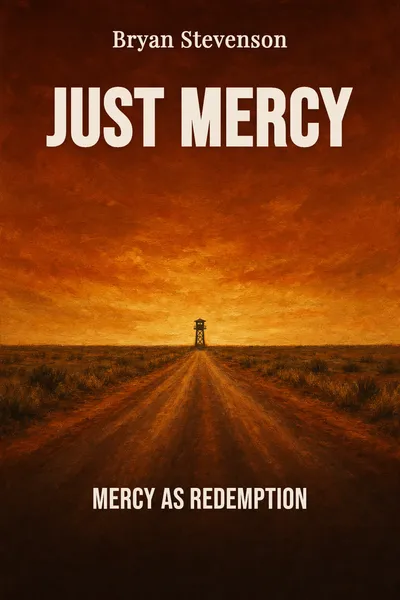
Just Mercy
Mercy as redemption
Description
In the late 1980s, a young lawyer named Bryan Stevenson drove down a Georgia highway toward a maximum-security prison to meet his first death-row client. He was a Harvard graduate, barely older than the men he was about to represent, and the visit was supposed to deliver a simple message: the State had no plans to execute this man within the coming year. Stevenson expected a brief, awkward exchange. Instead the two men talked for three hours, and the prisoner — a Black man named Henry, scheduled to die — ended the visit by singing a hymn as the guards led him back to his cell, his voice carrying down the corridor while the chains dragged.
That afternoon reorganized a career. Stevenson founded the Equal Justice Initiative in Montgomery, Alabama, in 1989, and spent the next decades representing the people the legal system was most ready to discard: condemned prisoners, children sentenced to die in prison, men convicted on evidence that fell apart the moment anyone looked closely. Just Mercy, published in 2014, is his account of that work — built around the case of Walter McMillian, a Black man sent to death row in Alabama for a murder he did not commit. It is part memoir, part legal history, part argument.
The book is unusual in that its central word is not justice but mercy — and it insists the two are not the same thing. Stevenson keeps returning to a claim that sounds almost too quiet for the brutality he describes: that the question of whether someone deserves to die exposes whether the rest of us deserve to kill. The cases are specific, dated, and often devastating. The idea running underneath them is larger.
The question we’re asking : What does Stevenson mean when he says mercy, not punishment, is what redeems a society — and who exactly is being redeemed?What we’ll see : How a single wrongful conviction in Alabama opens onto a wider account of who the law condemns, what it refuses to count, and why the author keeps insisting we are all implicated.
Table of contents
01Chapter 1 — A young lawyer and a man on death row
Stevenson grew up in a poor, segregated community in Delaware, the kind of place where the church was the center of life and the courthouse was somewhere you went when something had gone wrong. He arrived at Harvard Law School unsure of what lawyers actually did, and stayed unsure until an internship sent him to the Deep South to work with prisoners facing execution. The abstraction of law school fell away the first time he sat across a table from someone the State intended to kill. The work, he realized, was not about doctrine. It was about people the rest of the system had agreed to stop seeing.
The hymn in the corridor stayed with him. The condemned man had thanked him not for a victory — there was none — but simply for showing up, for treating the visit as a meeting between two human beings rather than a transaction over a body. Stevenson understood that the men on death row were starved less for legal relief than for the basic recognition that they still belonged to the human community. That recognition, withheld systematically, was part of how a society talked itself into killing.

02Chapter 2 — The case that made the work
Walter McMillian was a Black pulpwood worker in Monroeville, Alabama — the town, as it happens, that had inspired Harper Lee's To Kill a Mockingbird. In 1986 a young white woman named Ronda Morrison was murdered in a dry cleaner, and the pressure to solve the case was enormous. McMillian had no connection to the crime, but he had recently been involved in an affair with a white woman, a fact that in that place and time marked him as a target. He was arrested and, before any trial, placed on death row to await proceedings.
The case against him was, on inspection, almost nothing. The State's central witness was a man named Ralph Myers, a convicted felon who later admitted he had been pressured into testifying and had fabricated the entire account. Other witnesses had placed McMillian at a church fish fry, with dozens of people, at the time of the killing. Evidence pointing to his innocence had been collected and then buried. McMillian was convicted by a jury that recommended life imprisonment — and the judge overrode that recommendation to impose death, a power Alabama law then allowed.
03Chapter 3 — What the system actually counts
Around the McMillian case, Just Mercy widens to take in the people Stevenson kept encountering — and a pattern emerges in who ends up condemned. They are overwhelmingly poor. They are disproportionately Black, in a country where the legacy of slavery and lynching is, Stevenson argues, not behind us but folded directly into how punishment is distributed. Many are mentally ill, or were children when they were sentenced, or had endured abuse so severe that their crimes were inseparable from their wounds. The system, he shows, is precise about the offense and almost entirely indifferent to the life that produced it.
He writes about children — thirteen and fourteen years old — sentenced to die in prison, tried as adults, condemned before they had finished growing. He writes about women imprisoned after stillbirths, about veterans broken by war, about the mentally disabled executed despite knowing little of what was being done to them. The Equal Justice Initiative's litigation on juvenile sentencing reached the Supreme Court, which in rulings in 2010 and 2012 sharply limited life-without-parole sentences for children — a rare instance of the law correcting itself.
04Chapter 4 — Mercy as the thing that saves the merciful
The most surprising move in Just Mercy is who Stevenson decides the broken thing is. It would be easy to write a book about innocent men and corrupt institutions, with the reader safely on the side of the victims. He refuses that comfort. The condemned in his pages include people who are guilty — who did terrible things — and he insists that mercy must extend to them too, or it is not mercy at all. Forgiveness offered only to the innocent is just another verdict.
His claim is that mercy is not a gift the powerful bestow on the condemned. It runs the other way. When a society chooses to kill the people who have hurt it, it does not restore anything; it confirms that violence is the final argument. The capacity to refuse that — to look at someone who has done the worst thing and still recognize a human being — is what keeps the rest of us from becoming the thing we claim to punish. Mercy redeems the merciful. The hand that withholds the lethal injection is saving more than the prisoner.
05Conclusion
Walter McMillian lived another fourteen years after his release, though the trauma of death row never fully left him; he died in 2013, the year before Stevenson's book appeared. The Equal Justice Initiative is still in Montgomery, still taking the cases others won't, and in 2018 it opened a memorial to the thousands of Black Americans lynched across the South — a deliberate insistence that the history shaping today's courtrooms be named and seen. The hymn in the corridor, decades earlier, turned out to be the whole argument in miniature: a condemned man asking only to be recognized, and a young lawyer who decided that recognition was the work.
Related books