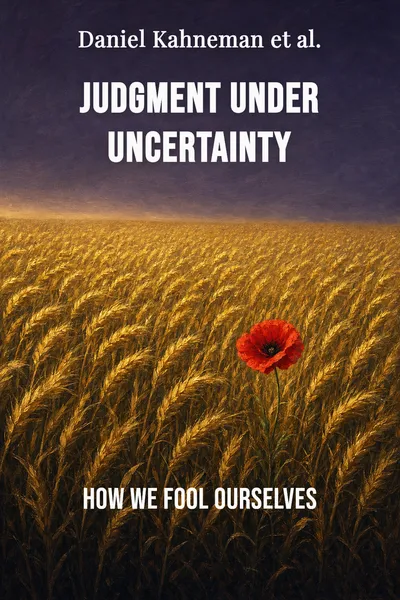
Judgment Under Uncertainty
How we fool ourselves
Description
In the early 1970s, two psychologists — Daniel Kahneman and Amos Tversky — began handing people short problems and watching them go wrong in the same direction. Not randomly wrong, the way a tired student is wrong, but predictably, tidily wrong. Ask a room of statisticians whether a small sample or a large one is more likely to produce a lopsided result, and a striking number miss it. Describe a quiet, meticulous man and ask whether he's more likely a librarian or a farmer, and people forget there are vastly more farmers. The errors had a structure. And a structure is something you can study.
Out of that work came a book, edited by Kahneman, Paul Slovic, and Tversky and published in 1982: thirty-five chapters, some of them now-classic papers, others written fresh, mapping the mental shortcuts we lean on when we don't have — or can't be bothered to compute — the real odds. The authors called these shortcuts heuristics. They're fast, they're usually good enough, and they come with a bill attached: recurring biases that show up not just on questionnaires but in courtrooms, hospitals, trading floors, and the way we read risk on the news.
The word "error" is almost misleading here. Nobody in these studies is foolish. The same shortcuts that trip people on a probability puzzle are the ones that let us function at all — reading a face, guessing a price, deciding whether a bridge feels safe. The interesting part isn't that we slip. It's that the slips are lawful, and that knowing the law doesn't fully protect us from them.
The question we’re asking : When we judge something uncertain — a diagnosis, a risk, a stranger — what are we actually doing instead of calculating the odds?What we’ll see : How a handful of mental shortcuts quietly reshape our judgments, why even experts fall for them, and what it takes to see past our own confidence.
Table of contents
01 Chapter 1 — The mind's shortcuts, and the price of taking them
Most of the time, we have no idea how likely anything is. Will this patient recover? Is this candidate any good? Should we worry about that plane crash on the news? The honest answer — a probability, weighted by base rates and evidence — is rarely available, and computing it would be exhausting anyway. So the mind does what minds do: it substitutes an easier question for a hard one. Instead of "how probable is this?", it quietly asks "how much does this resemble the typical case?" or "how easily can I think of an example?" We answer the easy question and mistake the answer for a reply to the hard one.
That substitution is the through-line of the whole book. Kahneman and Tversky named three main heuristics — representativeness, availability, and anchoring — and the surrounding chapters test them against real judgment: clinicians estimating disease, forecasters guessing outcomes, ordinary people rating hazards. In each case, the shortcut works well enough to explain why we rely on it, and fails often enough, in a fixed direction, to explain why we shouldn't fully trust it.

02 Chapter 2 — When resemblance replaces probability
Representativeness is the shortcut that judges by resemblance. How likely is X to belong to category Y? We check how much X looks like our mental image of a typical Y, and read that similarity straight off as a probability. It feels airtight. It usually points roughly right. But it ignores things that resemblance can't see — and chief among them is the base rate, the sheer prevalence of one category over another.
The book's most quoted demonstration is the sketch of a man described as shy, tidy, and fond of order. Asked whether he's more likely a librarian or a farmer, people lean librarian, because the description fits the stereotype. They forget that farmers vastly outnumber librarians, so even a librarian-ish profile is, on the numbers, more likely to belong to a farmer. Similarity wins; frequency gets ignored. The same blindness turns up when people rate a detailed, coherent scenario as more probable than a vaguer one it's actually a subset of — the so-called conjunction error, where adding plausible detail makes an event feel likelier even as it becomes, by definition, rarer.
03 Chapter 3 — What comes to mind first, and why we trust it
The second great shortcut is availability: we estimate how likely or frequent something is by how easily examples come to mind. If instances are quick to retrieve, we judge the thing common; if they're hard to summon, we judge it rare. Like representativeness, this is often a decent bet, because common events genuinely do leave more traces in memory. The trouble is that ease of recall tracks a lot of things besides frequency — how recent an event was, how vivid, how much coverage it got, how personally it touched us.
So the estimate drifts. People consistently overrate the risk of dramatic, well-publicized dangers — plane crashes, shark attacks, spectacular accidents — and underrate quiet, cumulative ones like ordinary disease or the slow damage of familiar habits. The book links this directly to risk perception, one of Slovic's central themes: the hazards that frighten us most are not the ones that kill most, but the ones that are easiest to picture. A single televised catastrophe reshapes a whole population's sense of what's dangerous, because it floods memory with a ready image.
04 Chapter 4 — The stubborn confidence of being wrong
If the book had only catalogued errors, it would be a curiosity. What gives it staying power is a broader claim about the architecture of the mind: that these biases are not defects bolted onto an otherwise rational thinker, but the natural output of the very tools thinking runs on. You cannot have the speed of the shortcut without inheriting its blind spots. The bug and the feature are the same piece of code. That reframing is why the work escaped the psychology lab and turned up in medicine, law, finance, and public policy.
Consider overconfidence, which several chapters treat as almost universal. Asked to give ranges they're 98 percent sure contain the true answer, people are wrong far more than 2 percent of the time. The gap between how much we know and how much we think we know is wide, stable, and largely immune to warning. Pair that with the earlier shortcuts and you get a mind that reaches conclusions quickly, by resemblance and recall, and then feels sure of them — a combination that is efficient in a familiar world and dangerous in an uncertain one.
05 Conclusion
The problems Kahneman and Tversky handed out in the early 1970s look, at first, like party tricks — small puzzles that catch clever people off guard. What the book built out of them is something larger: a portrait of a mind that judges the uncertain by resemblance, by recall, by whatever number sits nearby, and then believes its own answers with a confidence the answers don't earn. The heuristics are real cognitive equipment, and the biases are what that equipment does when the world doesn't match its assumptions.
Related books