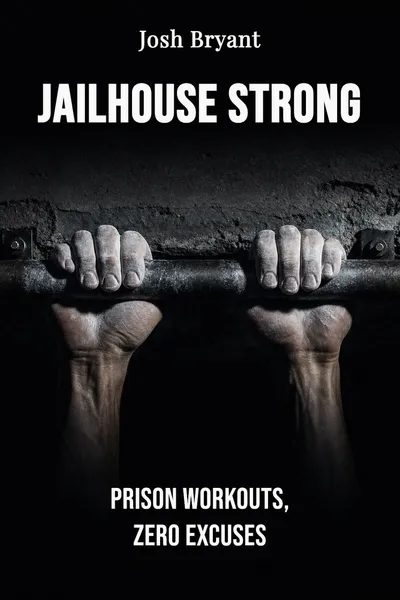
Jailhouse Strong
Prison workouts, zero excuses
Description
Somewhere in a cell block right now, a man with no gym membership, no protein powder subscription and no personal trainer is out-lifting most of the people paying two hundred dollars a month at a chain gym down the road. He has a concrete floor, his own bodyweight, maybe a pull-up bar welded above a doorway, and a lot of time. Josh Bryant, a strength coach who has trained powerlifters and pro athletes, wrote a whole book about why that man tends to win. It's called Jailhouse Strong, and its premise is almost insulting in its simplicity: the results everyone chases with gadgets and gimmicks were being produced, for decades, by people who had none of them.
Bryant didn't invent the methods. He collected them. He went to the source — men who built serious muscle and serious strength inside, including a former Mr. Olympia who first picked up weights behind bars, and even a co-founder of the Crips. What he found wasn't a secret exercise. It was a way of training born from having almost nothing: minimal equipment, minimal space, minimal time, and a very real reason to stay hard. Strength inside isn't vanity. It's currency, protection, and a way to hold your head straight when everything around you is designed to break it.
That's the uncomfortable hook of the book. The most controlled, consistent, no-excuses training environment many people will ever hear about is a place nobody wants to end up. And the lesson travels: if a man can get powerful in a cage, the guy with a spare corner of his apartment and thirty free minutes has run out of alibis.
The question we’re asking : How do people with almost no equipment, space or time get seriously strong — and what does the method demand of the rest of us?What we’ll see : How training born behind bars turns scarcity into a system, and why the same habits hold a life together on either side of the wall.
Table of contents
01 Chapter 1 — The gym with no membership fee
Start with what isn't there. No treadmills, no cable machines, no color-coded rubber dumbbells racked by weight. In many facilities there isn't even reliable access to a weight pile — and where there is, it's crowded, contested and time-limited. Bryant's book opens from this scarcity rather than apologizing for it. The men he interviewed didn't wait for better tools. They trained with what the environment gave them: their own bodies, the floor, a bunk, a bar, a towel, a partner's resistance. The equipment list for most of the book fits in a sentence.
What replaces the machines is volume and frequency. When you have hours instead of a lunch break, and when the alternative to training is boredom or worse, you train often. Bryant describes a rhythm most gym-goers never touch — pushups and dips accumulated across a whole day, hundreds of reps not because a program said so but because there was nothing stopping you. The body adapts to consistent, hard, repeated stress. Prison supplies the consistency by removing every distraction the outside world uses as an excuse.

02 Chapter 2 — Strength without the machines
The practical core of Jailhouse Strong is a set of methods that work when the gear is minimal. Bodyweight movements carry a lot of it — pushups in every variation, dips, pull-ups, squats, lunges, planks, the classic burpee. Bryant treats these not as beginner filler but as the foundation, scaled by leverage and volume rather than by loading a bar. Change the angle, slow the tempo, cut the rest, add reps, and a pushup keeps challenging a strong man long after it stopped challenging a beginner.
Where iron is available, the book leans on the big, honest lifts — presses, rows, squats, deadlifts, the movements that build real strength across the whole body instead of isolating a muscle for the mirror. Bryant's outside credentials as a powerlifting coach show here. He isn't offering a soft circuit. He's applying serious barbell principles to a limited setting, and the priorities are the same ones he'd give an athlete: get strong at the movements that matter, load them progressively, and don't waste time on the ornamental.
03 Chapter 3 — Programming built for chaos
A pile of exercises isn't a program, and Bryant knows it. The value of Jailhouse Strong is that it organizes the methods into actual plans — for lifting, for bodyweight-only training, and for conditioning — so a reader isn't left guessing. Each is built to survive an environment that offers no guarantees. You might get an hour on the weight pile today and nothing tomorrow. The programming has to bend without breaking, and Bryant designs it to.
The logic is progression under constraint. When you can't add plates, you add reps, sets, difficulty, or you shrink the rest between them. When a piece of equipment vanishes, a bodyweight substitute steps in without derailing the week. This flexibility is exactly what makes the system portable to the outside. Bryant is blunt about the appeal: for less than the price of a single day pass at a trendy gym, you get a complete method you can run at home, in a hotel room, in a garage, in a spare corner — anywhere with a floor.
04 Chapter 4 — The discipline that outlasts the sentence
Step back from the reps and the programs and a larger claim comes into focus, one Bryant threads through every interview: the strength that matters most isn't only physical. Inside, training is one of the few things a man controls in a world where almost nothing else is his to decide. The barbell doesn't care about your sentence. The pushup happens on schedule regardless of the noise, the tension, the danger. That controllable ritual becomes an anchor — a way to hold emotional balance amid a volatile reality, and to walk out with something other than time served.
This is where scarcity stops being a limitation and starts looking like the actual engine. Bryant's book keeps demonstrating, almost accidentally, that constraint produces the results abundance keeps promising and failing to deliver. The man with everything skips. The man with nothing shows up, because there's no cushion of options to hide behind and a hard reason to stay strong. Remove the excuses and the excuses were the problem all along. That's not a truth about prison. It's a truth about training that prison happens to make impossible to ignore.
05 Conclusion
Jailhouse Strong ends up being less a book about prison than a book about what happens when every excuse is taken away. Bryant gathered the methods of men who built power with a concrete floor and their own bodyweight, organized them into programs anyone can run, and priced the whole thing below a single visit to a chain gym. The equipment is minimal, the space is small, the time is short — and the results are real, precisely because none of the usual escape hatches are available.
Related books