Invariances
What stays true across everything
Description
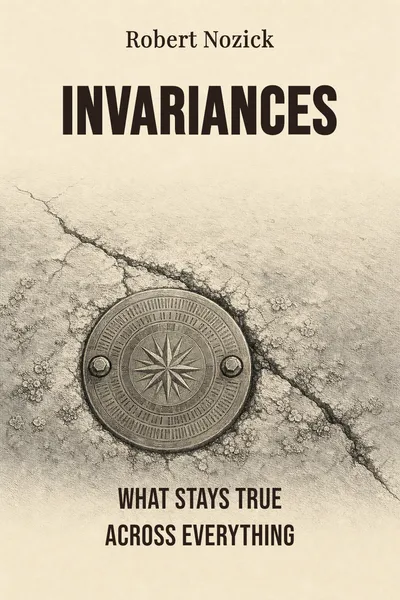
In 2001, near the end of a life spent turning philosophy on its head, Robert Nozick published a dense, difficult book called Invariances. He had made his name three decades earlier with Anarchy, State, and Utopia, the libertarian salvo that turned him into John Rawls's most famous sparring partner. But Nozick was constitutionally allergic to repeating himself — he once said he had no wish to keep polishing the same doctrine for forty years. So the final major work of his life doesn't argue politics at all. It goes after something bigger and stranger: what it even means for something to be objectively true.
The question sounds abstract until we notice how much rides on it. We routinely divide the world into two piles. On one side, facts — the boiling point of water, the mass of a proton, the theorems that hold whether or not anyone believes them. On the other, everything we suspect is merely a matter of taste or culture — beauty, morality, what counts as a good life. The first pile feels solid, the second negotiable. Nozick's late project was to ask what actually separates the two, and whether the border is where we think it is.
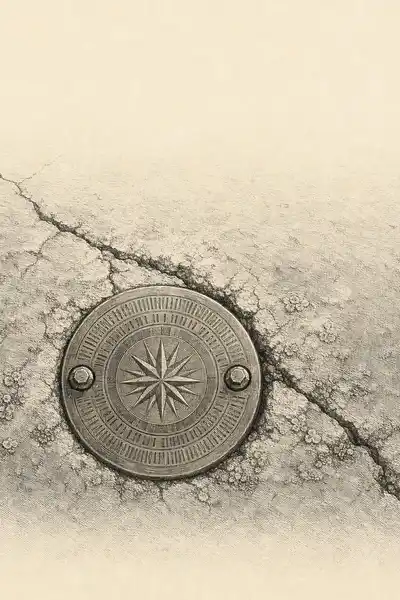
His answer runs through a single word borrowed from mathematics and physics. An invariant is something that stays the same when everything around it is transformed — rotated, translated, rescaled, seen from a different frame. Nozick's wager, written while he was already ill with the cancer that would kill him a year after publication, was that objectivity itself might be nothing more, and nothing less, than that kind of stability.
The question we’re asking : What makes something objectively true — and is the line between hard fact and mere opinion drawn where we assume?What we’ll see : How a physicist's notion of invariance gets turned into a theory of truth, objectivity, and even ethics — and what it costs the idea of a single view from nowhere.
Table of contents
01Chapter 1 — The book Nozick wrote against his own reputation
To understand why Invariances feels so unlike anything else Nozick wrote, it helps to know the kind of thinker he was. Trained at Princeton, a Harvard professor for most of his career, he had a reputation for restlessness — someone who would build an elaborate argument, publish it, and then wander off to something completely different rather than defend his old positions in the trenches. He wrote about the meaning of life, about rationality, about the self, and he wrote in a loose, exploratory style, full of tentative moves and philosophical detours, that irritated colleagues who wanted crisp conclusions.
Invariances is his attempt to put something firmer on the table. It is a book about the foundations — truth, objectivity, consciousness, ethics — and it tries to build them up rather than tear a rival's down. The framing question is disarmingly simple. When we say a statement is objectively true, as opposed to true just for us or in our little corner, what property are we actually crediting it with? Most answers reach for the idea of a fact that holds independently of any observer. Nozick found that phrasing empty on its own. Independent of observers how, exactly, and measured against what?

02Chapter 2 — Objectivity as invariance under transformation
The core idea deserves to be stated carefully, because it is easy to hear it as a slogan and miss the machinery. Something is objective, on Nozick's account, to the degree that it is invariant across a range of transformations — different observers, different positions, different ways of accessing it. A fact about the electron's charge is highly objective because nothing about who measures it, from where, using which language, changes the value. It is stable under a huge family of shifts. That stability is not evidence of objectivity sitting behind it; on this view, it is much closer to what objectivity means.
The elegance is that objectivity stops being all-or-nothing. It comes in degrees, indexed to how wide the family of transformations is. A truth that survives every reframing we can think of sits at one end; a preference that dissolves the moment we change who is looking sits at the other; and a great many interesting things live in between. Nozick was comfortable with that gradient. He thought the black-and-white split between the objective and the subjective had done real damage, tempting us to file whole domains — value, meaning, quality — under mere opinion simply because they were not invariant in the extreme way physics is.
03Chapter 3 — Ethics as a system that keeps working
If objectivity is invariance, the natural worry is that ethics fails the test outright. Moral judgments seem to vary wildly — across cultures, across centuries, across dinner tables. So Nozick does not try to smuggle ethics back into the physics-grade tier. He asks a different and more interesting question: what is the ethical realm actually for, and what stays constant about it once we know that?
His answer starts from function. Ethics, at its most basic layer, is what allows separate individuals with their own goals to cooperate, to coordinate benefits, to live together in a way that leaves everyone better off than open conflict would. That is the floor — what he calls the ethics of respect, the minimal set of constraints that make mutually beneficial cooperation possible in the first place. This layer is not an arbitrary local custom. Any group of intelligent beings facing the problem of living together would need something like it, which is exactly the kind of invariance the framework was looking for: constant across the transformation from one society to another because it is fixed by the shared problem, not by taste.
04Chapter 4 — Truth without the capital T
Step back from the particular arguments and the wider claim comes into focus. For a long stretch of Western philosophy, objectivity has meant a view from nowhere — a single, absolute standpoint that transcends every perspective and delivers the world as it really is, stripped of any observer. It is a powerful ideal, and it has a shadow. When people find they cannot reach that god's-eye view, the tempting conclusion is that there is no objectivity at all, that everything collapses into perspective, power, or preference. The absolute standard, unmet, breeds its own opposite: a shrugging relativism.
Nozick's invariance move is an attempt to walk between those two. There is no need for a view from nowhere. There is only the accumulating stability of what survives as we move between many views from somewhere. Objectivity is not what floats free of all perspectives; it is what stays put across them. That reframing quietly dissolves the panic. Losing the absolute standpoint does not leave us with nothing, because the thing the absolute standpoint was supposed to certify — reliable constancy across transformation — is available directly, and it comes in measurable degrees.
05Conclusion
Nozick died in January 2002, a little over a year after Invariances appeared, and the book stands as the last full statement of a mind that spent its life refusing to settle. It never became a landmark the way his first book did; it is too sprawling, too tentative in places, too willing to leave threads hanging. But its central instrument is genuinely useful. Take any claim to objectivity and ask which transformations it survives, and the fog around "is this real or just a matter of opinion?" begins to lift.
Related books