

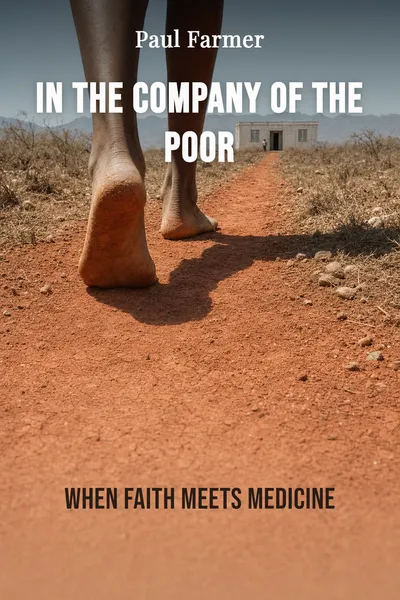
In The Company Of The Poor
When faith meets medicine
Description
In the early 1980s, a young American named Paul Farmer went to Haiti's Central Plateau to work in a place where tuberculosis and AIDS killed people who, almost everywhere else in the world, were no longer dying of those diseases. He was not yet a doctor. He was a student splitting his time between Harvard Medical School and a stretch of rural Haiti so poor that the difference between living and dying often came down to whether someone could reach a clinic. What he saw there did not fit the categories he had been given. The sick were not sick by accident. They were sick because they were poor, and they were poor because of arrangements older and larger than any single life.
Around the same time, a Peruvian priest named Gustavo Gutiérrez had already given that intuition a name. In 1971 he published a book that founded liberation theology, and at its center sat a phrase that would travel far beyond seminaries: the preferential option for the poor. God, Gutiérrez argued, is not neutral. The Gospel takes a side. Farmer read him, and the reading changed how he understood what he was doing with a stethoscope in the mountains of Haiti. Decades later the two men would sit down together, write together, and speak from the same stage at Notre Dame.
In the Company of the Poor gathers that encounter — a doctor and a theologian who arrived at the same place from opposite doors. One came through the clinic, the other through the church. Both landed on the poor, not as a cause to pity but as the standard against which everything else gets measured. The book asks what happens when a medical practice takes a theological idea literally, and what a theology gains when someone tries to live it out in a treatment ward.
The question we’re asking : What does a global-health doctor owe to a phrase coined by a Peruvian priest — and what does that phrase gain when it leaves the seminary?What we’ll see : How two lives, one in medicine and one in the church, converged on the same commitment to the poor — and refused to let it stay comfortable.
Table of contents
01Chapter 1 — A doctor who read a theologian
Paul Farmer's path into medicine did not run through the usual ambitions. Born in 1959 and raised partly in a bus and a boat on the Florida coast — his father was, by all accounts, an improviser — he arrived at Duke and then Harvard with a restlessness that fieldwork in Haiti sharpened rather than settled. In Cange, on the Central Plateau, he helped build what became Partners In Health, the organization he co-founded in 1987 with Ophelia Dahl, Jim Yong Kim and others. The premise was almost absurdly simple and almost universally resisted: that a poor Haitian farmer deserved the same standard of care as a patient in Boston.
What gave that premise its language was Gutiérrez. Farmer has said plainly that liberation theology shaped his idea of social-justice medicine — the conviction that treating the sick without confronting why they got sick is only half the job. The theology gave him a vocabulary for something the epidemiology charts could not hold: that disease follows the fault lines of power, that the bodies filling his clinic were the same bodies the world had already decided to overlook.

02Chapter 2 — The preferential option, in scrubs
Gustavo Gutiérrez, born in Lima in 1928, spent much of his life as a parish priest in a poor Peruvian neighborhood while teaching and writing theology. His 1971 book, A Theology of Liberation, did something the Church had not quite done in that form: it read the Gospel from the underside, from the point of view of the people history tends to crush. The preferential option for the poor was not an instruction to be charitable. It was a claim about who God stands with — and therefore about where the Church, and anyone paying attention, ought to stand too.
The phrase has often been misread as sentimental. Gutiérrez insisted it was not. To opt for the poor is not to romanticize poverty; poverty, in his view, is an evil, a form of early and unjust death. The option is a decision to see the world from where the poor stand, and to let that vantage point reorder one's priorities. It is preferential because it corrects a world that already has a preference — for the comfortable, the connected, the already-cared-for.
03Chapter 3 — Charity that ends, justice that keeps going
The sharpest edge in the book is the distinction between charity and justice, and neither man lets the reader stay comfortable with the softer word. Charity, in the ordinary sense, is generous and finite. It gives, it feels good, and then it stops — and the conditions that made the giving necessary remain exactly where they were. Farmer had watched a great deal of global health operate this way: episodic, camera-friendly, structured to relieve the giver more than to change the recipient's odds.
Justice, in Gutiérrez's framing and Farmer's practice, is different because it asks about causes. Why is this village without clean water? Why does a drug that costs pennies in one country cost a fortune in another? Why is a Haitian life implicitly valued at a fraction of a Boston one? These are not medical questions and not quite theological ones — they are questions about how the world is arranged, and both men insisted that anyone serious about the poor has to ask them out loud.
04Chapter 4 — Where a book by two men lands
Step back from the clinic and the seminary, and In the Company of the Poor is really about ideas that refuse to stay in their assigned rooms. Liberation theology was born inside the Catholic Church and drew suspicion from Rome for decades; parts of it were formally cautioned in the 1980s. Yet its central phrase escaped, and one of its most faithful applications turned out to be a secular-facing medical organization treating tuberculosis in the hills of Haiti and, later, Peru, Rwanda and beyond. An idea meant to reform how believers see God ended up reforming how doctors see patients.
That crossing runs in both directions, and it is the deeper subject of the dialogue between Farmer and Gutiérrez. A theologian usually argues from scripture and tradition. A doctor usually argues from data and outcomes. Here each borrows the other's authority: Farmer invokes the Gospel to defend a treatment protocol, and Gutiérrez points to survival rates in Cange to defend a reading of the Beatitudes. The effect is to unsettle the tidy division of labor by which we assign compassion to churches and competence to institutions, as if the two could not require each other.
05Conclusion
The book closes where the two lives kept returning: to the people in the clinic, the ones whose names do not make the charts. Farmer went on to work in Rwanda, Peru, Lesotho and beyond, carrying the same stubborn insistence that the poor deserve the best medicine, not the leftovers, until his death in 2022. Gutiérrez, who died in 2024 after a lifetime in his Lima parish, lived long enough to see his phrase outrun him — to watch it organize supply chains and treatment protocols he could never have designed from a desk.