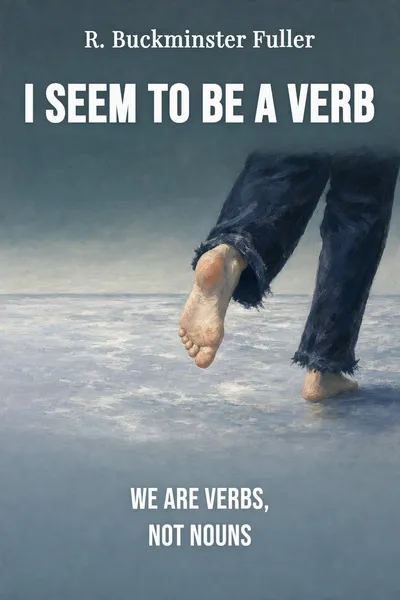
I Seem To Be a Verb
We are verbs, not nouns
Description
In 1927, a thirty-two-year-old man stood on the shore of Lake Michigan in the middle of winter, broke, out of work, mourning a dead child, and seriously considering walking into the water. His name was Richard Buckminster Fuller, and by his own later account, he decided not to. Instead he resolved to run what he called an experiment: to find out what one ordinary person, penniless and unremarkable, could accomplish on behalf of everyone else if he stopped worrying about earning a living and simply started doing. He would live, from then on, as if the question were not who he was but what he did.
Four decades later, that decision produced one of the strangest books ever put out by a major publisher. I Seem To Be a Verb appeared in 1970, co-created with Jerome Agel and Quentin Fiore, the team behind Marshall McLuhan's mind-bending paperbacks. It is not really a book you read front to back. Text runs upside down along the bottom of pages, photographs collide with slogans, a second thread of words crawls beneath the main one. The physical object argues its own thesis. You cannot sit still with it, and that is the point.
Fuller had by then invented the geodesic dome, designed a three-wheeled car, collected twenty-five patents, and been thrown out of Harvard on two separate occasions. He was an architect who never finished an architecture degree, an engineer by conviction rather than credential, a futurist who insisted he was only reporting what was already true. And the truest thing, he thought, was hiding in a grammatical error we all make about ourselves.
The question we’re asking : Why did Fuller insist that a human being is a verb rather than a noun, and what did he build on that idea?What we’ll see : A restless life turned into a design experiment, a book that refuses to sit still, and a way of seeing ourselves as motion rather than matter.
Table of contents
01Chapter 1 — A man who decided to be a verb
Fuller was born in Massachusetts in 1895, into a family with a long New England pedigree and a famous great-aunt, the writer Margaret Fuller. He was extremely nearsighted as a child and did not get proper glasses until he was several years old, which meant he spent his early life perceiving the world as a blur of color and pattern before he could resolve it into distinct objects. He liked to say later that this taught him to trust systems and relationships over things — he had felt the whole before he could name the parts.
Harvard did not go well. He was admitted, and then expelled, twice — the first time after spending his tuition money entertaining a troupe of dancers in New York, the second time for what the university politely called a lack of interest. He worked in a meatpacking plant, served in the Navy during the First World War, and drifted through jobs. In the early 1920s he went into business with his father-in-law manufacturing a new kind of building block. The company failed. Around the same time, his young daughter Alexandra died. The two blows arrived close together, and they nearly finished him.

02Chapter 2 — The book that reads sideways
I Seem To Be a Verb does not behave like a book. Open it and the design assaults the ordinary reading habit. There are two texts running at once: the main flow across the top and middle of the pages, and a second, continuous line printed upside down along the bottom, so that when you finish the book one way you can flip it over and read the counter-thread. Photographs of traffic, crowds, machinery, mushroom clouds and children are set against blunt phrases and statistics. The form was engineered, deliberately, to keep you moving.
This was no accident of a self-indulgent designer. Fuller worked with Jerome Agel and Quentin Fiore, who had just produced Marshall McLuhan's The Medium Is the Massage — the paperback that turned a media theorist's ideas into a kinetic collage. Fiore understood that a book about process should not sit inert on the page. If the argument is that reality is motion, then a static, linear column of prose quietly contradicts it. The layout had to do what the words were only claiming.
03Chapter 3 — The dome, the car, and the doing
The reason to take Fuller's word-play seriously is that he had a habit of building his metaphors. The most famous is the geodesic dome — a sphere assembled from a lattice of triangles that grows proportionally stronger as it grows larger, enclosing the maximum volume with the minimum material. Fuller patented it in the 1950s, and within a decade thousands of them had gone up around the world, from radar stations in the Arctic to the great glittering United States pavilion at the 1967 Montreal world's fair. It was ephemeralization made literal: more shelter, less stuff.
Before the dome came the Dymaxion projects, a word Fuller coined from "dynamic," "maximum," and "tension." The Dymaxion car of the 1930s was a three-wheeled, teardrop-shaped vehicle that could carry eleven people, turn in its own length, and reach speeds far beyond ordinary cars of the era. Only three were built, and a fatal crash at the 1933 Chicago fair — later shown to involve another vehicle — scared off investors. There was a Dymaxion house too, a round aluminum dwelling meant to be mass-produced and shipped anywhere, light enough to hang from a central mast. It never reached production, but the point was the ambition: a home treated as a manufactured product, not a fixed monument.
04Chapter 4 — What it means to say we are processes
Step back from the domes and the sideways typography and the claim underneath is oddly liberating. If a person is a noun — a fixed thing with a fixed nature — then the shape of a life is mostly given. You are what you are, and the most you can do is manage it. But if a person is a verb, a pattern in continuous motion, then nothing about the present arrangement is permanent, including you. Fuller's whole point was that we are never stuck with life as it is, because we are not objects that life happens to. We are one of the ways it keeps happening.
He extended this from the self to the species. The reason he treated Earth as a spaceship was to make the same grammatical move at planetary scale. A planet, in the ordinary imagination, is a given — a stage on which history unfolds. Fuller wanted us to see it instead as a system we operate, badly, with resources we could redistribute by design rather than by accident. Poverty, waste, and war were not features of a noun called "the world." They were the current results of a verb called "living together," and verbs can be conjugated differently.
05Conclusion
The man who nearly walked into Lake Michigan in 1927 died in 1983, having outlived the daughter he mourned by more than fifty years and having filled those decades with almost compulsive activity — the patents, the buildings, the lectures, the millions of miles. He kept a diary of his own life so detailed it ran to hundreds of thousands of pages, as if to document the experiment in real time. He never proved that one penniless individual could remake the world. But he did demonstrate, at book length and in aluminum and steel, that the attempt was available to anyone willing to make it.
Related books