I Judge No One
Jesus and the Roman order
Description
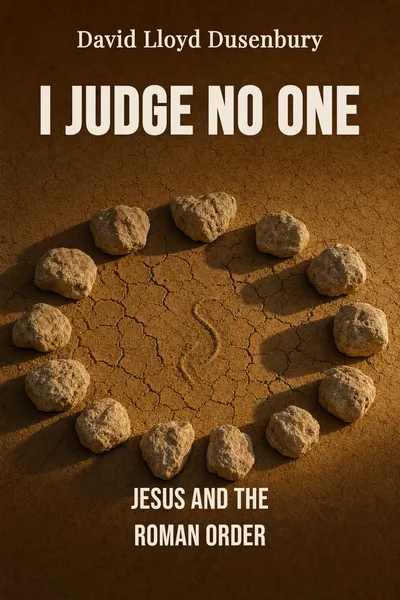
Somewhere in Judea, around the year 30, a woman is dragged before a teacher who has been drawing crowds. She has been caught in adultery, and the law her accusers cite is clear enough: such a woman can be stoned. They want a ruling. The teacher, according to the Gospel of John, bends down and writes in the dust with his finger, says almost nothing, and then delivers a line that dissolves the whole proceeding — let the one without sin throw the first stone. The accusers drift away. He tells the woman he does not condemn her either. It is a scene most of us half-remember, softened by centuries into a parable about mercy.
David Lloyd Dusenbury, a philosopher and historian of ideas, takes that scene and asks a harder question than the Sunday-school one. What does it mean, in a world governed by Roman law and Judean religious courts, for a man to stand in front of a legal case and say, in effect, I judge no one? Rome ran on judgment — magistrates, tribunals, the power to sentence and to crucify. The Temple ran on judgment too. Into that dense machinery of courts and verdicts steps a figure who keeps declining the seat everyone tries to put him in.
Dusenbury's book reads Jesus not primarily as a moral teacher or a theologian's abstraction, but as someone acting inside a specific political and legal order — and repeatedly refusing its terms. The refusal, he argues, is not vagueness or evasion. It is a position, and a consequential one. The man who would not judge would himself be judged, by two authorities at once, and the way they handled him tells us as much about power as it does about him.
The question we’re asking : What happens when a man embedded in the courts of Rome and the Temple keeps refusing to occupy the judge's seat?What we’ll see : How a first-century teacher's declining of worldly judgment collided with the legal machinery of his time, and left a fault line running through Western politics ever since.
Table of contents
01Chapter 1 — A rabbi with no interest in the courts
First-century Judea was thick with law. Rome had annexed the region as a province, installing prefects who held the power of the sword — the ius gladii, the authority to execute. Alongside them the Judean religious establishment ran its own courts, the councils that interpreted the Law of Moses and adjudicated disputes over purity, marriage, debt, and blasphemy. To be a public teacher in this setting was to be constantly pulled toward legal questions. People wanted rulings. They wanted to know what was permitted and what was forbidden, whose side the teacher was on.
Dusenbury shows how Jesus, again and again, sidesteps exactly this pull. When a man asks him to settle an inheritance dispute with his brother — a routine request for arbitration — Jesus answers with something close to irritation: who made me a judge or divider over you? It is a small moment, easy to skip past, but Dusenbury reads it as programmatic. Here is a figure with every opportunity to become a legal authority, a rabbi whose word would carry weight in ordinary disputes, and he declines the role outright.

02Chapter 2 — The trials that could not agree on a charge
The irony Dusenbury draws out is sharp. The man who would judge no one is arrested and passed through a sequence of hearings, and at each stage the authorities struggle to name what he has actually done wrong. He is brought first before the Judean council, where the charge that sticks is blasphemy — a religious offense, tied to what he is said to have claimed about himself. But blasphemy under Judean law is not something Rome recognizes, and Rome alone holds the power to execute. So the case has to be translated into a language the prefect will act on.
That prefect is Pontius Pilate, and the Gospels stage the encounter as a kind of collision between two legal worlds. Pilate keeps probing for a Roman crime and keeps failing to find one. He asks whether Jesus is a king — because kingship claimed against Caesar would be sedition, a genuinely capital matter. The answer he gets is oblique: my kingdom is not of this world. Dusenbury lingers on Pilate's exasperation, and on the line the prefect throws out almost to himself — what is truth? — before turning back to the crowd.
03Chapter 3 — A kingdom that refuses to be a kingdom
Behind the trials sits the phrase that Dusenbury places at the center of his political reading: the kingdom, or reign, that Jesus proclaims and yet insists is not of this world. It is language soaked in politics — kingdom, king, reign — deployed by a man who then empties it of everything the Roman and Judean order would recognize as political power. No army, no throne, no territory, no court. The vocabulary is imperial; the content dismantles the vocabulary.
Dusenbury argues that this is precisely why the authorities found him so difficult. A straightforward rebel they could crucify with a clear conscience, and Judea produced plenty of those. But a figure who used the language of sovereignty while refusing sovereignty's instruments occupied a space the law had no slot for. He was not claiming Caesar's throne, yet he was not simply a private mystic either. He spoke of a reign, and reigns are things Rome takes seriously. The ambiguity was not a failure of clarity on his part; it was the whole shape of his message.
04Chapter 4 — The long afterlife of a man who declined to judge
Step back from the trials and a longer pattern comes into view. By locating a reign that Caesar did not govern, Jesus opened a gap between two kinds of authority — the worldly power that judges and executes, and a claim that stands beyond its reach. Dusenbury's argument is that this gap did not close with his death. It became one of the durable structural features of Western political life, the seam along which the West would keep negotiating the limits of the state.
Rome itself would eventually absorb the movement it had crucified, and the paradox only deepened. A faith founded by a man who refused the judge's seat became, within a few centuries, entangled with emperors, laws, and courts of its own. The tension was never resolved so much as institutionalized: the idea that there are two authorities, spiritual and temporal, and that the temporal one is not the final word. Medieval quarrels between popes and kings, and later the very notion that the state's power over conscience has a boundary, all draw on the space that opened when someone said his kingdom was not of this world.
05Conclusion
We began with a woman, a circle of accusers, and a teacher writing in the dust. The scene ends without a sentence — no stones, no verdict, only a man who declines to condemn and sends everyone home to examine themselves instead. Dusenbury's book takes that refusal and follows it through the tribunals of the Temple and Rome, showing that what looks like gentleness is in fact a stance, and a costly one. The man who judged no one was tried by two courts that could not agree on his crime and executed on a charge of a kingship he never claimed in any earthly sense.
Related books