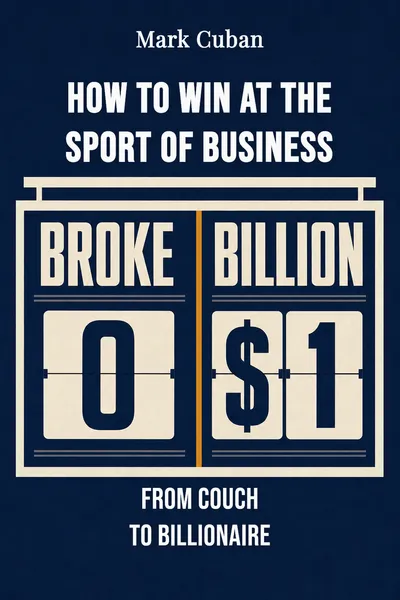
How to Win at the Sport of Business
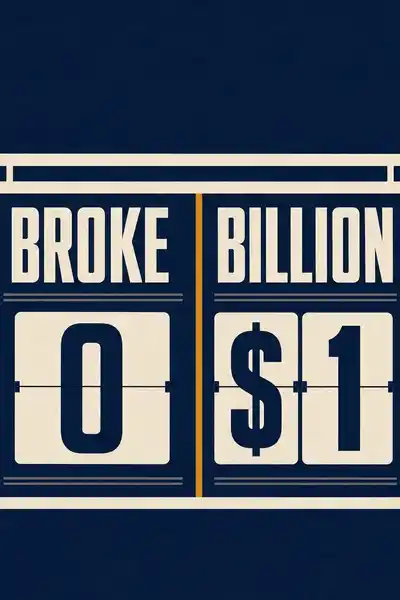
From couch to billionaire
Description
In the early 1980s, a young man from Pittsburgh was sharing a three-bedroom apartment in Dallas with five other guys, sleeping on the floor, no closet to call his own, driving a car with a hole in the floorboard and a passenger door held shut with rope. His name was Mark Cuban, and by his own account he was flat broke, occasionally getting his electricity cut, living off mustard-and-ketchup sandwiches when the money ran out. He had been fired from a job selling software after closing a deal his boss told him not to close. What he had instead was a habit of reading everything he could find about computers and a conviction that somewhere in all that reading was an edge nobody else was bothering to look for.
That man became a billionaire. He sold his first company, MicroSolutions, to CompuServe in 1990 for a reported $6 million. Then, near the top of the dot-com boom, he and his partner sold Broadcast.com to Yahoo in 1999 for around $5.7 billion in stock — and Cuban, in one of the shrewder moves of the era, hedged the stock so the crash couldn't take it all back. He bought the Dallas Mavericks, turned up on television, and became the loud, grinning face of a certain kind of American hustle.
His book collects the raw notes from that climb — blog posts, hard opinions, stories he'd told a hundred times — into something closer to a field manual than a memoir. It is not a tidy theory of success. It is a competitor talking about a competition he happens to love, and the through-line is right there in the title he chose for it.
The question we’re asking : What does someone who slept on a floor and woke up a billionaire actually believe about how business gets won?What we’ll see : A path from broke to enormous, and the unglamorous convictions Cuban built along the way about effort, edge, and winning.
Table of contents
01Chapter 1 — Sleeping on the floor with a spreadsheet
Cuban likes to start from the bottom because the bottom is where he learned the only things he trusts. Before Dallas there was a paper route, then selling garbage bags door to door as a kid, then powdered milk, stamps, baseball cards — whatever moved. He tells these stories not for the underdog glow but because they taught him a plain fact he keeps returning to: money is made by finding something people want and getting it to them, and no amount of theory substitutes for having actually done it, cheaply, badly, over and over.
The Dallas years were the hinge. He got a bartending gig, then a software sales job, and spent his nights not partying but reading manuals, reading code, learning the products cold. When he was fired for going around his boss to land a $15,000 sale, he didn't look for another job. He started MicroSolutions with a client he'd already talked into it and almost no money of his own. The company installed and integrated computer systems for businesses — dull work, but work he understood better than most competitors because he'd bothered to learn it from the inside.

02Chapter 2 — The one big idea, hunted like a job
The core of Cuban's thinking about business is that success rarely comes from a stream of good ideas. It comes, he insists, from one idea that you understand more deeply than anyone competing against you. His job — his actual daily labor — was hunting for that idea, and the hunting looked like reading. He read trade magazines cover to cover, read every book on his field, read the boring documentation nobody else read, on the theory that the edge is usually hiding in the material everyone finds too tedious to finish.
Broadcast.com came out of exactly that habit. He and his partner Todd Wagner wanted to listen to Indiana college basketball games over the internet, saw that streaming audio was becoming possible, and moved on it early — not because they'd predicted the future, but because Cuban was already saturated in the technology and could see what was about to be usable. He frames this as the payoff of relentless preparation: when the opportunity showed up, he recognized it in a second, because he'd done the reading that let him recognize it.
03Chapter 3 — Nobody works harder than the person who has to
If there's a single conviction that runs under everything Cuban writes, it's that effort is the great equalizer, and that most people simply don't put in enough. He describes years without vacations, without days off, learning new software late into the night, out-working smarter and better-funded competitors purely by refusing to stop. His argument isn't that hard work guarantees success — he's careful about that — but that it's the one input entirely within your control, and it's the input most people quietly negotiate down.
He tells the story to make a competitive point rather than a moral one. Somewhere out there, he says, someone is working to take what you have, and they don't care how many hours you feel like putting in. The market doesn't grade on effort or intention. It only registers results, and results tend to accrue to whoever showed up prepared and stayed longest. That's less inspiring than the usual pep talk and, he thinks, more honest.
04Chapter 4 — Business is a game with no final whistle
The title Cuban chose is not decoration. He genuinely experiences business as a sport, and that framing shapes everything about how he plays it. In a sport there are opponents, there is a scoreboard, there is film to study and preparation to do, and there is the plain fact that talent alone loses to talent plus work. He owns a basketball team; he sits courtside; and he treats his companies the way he treats the Mavericks — as a competitive operation where the point is to out-prepare and out-execute the other side, night after night.
What's revealing is what the sports frame does to the idea of winning. In business as Cuban plays it, there is no championship trophy you lift and then retire with. The lead is always temporary. The competitor who beat you last year is coming for you again, and the moment you start defending a position instead of attacking is the moment you start losing it. This is why he distrusts comfort and complacency more than he distrusts risk. Comfort, in a game with no final whistle, is just slowness with good PR.
05Conclusion
The distance from a floor in a shared Dallas apartment to a stake in Yahoo is enormous, but Cuban's own account of it is almost stubbornly flat. He read more than his competitors. He worked longer than they were willing to. He learned to sell, he hunted for one idea big enough to matter, and when he found it he moved before anyone asked for certainty. He failed often and cheaply, and he only needed to be right once. Stripped of the courtside grin and the television fame, the story he tells about himself is that ordinary — which is, of course, the provocation.
Related books