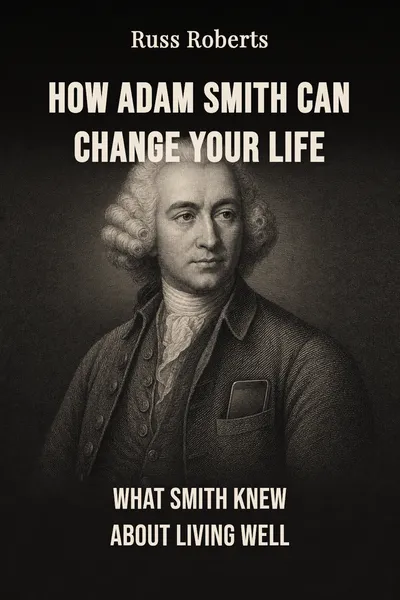
How Adam Smith Can Change Your Life
What Smith knew about living well
Description
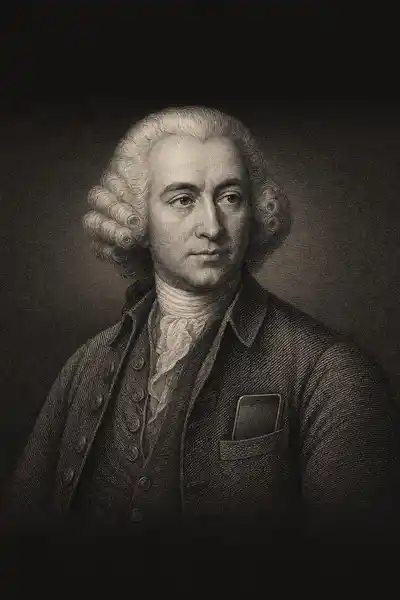
Most of us know Adam Smith for one book and one image: the father of capitalism, the man of the invisible hand, the eighteenth-century Scot who explained why the butcher, the brewer and the baker serve us dinner out of self-interest rather than kindness. The Wealth of Nations, published in 1776, is the founding text of economics, quoted by people who have never opened it and claimed by politicians who would have baffled its author. Smith is the patron saint of markets. That is roughly the whole of his reputation.
But Smith wrote another book first, and he thought it was the better one. The Theory of Moral Sentiments came out in 1759, seventeen years before the economics that made him famous, and he kept revising it until he died in 1790 — the final edition arrived the year of his death. It is not about money, growth or trade. It is about how we should live, why we behave well when no one is watching, and what actually makes a human being content. For two centuries it sat in the shadow of its more useful sibling, read mostly by scholars.
The economist Russ Roberts spent years with that neglected book and came away convinced it reads less like a philosophy treatise than like advice from an unusually perceptive friend — one who somehow understood social media, celebrity and status anxiety before any of them had names. His account, How Adam Smith Can Change Your Life, pulls the older Smith out of the archive and sits him down across the table.
The question we’re asking : What did Smith understand about happiness, virtue and reputation that the economist we remember never let on?What we’ll see : An eighteenth-century book on how to live, read as a strangely accurate mirror of our reputation-hungry present.
Table of contents
01Chapter 1 — The book Smith wanted burned
Adam Smith was a strange candidate for life-coach. He never married, lived much of his life with his mother, and was famous among friends for absent-mindedness so severe he once fell into a tanning pit while lecturing. He was a professor of moral philosophy at Glasgow, and The Theory of Moral Sentiments began as lectures to his students. When it was published in 1759 it made him a minor celebrity across Europe well before The Wealth of Nations existed. Voltaire admired it. It was Smith's calling card long before he was the economics man.
And yet Smith seemed to distrust the appetite for attention his own success fed. In his final days he had most of his unpublished manuscripts burned — years of work, thrown on the fire. What he chose to keep polishing, right up to the end, was the moral book. He revised it six times over thirty-one years. The economist who is supposed to have explained why we all pursue our own gain spent his last energy on a book arguing that pursuing gain, on its own, leaves us hollow.

02Chapter 2 — The impartial spectator inside us
The engine of Smith's whole moral vision is a single idea he calls the impartial spectator. Picture, he says, an imaginary observer standing just off your shoulder — someone fully informed about your situation but entirely unbiased, with no stake in flattering you. When you want to know whether you are behaving well, you ask how you would look to that spectator. Not to your friends, who will indulge you. Not to your enemies, who will condemn you. To the fair, unblinking witness you carry around inside your own head.
The impartial spectator is Smith's answer to the oldest question in ethics: why be good when no one is looking? Because someone always is — you are. We long, Smith writes, not merely to be praised but to be praiseworthy; not merely to avoid blame but to avoid actually deserving it. There is a real difference between wanting people to think you are generous and wanting to be generous. The first is about reputation; the second is about character. Getting away with something still leaves you exposed to the one observer you cannot fool.
03Chapter 3 — Why we chase the wrong shiny things
Smith noticed something that still stings: we routinely overrate what money and status will do for us. He tells the story of the poor man's son, cursed by ambition, who spends his life exhausting himself in pursuit of wealth and position — convinced that once he arrives, he will finally be at peace. He climbs, sacrifices, schemes, and only at the end, worn out, does he suspect that the trinkets he chased were no better than the ease he gave up to chase them. Smith calls the whole apparatus of luxury a collection of "baubles" whose real appeal is the attention they draw.
This is not an argument for poverty. Smith liked comfort and had no illusions about hardship. His point, which Roberts sharpens, is about the gap between what we think will make us happy and what actually does. We are wired to want to be noticed, and wealth is mostly attractive because it gets us noticed. But the pleasure of being seen is thin and quickly spent, while the underlying restlessness stays. The man with the bigger house wants attention as much as before; he has simply raised the price of getting it.
04Chapter 4 — What it takes to be loved and lovely
Step back from the individual advice and Smith's deeper claim comes into view — one Roberts treats as the heart of the book. Human beings, Smith says, want two things above all: to be loved, and to be lovely. To be loved is to be admired, wanted, thought well of by others. To be lovely is to be the kind of person who genuinely deserves it. Most of our misery comes from pursuing the first while neglecting the second — chasing the appearance of goodness rather than the substance, seeking the reward without doing the work that would earn it honestly.
This reframes everything Smith wrote about markets. The Wealth of Nations shows how self-interest, channeled through exchange, can produce prosperity for strangers who never meet. Moral Sentiments shows the limit of that logic: a society of people who only want to be loved, and never bother to be lovely, is a society of performers with nothing behind the performance. Commerce needs the second book to keep it human. Smith never thought self-interest alone could hold a civilization together; he thought it worked because it sat inside a web of restraint, sympathy and earned trust that the economics book quietly assumed.
05Conclusion
The picture we inherited of Adam Smith — the flinty economist of self-interest — turns out to be half a portrait, and not the half he cared about most. The book he kept revising until the year he died was the one about sympathy, restraint and the quiet business of deserving what we get. He burned his other papers; this one he polished. That choice tells us where the man himself thought the center of gravity lay, and it is not in the ledger.
Related books