Hold Still
A photographer's unflinching truth
Description
In the early 2000s, Sally Mann climbed into the attic of Boxerwood, the house near Lexington, Virginia, where she had grown up, and started opening the trunks and boxes her family had left behind. What she found was the raw material of a life she thought she knew: her father's photographs and strange death-obsessed drawings, letters, a Confederate ancestor's papers, the traces of the Black woman named Gee-Gee who had raised her. She had spent decades making pictures of other people. Now she was digging through the evidence of her own.
Mann was already one of the most argued-over photographers in America. In 1992 she had published Immediate Family, a book of black-and-white images of her three young children on the family farm — often naked, often unguarded — and the reaction had been ferocious. She had been called an exploiter, a genius, a mother who used her kids as models. The pictures hung in museums and got denounced from pulpits. Two decades later, sitting among the trunks, she set out to write not a defense but an accounting: of the images, the marriage, the land, the deaths, the inheritance she couldn't shake.
The result, Hold Still, is a memoir that refuses the memoir's usual comforts. Mann writes like she shoots — long exposures, imperfections left in, the accidents kept because the accident is the point. She is funny, self-lacerating, and unwilling to let herself off the hook, and she keeps circling one uneasy idea about what she has spent her life doing.
The question we’re asking : What does a photographer owe to the people and the past she turns into pictures — and what does the picture do to them in return?What we’ll see : How one American family, one contested body of work, and one much-photographed patch of Southern land come together in a reckoning with memory, image and inheritance.
Table of contents
01Chapter 1 — The trunks in the attic
Mann opens the book where memoirs usually end — in the attic, sorting the dead. The trunks belonged mostly to her father, Robert Munger, a country doctor in Lexington who was as private and as strange as she was open. He collected art, made his own morbid drawings, kept a skull on his desk, and died the way he had lived — on his own terms, refusing extraordinary measures, keeping his composure to the last. From the boxes came a version of him she had only half known, a man preoccupied his whole life with death and quietly steering his daughter's eye toward it.
The letters and photographs pull the family's story back generations, into money made and lost, into a great-great-grandfather who fought for the Confederacy, into the tangled Southern inheritance Mann can neither disown nor take pride in. She treats the archive with a photographer's honesty: she does not tidy it. The ancestors are vivid and compromised, and she lets them stay that way, resisting the temptation to make the past behave.

02Chapter 2 — The pictures that made everyone furious
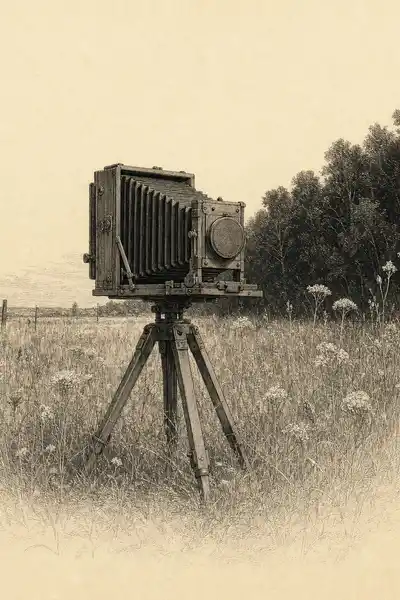
Through the 1980s, on the family's summer place along the Maury River, Mann photographed her three children — Emmett, Jessie and Virginia — as they actually lived out there: swimming, bleeding, sleeping, dressing up, often naked in the unbothered way small children are naked in the heat. She worked with a large-format camera on a tripod, slow and deliberate, and the children were collaborators as much as subjects, negotiating, posing, refusing. The images were luminous and sometimes unsettling, and when they became Immediate Family in 1992, the country lost its composure.
The book landed in the middle of the culture wars over art, obscenity and public funding, and Mann became a lightning rod. Critics accused her of sexualizing her own children, of endangering them, of manufacturing scandal for fame. Others called the work some of the finest American photography of its generation. A federal prosecutor was said to be weighing charges. Newspapers ran the pictures with black bars over the children's bodies, which is its own strange comment on who was seeing what.
03Chapter 3 — The land that keeps its dead
When the children grew up and out of the frame, Mann turned her large camera on the American South itself — the ground, the rivers, the light. She began working with wet-plate collodion, a nineteenth-century process on glass that is fussy, toxic and full of accident: dust, streaks, flares, chemical drips that bloom across the image. She welcomed the flaws. A landscape shot this way does not look like a place so much as a memory of a place, already fading at the edges, and that was exactly what she was after.
She photographed the battlefields — Antietam, the killing grounds where tens of thousands of men died in a single day — trying to catch what remains in soil that has absorbed so much death. She photographed the Deep South's ruined plantations and cypress swamps, the beauty inseparable from the horror underneath it. For Mann the Southern landscape is never innocent scenery. It is saturated ground, holding slavery and war and the bodies that were never fully accounted for, and she wants her pictures to feel that weight rather than prettify it.
04Chapter 4 — What a photograph actually holds
The idea Mann keeps circling — and the one that gives the book its title — is unsettling for someone who has spent her life with a camera. She argues that a photograph does not preserve a memory so much as consume it. Once you have the picture, the picture becomes the memory. The living, shifting recollection is quietly overwritten by the fixed image, and what you gain in permanence you lose in truth. She suspects she may have traded away large stretches of her own children's childhoods for the beautiful evidence that they existed.
This is why she distrusts the comfortable notion that photographs are how we keep the people we love. In her account they are as much a way of losing them — a substitution, a beautiful counterfeit that stands in for the flesh-and-blood original until the original is gone and only the counterfeit remains. The image tells the truth and lies in the same instant. It is faithful to a surface and treacherous to everything underneath, and no amount of love in the making resolves that contradiction.
05Conclusion
The book that began in the attic returns there in spirit at the end — Mann still surrounded by the trunks, the plates, the letters, the accumulated evidence of everyone she has loved and photographed. She has not built a monument to her family or a defense of her work. She has built something stranger and more honest: an accounting of what it costs to turn life into images, told by the person who did the turning and cannot pretend she came out clean.
Related books