Hindu Mysticism
Seeking the divine through yoga
Description
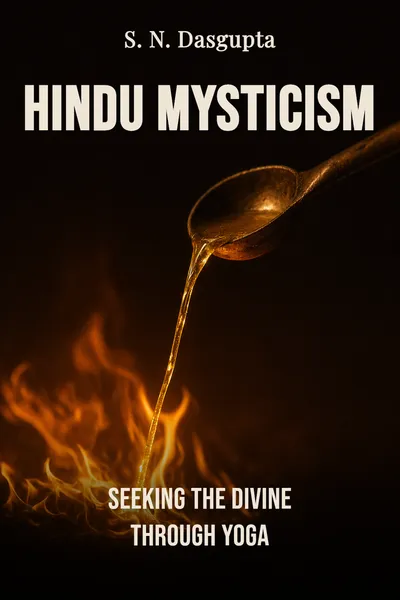
Somewhere in northern India, roughly three thousand years ago, a priest kneels before a fire and pours clarified butter into the flames while reciting verses whose exact meaning is already slipping away from the people who chant them. The ritual is enormous, precise, and public — a transaction with the gods conducted in the open air. This is the world of the early Vedas, the oldest layer of Hindu religious life, and it looks nothing like a mystic sitting alone with closed eyes. And yet, over the centuries that follow, that fire slowly moves inside. The sacrifice becomes breath. The altar becomes the body. The gods become something closer than the sky.
S. N. Dasgupta, one of the great historians of Indian philosophy, spent his life tracing that movement. In his short book Hindu Mysticism, he sets out to describe the many ways Indian seekers have tried to reach what lies behind ordinary experience — through ritual, through withdrawal, through knowledge, through disciplined breath, and through love. What makes his account unusual is that he refuses to flatten these into a single system. Hinduism, he shows, never settled on one road to the divine. It kept several open at once, sometimes in the same text, sometimes in the same lifetime.
The word yoga sits at the center of this story, though it means far more than posture. It names the whole effort of yoking the restless self to something steadier, of quieting the mind enough that whatever is real underneath can finally show itself. To follow Dasgupta is to watch a civilization argue, over millennia, about what that steadiness costs and what it reveals.
The question we’re asking : How did Hindu thought move from public sacrifice to the inward search for union with the divine, and what forms did that search take?What we’ll see : A journey through the turning-inward of Indian religion, the disciplines built to still the mind, and the rival ways seekers learned to close the gap between the self and the absolute.
Table of contents
01Chapter 1 — The sacrifice that turned inward
Dasgupta begins where Hindu religion begins: with the Vedas, hymns composed and transmitted orally over centuries in the second millennium BCE. This early religion is not mystical in any obvious sense. It is a religion of praise and petition, addressed to natural powers — fire, dawn, storm, the intoxicating soma plant. The gods are approached through carefully performed ritual, and the reward is worldly: cattle, sons, long life, victory. The sacred is out there, negotiated with, not merged into.
But even in these hymns Dasgupta finds the first stirring of something else — a wonder at the single principle that might lie behind the many gods, a hunger to name the one from which all this came. That hunger deepens in the Upanishads, the later philosophical texts that grow out of the Vedic tradition roughly in the first half of the first millennium BCE. Here the whole orientation shifts. The question is no longer how to please the powers, but what the self truly is and what the world truly rests on.

02Chapter 2 — Yoga and the discipline of stilling the mind
If the goal is to see the true self beneath the noise, the obvious problem is the noise. The mind will not hold still. It runs after sensation, memory, and desire, and each movement throws another veil over what the seeker is trying to reach. Hindu thought responded to this with one of its most influential contributions: a technical, almost surgical science of quieting the mind. Its classical statement is the system of yoga associated with Patanjali, whose Yoga Sutras Dasgupta treats as the disciplined counterpart to the soaring vision of the Upanishads.
Yoga here is not exercise. It is a graded training of the whole person, aimed at what Patanjali defines in his opening lines as the stilling of the fluctuations of the mind. The seeker works through stages — ethical restraint, bodily steadiness, control of breath, the deliberate withdrawal of the senses from their objects — each one narrowing the field of distraction. Posture and breath matter not for health but because a settled body and an even breath make a settled mind possible. The physical is a doorway, never the destination.
03Chapter 3 — When knowing and loving become the same road
The disciplined path of yoga is not the only route Dasgupta maps, and here his refusal to simplify becomes essential. Running alongside the way of concentration is the way of knowledge — the path of those who insist that liberation comes not from doing anything, but from finally understanding what is already the case. On this view, most sharply developed in the tradition that reads the Upanishads as teaching the sole reality of Brahman, bondage is a kind of mistake. The self is already free, already identical with the absolute; it merely dreams otherwise. Salvation is waking up.
But Dasgupta is equally attentive to a very different current, one that would eventually move more hearts than any philosophy of pure knowledge: the path of devotion, bhakti. Where the way of knowledge can feel austere, almost bloodless, devotion offers a personal God who can be loved, served, and longed for. The seeker here does not dissolve the self into an impersonal absolute so much as give it away, wholly, to a beloved deity. The Bhagavad Gita, which Dasgupta reads closely, holds these strands together, letting the discipline of action, the discipline of knowledge, and the discipline of loving surrender stand side by side as legitimate ways to the same end.
04Chapter 4 — One country, many maps to the same silence
Step back from the individual paths and something larger about Hindu mysticism comes into view — something Dasgupta returns to again and again. This is a tradition that never demanded a single answer. Ritual and renunciation, disciplined breath and unruly love, the cool logic of nondualism and the warm surrender of devotion all survived together, not in an uneasy truce but as a genuine acceptance that seekers differ and that the divine can be approached from more than one angle.
That plurality is not accidental. It follows from the founding intuition itself. If the absolute is truly infinite and truly identical with the depth of every self, then no single route can exhaust it, and the temperament of the seeker — contemplative, ascetic, or ardent — legitimately shapes the path. Dasgupta shows a civilization that took this seriously enough to build entire disciplines around each disposition rather than ranking one as orthodox and the rest as error. The mystic's problem, universal across cultures, is the felt gap between the finite person and the infinite; Hinduism's distinctive move was to keep several bridges standing at once.
05Conclusion
The fire the Vedic priest tended in the open air never really went out. It moved, as Dasgupta traces it, from the altar into the breath, from public transaction into private search, until the sacred that had once been petitioned in the sky was sought in the still point of the seeker's own being. What began as a religion of asking became, over three thousand years, a family of disciplines for finding — and the yoga that holds them together names less a posture than the whole labor of yoking a restless self to something that does not move.
Related books