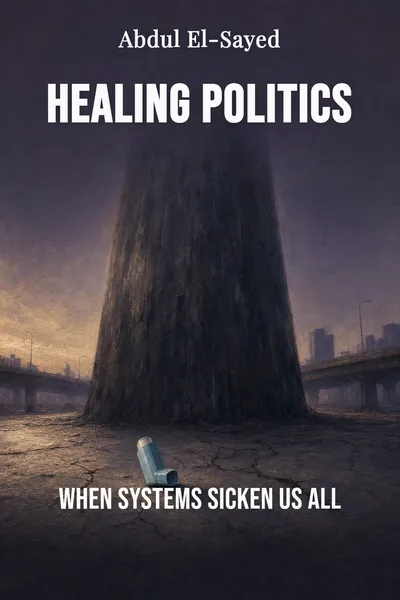
Healing Politics
When systems sicken us all
Description
In 2015, Abdul El-Sayed was thirty years old when he took over Detroit's health department. The city had just come out of the largest municipal bankruptcy in American history. Its public health infrastructure had been gutted — no functioning department to speak of, lead in the water, infant mortality rates closer to the developing world than to the suburbs a few miles away. El-Sayed had trained as a physician and an epidemiologist, and he arrived expecting to treat a city the way a doctor treats a patient. What he found was that the patient's illness had almost nothing to do with biology and almost everything to do with how the place had been built, funded, zoned, and abandoned.
That experience, and the failed run for governor of Michigan that followed it, sit at the center of "Healing Politics." El-Sayed is a doctor by training, but his book refuses the tidy separation we usually make between the body and the world it lives in. A child's asthma is not just a set of inflamed airways; it is also the mold in a landlord's apartment, the highway routed through a poor neighborhood, the clinic that closed. His argument is that we have been diagnosing individuals for problems that are really social, and prescribing pills for wounds that are really political.
The book braids three things that usually stay apart: a memoir of an Egyptian-American upbringing and a career in medicine, the hard science of how conditions shape health, and a firsthand account of running for office and losing. Out of that braid comes a single stubborn claim — that a person cannot be healthy in a society that is sick, and that our politics has been quietly making us ill.
The question we’re asking : What if the illnesses we treat one patient at a time are symptoms of something wrong with the systems we all share?What we’ll see : How a physician came to read a whole city as his patient, and what that reading did to his idea of what politics is for.
Table of contents
01Chapter 1 — The disease that isn't in any textbook
El-Sayed names the thing his medical training never gave him a word for: what he comes to call an epidemic of insecurity. Not a virus, not a bacterium, but a chronic condition of not knowing whether the rent will be paid, whether the job will last, whether the water is safe, whether the ambulance will come. He watched it in Detroit and he had felt versions of it in his own family history, and it does not show up on a blood panel. It shows up in bodies over years — in hypertension, in diabetes, in the slow grinding wear of stress that never lets up.
The book leans on a body of research El-Sayed knows from the inside as an epidemiologist. Chronic stress is not a metaphor; it is a physiological cascade. Cortisol that should spike and recede instead stays elevated. The immune system, tuned for short bursts of threat, stays switched on and begins to damage the very tissues it evolved to protect. Live with enough uncertainty for long enough, and the wear becomes measurable in the arteries and the pancreas and the brain. Poverty, in this reading, is not merely uncomfortable. It is a health exposure, as real as lead or tobacco smoke.

02Chapter 2 — How a broken system gets under the skin
If insecurity is the disease, the book's second move is to trace exactly how it enters the body. El-Sayed borrows a phrase from the epidemiology of inequality — the idea that social conditions become biological facts. The mechanism is not mysterious. A neighborhood without a grocery store produces diets built from what the corner store sells. A house near an incinerator produces lungs that breathe what the wind carries. A job with no sick leave produces a worker who shows up feverish because the alternative is losing the paycheck. None of these are individual failings. They are the predictable output of how a place was arranged.
He is careful about the science because he has to be — this is territory where sloppy claims get people hurt. He points to the well-documented pattern that a person's likelihood of a long, healthy life tracks closely with income and social position, and that the gradient holds even after you strip out the obvious confounders. It is not simply that poor people can't afford doctors, though that matters. It is that the daily texture of a subordinated life — the lack of control, the constant vigilance, the accumulated small indignities — does slow damage to the machinery of the body.
03Chapter 3 — From the clinic to the ballot
The somewhere else was government, and then it was a campaign. Running Detroit's health department taught El-Sayed that the levers that actually move health are political ones — a budget line, a water regulation, a zoning decision. He rebuilt a department from almost nothing, fought to get lead testing into schools, and learned how much of public health is really just the unglamorous work of making systems function for people who had been written off. The work was upstream, finally, and it worked in ways the clinic never could.
That conviction carried him into the 2018 Democratic primary for governor of Michigan. He ran as a physician who wanted to treat the state, campaigning on universal healthcare and a politics that took social conditions seriously as health matters. He lost the primary. The book does not flinch from the loss or dress it up as a moral victory. He reckons honestly with what it means to make an argument that is true and still not persuade enough people to win, with the money and the machinery arrayed against an outsider, and with the exhaustion of asking a system to reform itself.
04Chapter 4 — Care as the missing word in politics
Step back from Detroit and the campaign, and the book is finally an argument about empathy — not as a soft virtue but as the load-bearing foundation of public health itself. El-Sayed's deepest claim is that a society stays well only to the extent that its members can see their own fate bound up with a stranger's. Public health, at its origins, was exactly this: the recognition that your neighbor's untreated illness is also your problem, that a contaminated well poisons everyone who drinks, that we are, biologically and socially, in it together. The erosion of that recognition is the sickness underneath all the others he names.
This reframes what he means by "healing politics." He is not asking politics to become gentler in tone. He is arguing that the very purpose of collective life is to metabolize risk that no individual can carry alone — and that a politics organized around every-person-for-themselves is not just cruel but epidemiologically incoherent. Insecurity spreads. Distrust spreads. A society that lets some members fall does not quarantine the damage to them; it degrades the whole, because health, like disease, is contagious across the connections that bind people together.
05Conclusion
El-Sayed began as a doctor who thought he could treat a city the way he treated a patient, and ended by concluding that the patient was all of us, and the treatment was politics. Detroit taught him that the illnesses filling his colleagues' clinics were authored upstream, in decisions about who gets clean water and secure work and a safe place to sleep. The campaign taught him that the levers to change those decisions are political, and that they will not move on their own. The loss taught him that being right is not the same as prevailing.
Related books