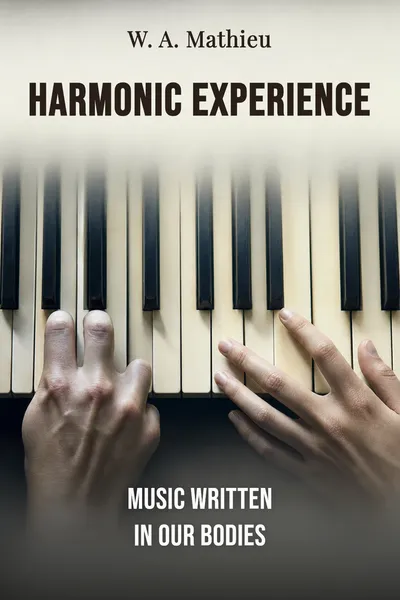
Harmonic Experience
Music written in our bodies
Description
Sit at a piano, press two adjacent white keys, and something in you flinches. Press a key and the one seven white keys up, and something in you settles. Nobody taught us this. We didn't read it in a manual or memorize it for a test. The reaction arrived before the vocabulary did, and for most of us it stays wordless our whole lives — a set of physical responses we trust completely and can't explain at all. W. A. Mathieu, a composer and teacher who spent decades between jazz, Western classical music, and Indian raga, built an entire book around taking that flinch and that settling seriously.
His claim, stated near the start of Harmonic Experience, is deceptively plain: the rules of music were not formed in our brains but in the resonance chambers of our bodies. Consonance and dissonance aren't conventions we agreed to, the way we agreed to drive on one side of the road. They're rooted in the physics of a vibrating string and the way overtones stack above any sounded note — and our ears, our chests, our nervous systems have been tuned to that stacking since long before there was theory to describe it. The problem, as Mathieu saw it in his years of teaching, is that we've split the doing of music from the thinking of music so completely that most students learn the second while starving the first.
So the book sets out to stitch them back together. It's a big, patient thing — well over a thousand musical examples and diagrams, exercises you're meant to sing rather than merely read — and it refuses the usual shortcut of explaining harmony from the top down. It starts with one tone and a drone and asks you to feel your way up from there, the way a child feels their way into a language before anyone hands them grammar.
The question we’re asking : If our sense of what sounds right lives in the body rather than the mind, how do we learn to hear music the way we actually experience it?What we’ll see : How Mathieu rebuilds the whole harmonic world from a single sustained tone, and reconciles two rival tuning systems most of us never knew were at war.
Table of contents
01Chapter 1 — A tone, a drone, and the body listening
Mathieu doesn't begin where most theory books begin, with scales and key signatures and the circle of fifths laid out like a subway map. He begins with a drone — a single sustained pitch you keep sounding, on a keyboard, a tanpura, or your own held breath — and then a second tone that you sing against it. That's the whole first lesson. Nothing to analyze, just two frequencies in a room and a body caught between them. What he wants you to notice is that some intervals lock in and hum, and others buzz and pull, and that the difference is not a matter of taste. It's something the body reports the way it reports temperature.
This is the experiential teaching the book keeps insisting on. When you sing a note a fifth above the drone and it settles into a clean, ringing stability, you are not remembering a rule about fifths. You are landing on a frequency that vibrates in a simple whole-number ratio with the drone — three to two — and the simplicity is audible as a kind of rest. Slide off it and the ringing dissolves into roughness. Mathieu's point is that this feedback loop, ear to voice to body, is the oldest music teacher there is, and it works better than any diagram because it can't be faked or memorized around.

02Chapter 2 — The ladder built from perfect fifths
Once the ear trusts the octave and the fifth, Mathieu shows how nearly the entire harmonic world can be generated from those two intervals alone. Stack a fifth on a fifth on a fifth — the three-to-two ratio, over and over — and you begin to produce every note we sing. This is just intonation: a system where each pitch is defined by a pure, whole-number relationship to the ones around it. The intervals it produces are the ones the body recognizes as clean, because they are the ones the overtone series delivers for free above any sounded string. Sing in a good choir with no piano and you drift naturally toward these tunings; the voices lock, and the sound blooms.
Mathieu builds this ladder slowly, one rung at a time, and he does it by ear before he does it on paper. He has you sing a fifth up, then a fifth up from there, tracking how far you've traveled and how the new note relates back to the drone. The major third that emerges from this process is noticeably lower and sweeter than the one on a piano — a fact most trained musicians have never consciously heard, though their bodies have been quietly protesting it for years. That gap, tiny in numbers and enormous in feeling, is the crack through which the book's central tension enters.
03Chapter 3 — The compromise that let the piano travel
The solution the West arrived at, and eventually standardized, is twelve-tone equal temperament: the tuning built into every piano, guitar, and synthesizer we've ever touched. The idea is to take the comma — that stubborn leftover from the ladder of fifths — and smear it evenly across all twelve semitones. No interval stays perfectly pure, but none is badly out of tune either. Every fifth is shaved a hair narrow, every major third widened noticeably sharp, and in exchange the whole system closes cleanly and repeats. You can play in any key and modulate freely from one to another, because all keys are now equally, democratically slightly wrong.
Mathieu is careful here, and this is where the book earns its subtitle about reconciliation rather than nostalgia. He is not a purist scolding modern music for abandoning the true path. Equal temperament, he argues, is one of the great practical achievements in the history of the art — it's what made Bach's wandering harmonies and the entire Romantic project of restless modulation possible. Without the compromise, the piano could not travel through all twelve keys, and a huge portion of the music we love would never have been written. The trade was real and the payoff was enormous.
04Chapter 4 — Learning music the way we learned to speak
Step back from the tuning theory and what Harmonic Experience is really arguing is something about knowledge itself — about the difference between knowing a thing and knowing it in the body. A student can pass every written exam on harmony, name every interval, spell every chord, and still not be able to hear the difference between a pure third and a tempered one when it's sung right in front of them. Mathieu treats that gap as the central failure of ordinary music education: it produces people who think music fluently and do it haltingly, the way one might read a language on the page yet freeze when asked to speak it.
His remedy runs through the whole design of the book, which is why it's built from singing exercises rather than lectures. You are meant to produce the intervals with your own voice against a drone, over and over, until the recognition moves from the analytical mind down into reflex — until landing on a pure fifth feels as certain and unthought as catching a ball. This is how children acquire their first language: not by studying grammar but by babbling, imitating, and feeling their way into what sounds right long before they can explain any of it. Mathieu wants adult musicians to reclaim that route, which they abandoned the moment music became a subject with tests attached.
05Conclusion
The book comes back, always, to that body caught between two tones. Everything Mathieu builds — the ladder of pure fifths, the comma that won't close, the equal-tempered compromise that let music travel through all twelve keys — is meant to be heard, not filed away. He never asks us to abandon the piano's tuning for some purer past; he asks us to carry both systems in the ear at once, so that every ordinary major chord rings with the modern version we play and the ancient version we still, somewhere, long for.
Related books