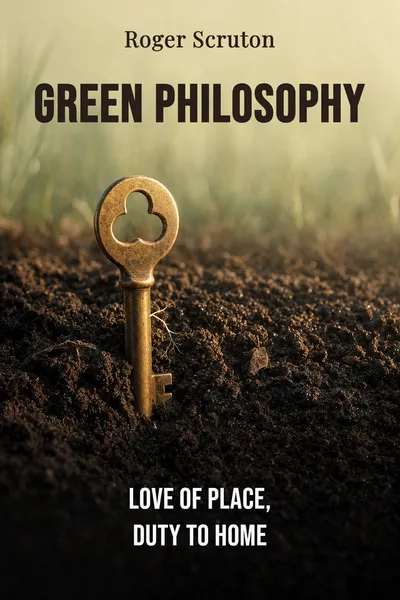
Green Philosophy
Love of place, duty to home
Description
In 2010, an English philosopher better known for writing about wine, aesthetics and the sins of the modern left published a book that surprised almost everyone who picked it up. Roger Scruton, then in his mid-sixties, was a conservative of the old kind — a defender of tradition, custom and settled ways of living — and he had decided to write about the environment. Not to scold industry, and not to praise the treaties and summits that dominate the subject. His argument, laid out across the pages of Green Philosophy, was that conservatives, of all people, ought to be the natural friends of the earth, and that the environmental movement had been looking for its foundations in exactly the wrong place.
That claim cut against the grain twice over. Green politics, by 2010, was firmly coded as progressive, global and suspicious of markets. Scruton accepted almost none of that. He distrusted the large-scale, the top-down, the schemes designed in one capital to be imposed on the whole planet. What he trusted instead was smaller and stranger: the attachment people feel to the particular patch of ground they call home, and the sense of obligation that comes with wanting to hand it on intact. He gave this feeling a name borrowed from the Greek — oikophilia, the love of the household, the home, the familiar place.
The book is a philosophical argument dressed in a conservationist's coat, and it refuses the usual sides. It has warm words for hedgerows and hard words for wind farms, praise for local associations and doubt about international agencies, and it treats economics, beauty and even mourning as parts of the same question. It is not a comfortable read for anyone who arrived with a settled position, which is precisely what makes it worth following.
The question we’re asking : Where does the will to protect the natural world actually come from — and why might a conservative think the greens have looked for it in the wrong direction?What we’ll see : A philosopher's case that saving the earth begins not with grand plans but with the love of a particular place.
Table of contents
01Chapter 1 — The homing instinct nobody costed in
Scruton begins from a feeling most people recognise before they can defend it. There is a place — a valley, a street, a stretch of coast — that we feel is ours, not as property but as belonging, and we would rather it were not ruined. This is not an abstract concern for the planet. It is closer to affection, the way we feel about a house we have lived in or a face we have known a long time. He argues that this local, particular attachment is the real engine of conservation, and that most of the environmental literature has managed to write it out entirely.
The reason it gets written out, he suggests, is that the dominant ways of thinking about the environment have no room for it. Economics treats the world as a set of resources to be priced and allocated. It handles pollution as a cost that has landed on the wrong ledger — what economists call an externality, a harm someone causes but does not pay for. That framing is useful, and Scruton does not dismiss it, but he notices what it cannot capture. Love of home is not a price. It does not show up in a calculation. And yet it is the thing that actually makes people plant trees they will never sit under.

02Chapter 2 — Big solutions, small failures
The heart of Scruton's suspicion is directed at scale. He distrusts the large solution imposed from a distance, and much of the book is a catalogue of how such solutions go wrong. The problem is not that governments are wicked or that international bodies are useless. It is that decisions made far from a place, by people who do not have to live with the results, lose the feedback that keeps decisions honest. A bureaucrat in a distant capital pays no personal price for a scheme that scars a landscape. The people who do pay have no way to make him feel it.
His favourite target is the grand top-down environmental programme, and he is unsparing about the ones that failed. Central planning of the natural world, he argues, has a dismal record — the environmental catastrophes of the old Soviet bloc, where a state that answered to no one turned rivers and seas to poison, are for him the clearest case. Where there is no private ownership and no local accountability, no one has the standing to say stop. He extends the same wariness to well-meaning modern schemes, including the large renewable installations that arrive stamped with green credentials and yet impose themselves on communities that were never really asked.
03Chapter 3 — Oikophilia, or the love that keeps a place
The word Scruton coins to hold all this together is oikophilia — from oikos, the Greek for house or household, and philia, love. It is meant as the counterweight to oikophobia, the fear or rejection of home that he thought had crept into much modern thinking. Oikophilia is the love of the settled place and the people in it: the parish, the town, the countryside one grew up looking at. He builds the whole conservationist case on it. If we protect what we love, and we love what is near and familiar, then the surest route to protecting the earth runs through the local, not around it.
This love, crucially, reaches in two directions across time. It looks back, in gratitude to those who left us the landscape we inherited — the hedgerows planted, the churches built, the woods left standing. And it looks forward, in obligation to those who will inherit from us. Scruton leans here on Burke's idea that society is a partnership between the dead, the living and the not-yet-born. We are not owners of our surroundings so much as trustees, holding them for a moment before passing them on. The environmental duty, in this light, is not a calculation of future utility but something closer to loyalty.
04Chapter 4 — Beauty is not a luxury item
Step back from the particular quarrels — the wind farms, the treaties, the little platoons — and Scruton is making a larger claim about where the will to protect the future comes from at all. His answer is that it does not come from reason working out our long-term interest, because our long-term interest is exactly the thing we are worst at feeling. It comes instead from love and from beauty, which reach us where argument cannot. We protect what we find beautiful and what we hold dear, and a philosophy of the environment that ignores this is trying to run an engine with the fuel removed.
Beauty, for him, is therefore not a soft concern to be indulged once the serious economics is settled. It is central. An ugly landscape is one no one will fight for; a beautiful one enlists defenders without being asked. This is why he cares so much about how things look — why he objects to developments that scar a view or a town, and why he treats aesthetic judgement as a form of moral seriousness rather than mere taste. The instinct that recoils from a ruined valley is, in his account, the same instinct that will preserve it.
05Conclusion
Green Philosophy set out to unsettle both the people who assumed conservation belonged to one side of politics and the people who assumed conservatives had nothing to say about the earth. Its argument runs entirely through the small door of attachment: we save what we love, we love what is near, and so the protection of the whole begins with the care of the particular. Against the grand schemes and the distant authorities, Scruton put the parish, the little platoon, the trustee who holds the land for a moment and hands it on.
Related books