Green Ideas Slipcase
How we learned to save Earth
Description
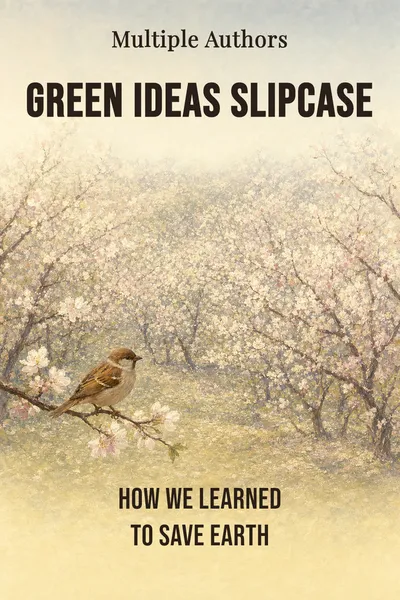
In 2020, Penguin published a boxed set of small green-spined books under a plain name: Green Ideas. Twenty short volumes, each pulling a landmark piece of environmental writing out of its original context and setting it on its own — a chapter from Rachel Carson, an essay from George Monbiot, a warning from Greta Thunberg, older voices like Thoreau and Masanobu Fukuoka. No single author, no unifying thesis, no narrator to tell us how the pieces fit. Just a slipcase, and a bet that these texts, laid side by side, would say something together that none of them said alone.
The bet is odd when you notice what it refuses to do. It does not summarize the science. It does not rank the writers or crown a founder of the movement. It does not even keep them in tidy chronological order in the box. What it does instead is gather the arguments as arguments — the alarm, the manifesto, the quiet observation, the furious rebuttal — and let a reader hold two centuries of ecological thinking in one hand. The effect is less like a textbook than like overhearing a very long conversation already in progress.
That conversation is what this collection is really about. Read together, the volumes stop being a reading list and become a record of how a way of seeing the planet got built — slowly, by people who often disagreed, and who were rarely believed the first time they spoke.
The question we’re asking : How did scattered warnings, manifestos and quiet observations harden into something we now call environmental thought?What we’ll see : How a boxed set of small books traces the arguments, the alarms and the arguments-with-each-other that taught us to see the planet as something we could lose.
Table of contents
01Chapter 1 — The pesticide book that named the silence
If the slipcase has a keystone, it is Rachel Carson. In 1962 she published Silent Spring, and the volume drawn from it opens on an image that did more work than any statistic: a town where the birds have stopped singing, killed off by the chemicals sprayed to make farming easier. Carson was a marine biologist and a careful writer, not a polemicist, and that is partly why the book landed the way it did. She did not shout. She described, in plain sentences, what happens when DDT moves up a food chain, and she made the invisible visible.
The reaction tells us as much as the book. The chemical industry mobilized against her, questioning her credentials, her data, and — a familiar move — her right as a woman to speak on the subject at all. Carson was already ill with the cancer that would kill her in 1964, and she testified before Congress knowing she would not see the outcome. The outcome was substantial: a shift in public trust that helped produce the US Environmental Protection Agency in 1970 and the American ban on DDT in 1972.

02Chapter 2 — From wilderness to spaceship: two ways of seeing
Read across the volumes, one tension keeps surfacing, and it is older than any of the writers. Do we protect nature because it is separate from us — wild, sacred, better left alone — or because it is the system we happen to live inside and cannot survive without? The slipcase holds both instincts, and it does not pretend they agree.
The first instinct runs back through the American tradition the box preserves: Thoreau at Walden Pond, the idea of wilderness as a place to be defended from human touch. It is a powerful frame, and it built the national parks. But it carries a hidden assumption — that people stand outside nature, visiting it, guarding it, rather than being part of it. Later writers in the collection push hard against that. Nature, in their telling, is not a cathedral we visit; it is the atmosphere, the soil, the water cycle we are altering by the hour.
03Chapter 3 — The economics of enough
The most uncomfortable thread in the slipcase is the one about money. It is easy to agree that clean air is good and dead rivers are bad. It gets harder the moment a writer suggests that the machine producing our prosperity is the same machine producing the damage — that the problem is not a stray chemical or a bad actor but growth itself.
Several volumes press exactly this point. The argument, running through the economic and systems-minded writers the collection gathers, is that an economy built to expand forever cannot sit comfortably inside a planet that does not. The famous 1972 report The Limits to Growth had modelled the collision decades earlier, and the writers who inherit that thinking translate it into a plainer question: what would enough look like, and would we recognize it if we had it? A steady-state economy, degrowth, a redefinition of prosperity that is not measured by how much more we consume each year — these are the ideas that make readers most uneasy, precisely because they touch the way we actually live.
04Chapter 4 — A library assembled against forgetting
Step back from the individual volumes and the shape of the slipcase becomes its own argument. There is no founding genius here, no single book that solved the problem. There is a chain — Carson correcting an age that trusted chemistry, later writers correcting Carson's focus on toxins with a wider lens on carbon and climate, systems thinkers arguing with wilderness romantics, Thunberg arriving to say that all the earlier warnings were filed and ignored. Environmental thought, the box suggests, is not a revelation. It is an accumulation.
That is a more honest picture of how ideas actually move than the tidy story of a lone visionary. Each writer in the collection was, in their moment, unwelcome — dismissed as alarmist, or naive, or credentialed insufficiently to speak. Being right early is rarely rewarded in real time. What the slipcase does is take the long view that no single career can: it lets us see that the alarms were not isolated cranks but successive drafts of the same warning, each sharpened by what the last one got wrong or left out.
05Conclusion
Return to the box on the shelf, twenty green spines lined up in no particular hurry. What looked at first like a reading list turns out to be a record of a slow change in human attention — the decades in which the planet stopped being scenery and became a subject, something with limits, something we could break. Carson's silent town, the spaceship with no exit, the economics of enough, Thunberg's refusal to be reassured: they are not a single message but a long relay, each runner handing the argument to the next.
Related books