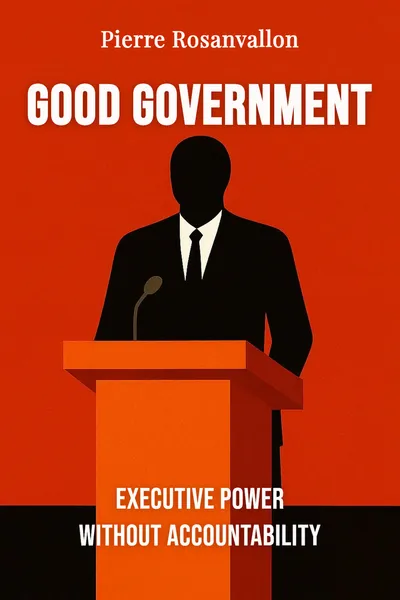
Good Government
Executive power without accountability
Description
On election night, the camera finds one face. A single person walks onto a stage, raises an arm, and a country decides its future has a name and a jawline. We tell ourselves this is democracy at its purest — millions of voices resolving into one mandate. But look at what we actually chose. Not a program debated line by line in a chamber. A person. And once that person is installed, the chamber where laws are supposedly made recedes into background noise, while every morning's news orbits the office of one individual whose decisions we did not vote on, one by one, and cannot easily undo.
This is the puzzle Pierre Rosanvallon sets out in Good Government, published in French in 2015. For two centuries, he argues, we built our theories of democracy around the legislature — the assembly, the vote, the making of law. That was where sovereignty was supposed to live. Meanwhile, almost without anyone deciding it, real power drained toward the executive: the president, the prime minister, the office where things actually get done. We ended up with what he calls a presidential-governing democracy, and we are still using a nineteenth-century instruction manual to run it.
The gap matters because our tools for holding power to account were all designed for the wrong branch. We know how to authorize a government at the ballot box every few years. We are far worse at supervising it day to day, once the applause dies down. Rosanvallon's wager is that democracy's next chapter is not about who we elect but about the relationship we sustain with those who govern in the long stretch between elections.
The question we’re asking : Once power migrated from the assembly to the executive, why did our idea of democracy stay stuck at the ballot box — and what would it take to catch up?What we’ll see : How a two-century blind spot handed unaccountable authority to a single office, and what Rosanvallon proposes to close the gap.
Table of contents
01Chapter 1 — The president we watch, the parliament we forgot
Rosanvallon starts with a quiet historical embarrassment. The founding thinkers of representative government — the men who wrote constitutions after the American and French revolutions — obsessed over the legislature. The assembly was where the people's will would take shape; the executive was a servant, a hand that carried out what the chamber decided. Montesquieu, Sieyès, the framers in Philadelphia: they poured their ingenuity into the making of law and left the exercise of power almost as an afterthought, something to be kept small, suspicious, on a short leash.
History did not cooperate. Across the twentieth century, and accelerating after it, power slid steadily toward the executive. Wars demanded fast decisions. Economies demanded managers. Media discovered that a single face reads better than a debating chamber. The result is what Rosanvallon calls the presidentialization of democracies — a pattern visible far beyond countries with an actual president. Even parliamentary systems now revolve around a prime minister who campaigns like a head of state and governs like one.

02Chapter 2 — A democracy of authorization, not of exercise
To sharpen the diagnosis, Rosanvallon draws a distinction that runs through the whole book. There is a democracy of authorization and a democracy of exercise. Authorization is the front end: the campaign, the vote, the handing-over of a mandate. Exercise is everything after: the daily use of power, the thousand decisions that add up to how a country is actually run. We have poured centuries of thought into the first and treated the second as a black box that opens only at the next election.
The mismatch has real consequences. A mandate is a blunt object. Nobody votes for a specific tax regulation or a particular foreign posture; we vote for a person and a rough direction. Yet governing is made of specifics, and each specific arrives with its own winners and losers, its own reasons that were never on the ballot. The gap between the general mandate we grant and the particular acts it is used to justify is where the sense of powerlessness grows — the widespread feeling that we chose someone and then lost sight of what they were doing in our name.
03Chapter 3 — The three virtues a leader owes the governed
Rosanvallon's answer is unusual for a political theorist: he turns to qualities, almost to a code of conduct. If the executive cannot be constrained the way a legislature can, then the relationship between the governed and those who govern has to be regulated by demands we place on the governors' conduct itself. He proposes three governing virtues — not private morals, but public obligations woven into the job.
The first is legibility, or readability. Power owes citizens an account of itself that they can actually follow. Not spin, not the choreographed announcement, but a genuine effort to make decisions and their reasons intelligible — to open the black box of exercise so the governed can grasp what is being done and why. A government that explains itself is submitting to a soft but real form of control, because reasons offered in public can be examined, challenged, and remembered.
04Chapter 4 — Rebuilding the citizen's second job
Step back and Rosanvallon's larger claim comes into focus: representative democracy was only ever half-built. We finished the electoral half — the machinery of choosing — with impressive care, and we left the other half, the democracy of the governing relationship, as an empty lot. Good Government is an argument that this unfinished half is the political project of our century, and that the disillusion souring democracies everywhere is less a crisis of institutions than the ache of a structure completed on one side only.
What follows from the diagnosis is a shift in where democratic energy should go. For two centuries, reform meant improving the vote: extending the franchise, refining electoral systems, guarding the ballot. Rosanvallon does not dismiss any of that, but he argues its returns are exhausted. The frontier now is the long interval between elections, the stretch where power is actually used and citizens are supposedly asleep. Democratizing that interval is not a matter of voting more often; it is a matter of building institutions of oversight, transparency, and answerability that operate continuously.
05Conclusion
Return to that single face on the stage. What Rosanvallon has done is show why the image is both true and misleading. It is true that we chose the person; it is misleading to think the choosing was the democratic act that mattered most. The harder, largely unbuilt part begins the next morning, when that person starts to govern and we discover we have almost no settled way to stay in the room. Good Government reframes the malaise of contemporary democracies not as decay but as incompleteness — a system that mastered the entrance and never designed the rest of the visit.
Related books