
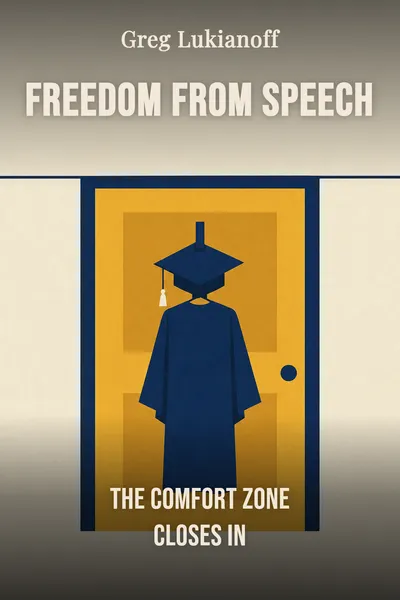
Freedom from Speech
The comfort zone closes in
Description
In 2014, Condoleezza Rice was invited to give the commencement address at Rutgers University. Before she could speak, a wave of student and faculty protest over her role in the Iraq War convinced her to withdraw. The same spring, Christine Lagarde backed out at Smith College, and Ayaan Hirsi Ali lost an honorary degree at Brandeis. None of these people were silenced by a government. No law was broken. They were simply made unwelcome — and chose, or were pushed, to stay away. This is the small, revealing scene that opens Greg Lukianoff's short book Freedom from Speech, published that year.
Lukianoff, who runs a foundation dedicated to free expression on campus, noticed something odd about his moment. On paper, American free speech had rarely been healthier. The First Amendment, backed by decades of Supreme Court rulings, gave speakers protection that most of the world would envy. And yet the culture around speech was tightening. People were being fired over a bad joke, disinvited over an old position, asked to warn a classroom before discussing a difficult text. The law said one thing; the mood said another.
His argument is that we have misread the trend. We keep calling it political correctness, or campus politics, or one side policing the other. Lukianoff thinks that framing is too narrow and too comforting. What he sees underneath is a shift in what people expect from public life — and it does not belong to any single party.
The question we’re asking : If the law protects speech better than ever, why does the space to actually say things keep shrinking?What we’ll see : How a lawyer who defends campus speech came to see the real threat as something quieter than politics — a growing appetite for comfort itself.
Table of contents
01Chapter 1 — The paradox of a strong First Amendment
Lukianoff starts from a fact he finds almost surreal. By any legal measure, freedom of speech in the United States is robust. The courts have spent a century widening its scope, protecting flag burning, offensive protest, hateful pamphlets, even lies in many contexts. A government official who tried to jail someone for an unpopular opinion would lose in court, badly and quickly. If you only looked at the statutes and the rulings, you might conclude the battle had been won.
But he spends his days watching a different picture. As head of the Foundation for Individual Rights in Education — the group known as FIRE — he tracks what actually happens to people who say the wrong thing. And what happens increasingly has nothing to do with the state. A professor writes a provocative essay and faces a campaign for his dismissal. A student cracks a joke that circulates online and finds himself hauled before a disciplinary board. A speaker accepts an invitation and then watches it evaporate under pressure.

02Chapter 2 — The campus becomes the laboratory
To understand where the culture is heading, Lukianoff looks at the place he knows best: the university. Campuses, he argues, are a kind of early-warning system. They concentrate young people, ideas, and institutional anxiety, and they show us the attitudes that tend to spread outward a few years later. And on campus, the trend he worries about is already advanced.
He points to the wave of disinvitations that gave his 2014 book its occasion. Speakers across the political spectrum were being blocked or pressured into withdrawing — not because their views were illegal, but because some students found them offensive enough to demand their absence. What struck him was the underlying assumption: that being exposed to an objectionable speaker was itself a harm the institution owed students protection from. The goal was no longer to argue back. It was to avoid the argument.
03Chapter 3 — Comfort as the new right
Here Lukianoff reaches for the phrase that titles the book. What he sees emerging is not a demand for freedom of speech but a demand for freedom from speech — the expectation of a right to be protected from words one finds upsetting. It is a subtle inversion, and he thinks it explains cases that political labels cannot.
His deeper claim is that this appetite is not really about politics at all. He borrows from the psychologist Nick Haslam the idea of concept creep — the way notions like trauma, harm, and abuse have quietly widened over recent decades to cover milder and milder experiences. As the definition of harm expands, more speech falls inside it, and more protection seems justified. The vocabulary of injury, once reserved for serious wounds, now stretches to cover the merely offensive or uncomfortable.
04Chapter 4 — The demand that keeps growing
Stepping back, Lukianoff's argument is that the free-speech problem has been misdiagnosed as a political one when it is really a psychological and cultural one. If the root is a growing expectation of comfort, then the trend is not going to reverse when one faction loses an election or one campus reforms its rules. It will keep going, because the underlying appetite keeps growing — and it belongs to human nature under conditions of prosperity, not to any ideology.
This is why he refuses to file the phenomenon under liberal groupthink alone, even though much of his evidence comes from left-leaning campuses. The desire to be shielded from unwelcome ideas is not owned by one side; anyone can want the discomfort to stop. He expects the impulse to spread wherever people feel entitled to intellectual ease, across the political map and across borders, as global populations reach the same threshold of security that first produced the demand.
05Conclusion
The disinvited speakers of 2014 were, for Lukianoff, never the real story. They were a symptom. Behind each cancelled address stood a quieter belief: that being exposed to a disagreeable idea is a kind of injury, and that a decent institution should spare people from it. His book is an attempt to name that belief before it hardens into common sense — to show that the greatest pressure on speech now comes not from a government but from ourselves, from an entirely understandable wish to be left in peace.