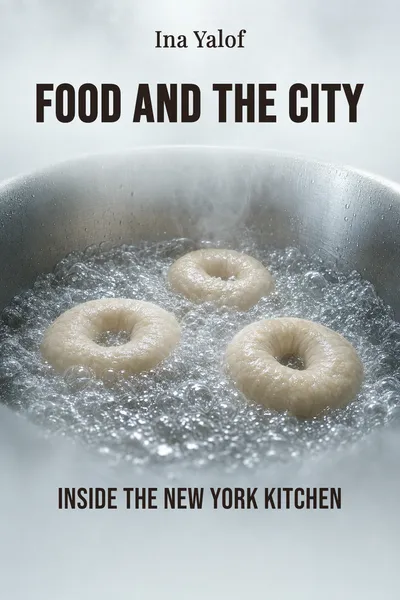
Food and the City
Inside the New York kitchen
Description
Somewhere in New York right now, a baker is pulling bagels out of a boiling kettle before dawn, a fishmonger at the Fulton market is reading the day's catch, and a line cook is prepping two hundred covers for a service that hasn't begun. The city eats constantly, at every hour, in every price range, and almost none of the people eating give a thought to the machinery that makes it possible. Ina Yalof spent years talking to that machinery. A sociologist by training and a New Yorker by temperament, she went looking for the people who cook, serve, sell, deliver, and clean up after the meals a metropolis consumes, and she let them talk.
The result, gathered in her book Food and the City, is not a restaurant guide and not a chef's memoir. It's a chorus. A hot-dog vendor, a three-star chef, a kosher butcher, a pastry apprentice, a maître d' who has run the same dining room for decades — each gets to describe the work in their own words, on their own terms. Some arrived from another country with nothing. Some inherited a family counter. Some fell into the trade by accident and never left. What links them isn't ambition or fame. It's the daily fact of feeding strangers.
Taken together, these voices sketch something a food critic rarely sees: the city not as a collection of dishes but as a collection of jobs. The kitchen, it turns out, is one of the last places in New York where a person with no diploma and no English can still climb. Yalof was less interested in what tastes good than in what it costs, in hours and bodies and lives, to put it in front of you.
The question we’re asking : Who are the people who actually keep a city of millions fed, and what does their work ask of them?What we’ll see : The trades behind the meal, told by the cooks, sellers and servers who spend their lives inside them.
Table of contents
01Chapter 1 — The city that never stops eating
New York's appetite runs on a clock most diners never see. Long before a restaurant opens its doors, the supply chain has already turned over several times. At the old Fulton Fish Market and its successor in the Bronx, buying begins in the small hours, when the light is bad and the floors are wet and a wholesaler decides in seconds whether a crate is worth the price. Bread arrives while the streets are still empty. Produce moves through Hunts Point in volumes that are hard to picture until you stand inside the warehouses. Yalof's interviews keep returning to this hidden shift, the one that ends around the time office workers are waking up.
The scale is part of what makes the food culture so dense. A city this size can support a shop that sells almost nothing but pickles, a bakery devoted to a single Eastern European loaf, a cart that has stood on the same corner for thirty years. Demand is deep enough that specialization pays. That's why New York produces both the temple of fine dining and the perfect two-dollar slice, and why the people who make them often live within blocks of each other while occupying entirely different economic worlds.

02Chapter 2 — The road into the kitchen
Almost none of the people Yalof interviewed set out to do the job they now do. The paths into New York's kitchens are crooked, and that crookedness is the point. A dishwasher who came from Mexico with no papers and no English describes learning the line by watching, then being handed a knife, then a station, then a whole section of the menu. A pastry chef recalls falling into baking because it was the shift no one else wanted. The kitchen, in these accounts, is one of the few workplaces left where you can start at the bottom and be judged almost entirely on what you can do with your hands.
For immigrants especially, the trade functions as a ladder that other industries no longer offer. Yalof gathers voices from every corner of the world — Dominican, Chinese, Italian, Bangladeshi, Greek — and a striking number tell versions of the same story: arrived with nothing, took the hardest job available, learned English over a stove, and eventually earned a title or a business. The romance of the self-taught American cook is real here, but it comes attached to fourteen-hour days and burns that never fully heal.
03Chapter 3 — The room behind the dining room
The dining room is theater; the kitchen is the crew that makes the theater possible, and Yalof spends much of the book on the difference. A service that looks effortless to a table of four is, on the other side of the wall, a tightly choreographed rush in which a dozen people move through cramped space at speed, calling out orders, plating in seconds, and holding a rhythm that cannot slip. The chefs describe it less like cooking and more like conducting — timing everything so that four plates for one table land together, hot, exactly when the server reaches for them.
The hierarchy is strict and, most of the interviewees insist, necessary. There is a reason the executive chef's word is final and the line runs on a chain of command borrowed from the military. When two hundred meals have to leave a kitchen in three hours, there's no room for debate about who does what. Yet the same cooks who defend the discipline also describe an intense loyalty among the people who share it, a family formed by proximity and pressure, eating staff meal together before the doors open and drinking together after they close.
04Chapter 4 — Who feeds a city of eight million
Step back from any single kitchen and the collected voices start to say something larger about what a food culture actually is. We tend to talk about a city's cuisine as if it were a matter of flavors and traditions, something you taste. Yalof's chorus reframes it as something closer to a labor system — an enormous, mostly invisible workforce, heavily immigrant, running on long hours and thin margins, whose collective effort is the real substance behind the word "delicious." The meal is the visible tip; the people are the mass beneath the water.
This reframing carries a quiet argument about visibility and dignity. The person who assembles your lunch, sells you your morning coffee, or breaks down the fish you'll eat that night is usually anonymous to you, and the anonymity is structural, not accidental. By handing each of them the microphone, Yalof does something restaurant culture rarely does: she treats the work as worthy of the same curiosity we lavish on the finished plate. The street vendor's account of his day turns out to be as rich as the celebrated chef's.
05Conclusion
We began before dawn, with the baker and the fishmonger and the cook prepping a service no one has seen yet, and that is where Yalof's book keeps its center of gravity. Food and the City never lets the meal float free of the hands that made it. Every plate is attached to a person, and every person to a story that usually involves long hours, a hard start, and a stubborn attachment to a craft that gives back exactly what you put in. The famous chefs are here, but they share the page with the porter and the pickle seller, and the sharing is the whole idea.
Related books