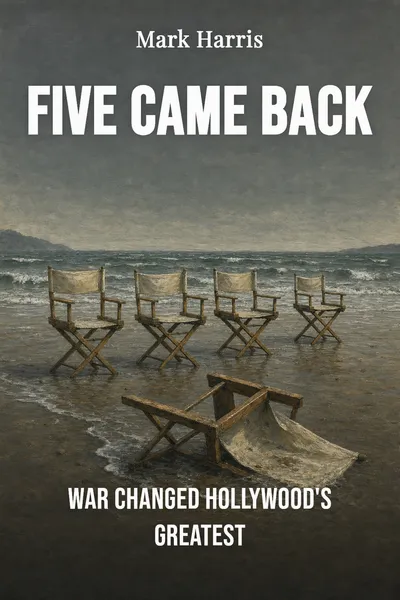
Five Came Back
War changed Hollywood's greatest
Description
In the weeks after Pearl Harbor, five of the most successful directors in Hollywood put down projects worth millions and enlisted. Frank Capra, fresh off a string of hits and an Oscar shelf, took a colonel's commission. John Ford had already been quietly building a naval film unit before the attack. William Wyler, George Stevens, and John Huston followed, each trading a studio contract for a uniform. None of them had to go. They were established, wealthy, and in Ford's case pushing fifty. They went anyway, and the choice would mark the rest of their lives.
Mark Harris tells their story in Five Came Back, following the five men from December 1941 to the end of the decade. What he tracks is not just five biographies running in parallel but a collision: Hollywood's most confident storytellers meeting a subject that refused to obey a script. These were craftsmen used to controlling every frame — light, actors, the ending. The war gave them none of that. It gave them corpses that would not be moved for a better angle, army bureaucracies that wanted a message rather than the truth, and footage so raw that studios and censors did not know what to do with it.
The title carries a small ache. Five went, and five came back — but the phrase quietly measures how many did not, across the whole enterprise, and how changed the survivors were. Harris is interested in the gap between the men who left and the men who returned, and in what their years at war did to the movies they made afterward.
The question we’re asking : What did the Second World War do to five of Hollywood's most powerful directors — and, through them, to the movies?What we’ll see : How Capra, Ford, Wyler, Huston, and Stevens went to war, what they filmed there, and the harder, less certain films they made once it was over.
Table of contents
01Chapter 1 — Five men who didn't have to go
By late 1941, all five were near the top of their profession. Frank Capra had won three directing Oscars in the previous decade and was, by most measures, the most famous director in America. John Ford had his own Academy Awards and a reputation as the great poet of the Western. William Wyler was Hollywood's most demanding perfectionist, William Wyler of the forty-take reputation. George Stevens made polished comedies and dramas. John Huston, the youngest, had just directed The Maltese Falcon and was the industry's brightest new name. They had every reason to stay home.
They stayed home for a while, then didn't. Ford moved first, organizing a photographic reserve unit before Pearl Harbor and shipping out to run the field-photographic branch of the Office of Strategic Services. Capra, feeling too old and too settled, still could not bear to sit the war out; he took a commission and was handed a problem the army did not know how to solve. Wyler, a Jewish immigrant from Alsace, had a personal stake sharper than the others'. Stevens and Huston came in as the machine expanded.

02Chapter 2 — The war that wouldn't behave for the camera
The first shock was that the war would not perform. A Hollywood director builds a scene: places the light, blocks the actors, calls for another take if the first is wrong. Combat offered none of this. Ford filmed the Battle of Midway in June 1942 from an exposed position on the island, hand-held, the camera shaking as bombs fell around him — he was wounded during the shoot. The footage was jumpy, scratched, sometimes out of focus. By the rules of the studio it was unusable. By the rules of the war it was the most honest thing anyone had brought back, and Ford kept the shaking in.
Capra faced a stranger problem. Ordered to make films that would explain to American soldiers why they were fighting, he discovered he had almost no footage of his own — the enemy had made the best war films in the world. He solved it by turning the Nazis' own propaganda against them, cutting German and Japanese footage into the Why We Fight series so that the enemy seemed to indict itself. It was a brilliant act of editing, and it raised a question Capra never fully resolved: was he telling the truth, or making better propaganda than the men he opposed?
03Chapter 3 — What they filmed, and what the army wanted filmed
Between the directors and their footage stood the army, and the army had opinions. It wanted films that would recruit, instruct, and reassure. It did not always want the truth. Ford's Battle of Midway was released, but only after wrangling — its rawness unsettled officials who preferred a cleaner story. Huston ran into the wall hardest. His documentary The Battle of San Pietro, shot in Italy in 1943, showed American soldiers dying and villages in ruins with a frankness that alarmed the War Department. The film was cut, delayed, and released only after the campaign it depicted was safely over, its impact managed.
Huston's next film went further and paid for it. Let There Be Light, made in 1946, filmed traumatized soldiers in an army psychiatric hospital — men who stammered, wept, could not walk without shaking. Huston meant it as a portrait of recovery and dignity. The army suppressed it, citing patient privacy, and kept it effectively banned for decades. It was one thing to show the enemy's cruelty; it was another to show what the war had done to American minds. That line — between the wound you may photograph and the wound you may not — runs through the whole chapter.
04Chapter 4 — The men who came home were not the men who left
Harris's larger argument sits in the space between propaganda and witness — the two things a war camera can do, and the fact that the same man often did both. Capra assembled truth out of enemy lies; Huston insisted on truths the army would rather bury; Ford kept his shaking frames because the shake was the point. What the five discovered, collectively, is that the moral weight of an image does not live in the image alone but in what it is asked to do. That discovery does not stay behind in the archive. It followed them home and reshaped the kind of films a serious director could now make.
Look at what came after. Wyler returned to direct The Best Years of Our Lives in 1946, a film about veterans struggling to re-enter civilian life, made with a plainness and emotional honesty that his glossier prewar work had not reached — one of its actors was a real veteran who had lost both hands. Stevens, the maker of comedies, turned toward heavier subjects; he would eventually direct the film adaptation of The Diary of Anne Frank, unable, as Harris shows, to leave the camps behind. The lightness had gone out of him.
05Conclusion
Five went and five came back, which is what the title promises and also what it withholds. They returned to studios that had kept their offices warm, to careers that resumed on paper, to an industry eager to forget the interruption and get back to entertainment. But the interruption had gone all the way through them. Ford, Wyler, Huston, Stevens, and Capra came home carrying footage of Midway and Dachau, of psychiatric wards and burning villages, and none of it could be filed away as neatly as a finished picture.
Related books