
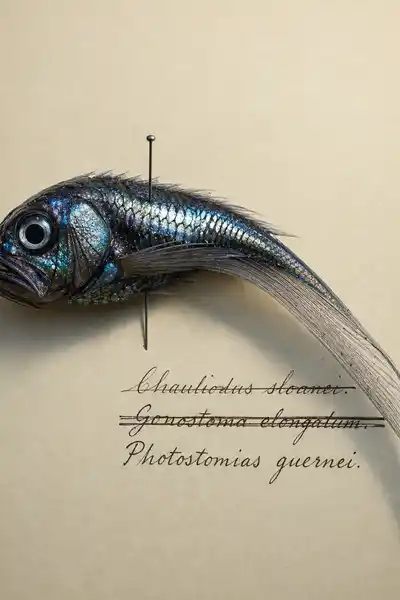
Fishes of the World
Evolution's blueprint for all fishes
Description
There are more kinds of fishes than of all other vertebrates combined. Roughly thirty-four thousand species have been described, and the count climbs every year as expeditions haul up new forms from coral reefs, cave systems, and the deep sea. Somewhere in the middle of that flood of life sits a single book that has tried, across five editions since 1976, to hold the whole thing in one order. Its title is disarmingly plain: Fishes of the World. Its ambition is not plain at all. It sets out to arrange every order, family, and genus of fish into one coherent scheme — a tree in which every branch reflects real descent.
Joseph S. Nelson, the Canadian ichthyologist who carried the book through most of its life, was clear about what the work was and was not. It is not a field guide. It will not help identify the fish on a dinner plate by its color. It is a classification — a map of relationships, built to show which groups share ancestors and how the great limbs of the fish family tree connect. And that map has been redrawn, sometimes drastically, with each edition, because the science underneath it will not sit still.
The fifth edition, published in 2016, is the first to be fully phylogenetic — organized entirely around ancestry rather than convenience. New diagrams trace how the groups branch apart. New drawings, many made for this edition, let the eye follow what the text argues. And the sheer honesty of the thing is striking: a reference book that admits, page after page, where the evidence is thin and the arrangement might not survive the next decade of research.
The question we’re asking : How do you draw a single family tree for a group of animals more diverse than every other vertebrate combined — and keep redrawing it as the evidence shifts?What we’ll see : A classic reference wrestling a third of all vertebrate life into one evolutionary order, and revising itself every time the ground moves under it.
Table of contents
01Chapter 1 — A reference book that keeps changing its mind
The first edition of Fishes of the World appeared in 1976, when Joseph Nelson was a professor at the University of Alberta. It ran a few hundred pages and already tried to do the impossible thing the later editions would keep attempting: list every family of fish and place it in a rational sequence. Three more editions followed, in 1984, 1994, and 2006, each one thicker than the last, each one absorbing a wave of new discoveries and a shifting consensus about what belonged where.
What changed between editions was not just the number of species. The whole logic of arrangement drifted. Early ichthyology grouped fishes by shared features that were easy to see and measure — the shape of fins, the structure of the skull, the arrangement of bones in the jaw. That approach produced tidy categories, but some of those categories turned out to be conveniences rather than truths, collections of animals that looked alike without sharing a recent common ancestor.

02Chapter 2 — The order the tree imposes on chaos
To grasp what the book does, it helps to see the raw material it is up against. Fishes are not a natural group in the way birds or mammals are. The word covers everything from hagfishes, which lack jaws and a true backbone, to lampreys, to the cartilaginous sharks and rays, to the vast assembly of bony fishes that includes almost everything most people picture when they hear the word. Some of these lineages diverged from one another hundreds of millions of years ago. A tuna is closer, in evolutionary terms, to a human than to a shark. "Fish" is a stage of organization, not a single branch.
Nelson's response is to impose the order of the tree. The book proceeds down the branches, class by class, order by order, family by family, following descent rather than resemblance. The great bony-fish radiation — the teleosts, tens of thousands of species — takes up most of the volume, because that is where most of the diversity actually lives. The arrangement is sequential on the page, but the sequence encodes a branching structure, and the phylogenetic diagrams show the branching directly, so the flat list on paper can be read back into a three-dimensional tree.
03Chapter 3 — Where morphology and molecules argue
For most of the history of fish classification, the evidence came from anatomy. You dissected the animal, you compared its bones and muscles and organs to others, and you grouped by shared derived features. This morphological approach built the entire early architecture of ichthyology, and much of it has held up. But anatomy can mislead. Animals living the same kind of life in the same kind of water often evolve the same body shapes independently, so a resemblance that looks like kinship can be nothing more than a shared solution to a shared problem.
Then came molecular biology. Once it became possible to read and compare DNA sequences across species, ichthyologists had a second, largely independent line of evidence about who was related to whom. Genes do not care what a fish looks like. Two species that had been filed far apart on anatomical grounds sometimes turned out to share long stretches of sequence, betraying a closeness the bones had hidden. Groups that had seemed obviously natural sometimes fell apart under molecular scrutiny.
04Chapter 4 — Reading the living record
Step back from the families and the diagrams, and Fishes of the World becomes a case study in how a certain kind of knowledge actually holds together. We tend to imagine a scientific classification as a finished object — nature carved cleanly at its joints, filed away for good. What the book shows instead is that a classification is a living argument, always partly settled and partly open, and that this is not a weakness to be apologized for. It is how the enterprise works.
The evolutionary tree is not something anyone observed directly. No one watched teleosts split from their ancestors. The tree is inferred, reconstructed from clues left in living bodies and, more recently, in genomes, and every inference carries a margin of uncertainty. A classification like Nelson's is the best current reconstruction of a history that has to be read backward from its survivors. It is a hypothesis with a great deal of evidence behind it, not a decree, and it changes when the evidence changes because that is what a hypothesis is supposed to do.
05Conclusion
Joseph Nelson spent much of his career carrying a single book through four editions, and colleagues completed the fifth after his death in 2011, keeping his name and his method on the spine. Across those forty years the volume grew from a slim listing into the definitive phylogenetic account of the world's fishes — the one place where every order, family, and genus is set in evolutionary order, drawn where possible, and footnoted to the arguments still swirling around it. The animals kept arriving, the DNA kept talking back to the bones, and the book kept redrawing the tree to match.