
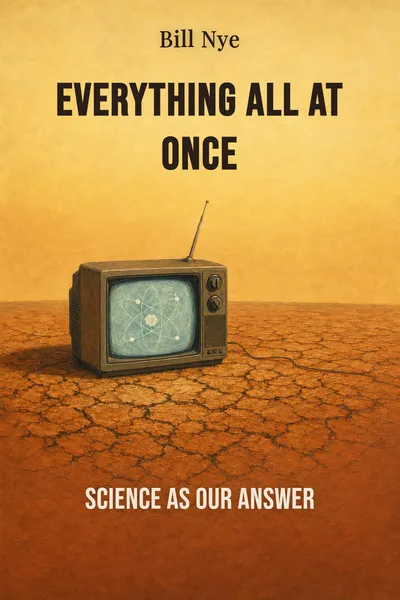
Everything All at Once
Science as our answer
Description
Bill Nye spent five seasons in the 1990s doing a thing that shouldn't have worked on television: explaining friction and photosynthesis to nine-year-olds in a lab coat and a bow tie, and making it feel like the coolest job on the planet. A generation grew up quoting the theme song. Nye the Science Guy won nineteen Emmys and then, like a lot of children's programming, receded into reruns and nostalgia. What happened next is the part people forget. The Science Guy grew up, looked at the state of the world, and got worried.
By the time he published Everything All at Once in 2017, Nye had traded the classroom demos for a harder audience: adults who already know climate change is real and still don't do much about it, and adults who've decided the whole thing is a hoax. He'd been through the public fights — the debate with a creationist at the Creation Museum, the endless cable-news segments where he's asked to argue with someone about settled physics. The bow tie was still there. The optimism had teeth now.
The book's title comes from the feeling the era produces — climate, overpopulation, political tribes talking past each other, all landing on us simultaneously with no obvious place to start. Nye's response isn't a lecture about carbon or a doom forecast. It's an argument about a mindset, one he built as an engineer and refined as a teacher, and one he thinks is available to anyone who wants it.
The question we’re asking : When the problems arrive faster than we can process them, what does someone who has spent a lifetime explaining science actually recommend we do?What we’ll see : How an engineer-turned-teacher reframes science not as a stack of facts but as a way of moving through a world that keeps handing us everything at once.
Table of contents
01Chapter 1 — The kid with the bow tie and the everything itch
Before the television show, Nye was an engineer at Boeing in Seattle, working on hydraulic systems for the 747. The bow tie came from that world, more or less — he tells the story of a mentor who wore one because it doesn't dangle into the machinery. It's a small detail, but Nye returns to it because it captures something about how he thinks: the accessory that looks like whimsy is actually a practical fix for a real problem. The engineer's instinct is to notice the annoyance, then design around it.
He didn't set out to be a science communicator. He did stand-up comedy on the side, won a Steve Martin lookalike contest, and drifted into local Seattle TV doing science bits. The children's show grew out of that — the realization that the same clarity that makes a joke land can make a concept land. Nye's argument, built quietly through these autobiographical scraps, is that explaining and inventing come from the same place. Both start with really looking at how something works.

02Chapter 2 — The problem-solving mindset, not the answer key
The heart of the book is a distinction most people miss. Science, as Nye frames it, is not the collection of facts you memorized for a test. It's a process — a way of asking questions that can actually be answered, checking your answers against reality, and updating when reality disagrees. The facts are the output. The method is the thing worth having, because the method keeps working even when the facts change.
He leans on his engineering background here rather than pure lab science, and it changes the flavor of the argument. An engineer doesn't get to say the problem is too hard and go home. The plane has to fly. So the question is never whether a problem is solvable in principle; it's what the next workable step is. Nye applies this deliberately to climate. The temptation, faced with something that huge, is paralysis — the sense that no individual action matters against a planetary system. His counter is the engineer's counter: break it down, find the leverage points, and start.
03Chapter 3 — Why the science denial isn't about the science
A more surprising thread runs through the book: Nye spends a lot of energy on the people who reject what he's saying, and he's genuinely curious about why. He's been in the room with them. The 2014 debate with Ken Ham at the Creation Museum drew millions of viewers and taught Nye something he keeps circling back to — that arguing harder about the evidence rarely moves anyone, because the disagreement was never really about the evidence.
His reading is that denial is usually about identity and belonging, not data. Accepting a scientific consensus can feel, to someone inside a particular community, like defecting from the team. The facts become secondary to what believing them would cost socially. Nye is unusually generous about this, given how frustrating it must be. He doesn't treat deniers as stupid; he treats them as people whose reasoning has been captured by loyalty, which is a thing that happens to everyone in some domain.
04Chapter 4 — Optimism as a working method, not a mood
Step back from the specific problems and the book reveals its real subject, which isn't climate or evolution or overpopulation at all. It's optimism — but a particular, unsentimental kind that Nye treats less as a feeling than as a discipline. Pessimism, in his account, is intellectually easy and practically useless. If the outcome is already lost, there's nothing to do, and doing nothing is exactly what despair recommends. Optimism, by contrast, is the assumption you have to make before any work is possible.
This is why he keeps returning to the phrase from his mentor Carl Sagan, whom he studied under at Cornell: the idea that we are a way for the universe to know itself. It sounds like a poster, but for Nye it's load-bearing. If the same curiosity that produced language and vaccines and spaceflight is a genuine feature of what we are, then the tools to handle the everything-at-once moment are also part of the equipment. Despair, on those terms, is a kind of category error — mistaking a hard problem for an unsolvable one.
05Conclusion
The bow-tie kid who explained friction to nine-year-olds ends up, three decades on, making the same move at adult scale. The show was never really about the facts of any given episode; it was about the delight of figuring something out, and the confidence that you could. Everything All at Once takes that confidence and points it at the problems a grown-up world actually faces, insisting they're the same kind of thing — puzzles with next steps, not verdicts already handed down.