
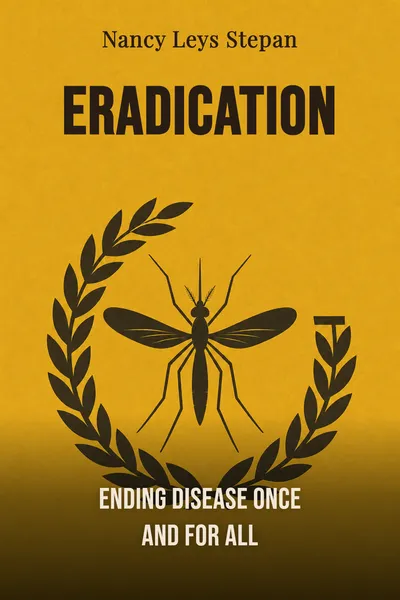
Eradication
Ending disease once and for all
Description
In 2007, at a malaria forum in Seattle, Melinda and Bill Gates announced that their foundation would aim not to control malaria but to eradicate it — to end it everywhere, forever. The word landed like a promise. Eradication doesn't mean fewer cases, better treatment, or a good year in the numbers. It means the last case. It means driving a disease to zero across the entire planet so that it can never come back, and then walking away from the fight because there is nothing left to fight. Polio sat on the same list. For a room full of scientists who had spent careers watching diseases recede and return, it was a bold thing to say out loud.
The historian Nancy Leys Stepan spent years tracing where that promise comes from. Her book follows eradication as an idea — a specific, radical, and surprisingly modern one — through a century of campaigns launched with enormous confidence and, more often than not, quietly abandoned. Hookworm, yellow fever, malaria, smallpox: each was going to be the disease that proved humanity could delete an affliction from the earth. Only one of them actually was.
What makes eradication worth thinking about is not that it sounds noble, but that it is an absolute in a field that usually deals in compromise. Public health is normally the art of doing better with what you have. Eradication refuses that. It says the goal is not less suffering but none — and it stakes fortunes, careers, and the trust of poor countries on getting all the way to zero.
The question we’re asking : Why does the goal of ending a disease forever keep drawing us in, and why does it almost never work?What we’ll see : We follow eradication from its confident beginnings through its one clean victory to the campaigns that stalled, and what the whole idea asks of us.
Table of contents
01Chapter 1 — The dream of the last case
Eradication is younger than it feels. For most of history, disease was something you lived alongside, prayed against, or fled. The notion that a specific illness could be deliberately erased from the whole world — not managed, not reduced, but ended — belongs to the twentieth century, and to a particular kind of confidence about what science and organization could do. Stepan locates its roots in the sanitary campaigns of the early 1900s, when the Rockefeller Foundation went to war on hookworm in the American South and then carried the same model abroad.
The appeal was partly technical and partly moral. If you could find a disease with the right biology — one that lived only in humans, that you could reliably detect, and that you had a tool to interrupt — then in principle you could chase it into a corner and finish it. And unlike ordinary public health, eradication had an end point. You would not need to fund the campaign forever. Spend hard now, the logic went, and you buy a future with zero cost, because the enemy will simply no longer exist.

02Chapter 2 — Smallpox, and the one time it worked
Smallpox is the reason anyone still believes eradication is possible. It is the only human disease ever deliberately wiped from the earth, and its last natural case was a hospital cook in Somalia named Ali Maow Maalin, in 1977. The World Health Organization certified the world free of it in 1980. For a species that had lived with smallpox for thousands of years — it killed roughly three hundred million people in the twentieth century alone — this was an achievement without precedent.
But Stepan is careful about the lesson people draw from it. Smallpox was, in a sense, the ideal target. It infected only humans, so there was no animal reservoir where the virus could hide and return. Its rash was unmistakable, so cases were easy to find without a laboratory. And there was a cheap, stable, single-dose vaccine that worked. Almost no other disease offers that combination. Smallpox did not prove eradication works in general; it proved eradication works when the biology allows it.
03Chapter 3 — Why the mosquito always comes back
Malaria is the counter-story, and it is the one Stepan returns to most. In the 1950s the WHO launched a global campaign to eradicate it, built almost entirely on one tool: DDT, the insecticide that could be sprayed on the walls of houses to kill the mosquitoes that rested there after biting. For a few years it looked miraculous. Cases collapsed in southern Europe, in parts of Asia and Latin America. Whole regions that had been drenched in fever went quiet.
Then the plan met the world. Mosquitoes evolved resistance to DDT. The parasite persisted in people who were never fully treated. Spraying every house in a district, twice a year, for years, demanded an administrative reach that many poor countries simply did not have — and where the state was weak, or a war broke out, or the money ran short, the mosquitoes returned and the disease came roaring back, sometimes worse than before because immunity in the population had faded. By 1969 the WHO quietly downgraded the goal from eradication to control. Malaria is still with us, killing hundreds of thousands a year.
04Chapter 4 — The absolute and its price
Step back, and eradication turns out to be a choice about what health is for. It says the target is not suffering managed but suffering ended — a clean, permanent, measurable zero. That absolutism is what gives eradication its moral energy and its fundraising power; it is far easier to rally a foundation, or a public, around ending a disease forever than around the unglamorous, endless work of keeping it in check. Stepan's history is, in part, an account of how that appeal repeatedly overpowered more sober judgments about what was achievable.
The cost of the absolute is a particular kind of tunnel vision. Because eradication only pays off at completion, it concentrates resources on one disease and one technology, often at the expense of building the general health systems that would help with everything else. A country pours its scarce nurses and money into chasing the last cases of a single illness while other, larger burdens go unattended. And if the campaign ultimately fails, as most have, the diverted effort is largely lost. The all-or-nothing structure makes eradication both intoxicating and dangerous.
05Conclusion
When the Gates Foundation put malaria and polio back on the eradication list, it revived an idea with a long and uneven ledger: one clean victory over smallpox, and a graveyard of campaigns that began in triumph and ended in downgrade. Stepan does not read that record as proof that eradication is folly. She reads it as proof that eradication is hard in a very specific way — that it works only when a disease's biology cooperates and when there is a system on the ground robust enough to reach the very last case, in the very last place.